Unknown's avatar

Familiar Faces in Foreign Places

You’re in your home country at a bus stop or in a lift or some other enclosed space, joined only by an older stranger. The stranger begins speaking to you and so you engage in polite small talk to fill the time, almost because it feels necessary in order to avoid an awkward silence. Then you part ways and forget about the other person. A few days later, you see them again in a more public context, but they are not looking to be busy themselves. They don’t notice you and you have no reason to speak to them. What would you do – walk right past them whilst looking in the opposite direction, or go up to speak to them, regardless of hardly knowing them?

It is hard to believe that one would feel any desire to approach them. The social-networking generation seems almost too afraid of the potential gawkiness of human interaction to strike up conversation with a random person they share no established connection with. Familiarity is a comfort. When someone is certain of their position in their nearby surroundings, they are less likely to feel the need to communicate with a vaguely familiar human being. If you go on a solo trip to a foreign-speaking country, you might find yourself amazed at how easily the rules of the equation can change.

Day One in the Black Forest, Germany. I had spent the night in a youth hostel in Freudenstadt, a market town in the north of the area. Before a day of hiking commenced, I dropped into the tourist office to quickly find inspiration for a route. Walking out of the door whilst running the directions through my mind, I almost bumped into a man chaining up his bike. “Hey there!” he said cheerily in an accent I instantly recognised as Canadian. “You’re staying up at the youth hostel, aren’t you?” I was taken aback by his genial approach and replied with a hint of uncertainty, wondering how he knew. “I cycled past you on the way here – I’m at a guesthouse in town,” he added, as if noticing a look on my face. He looked to be in his early forties, but despite his older age I still found his confident chattiness quite surprising.

It seemed only polite to ask a short question or two.  After sharing his plan for the day, the man remarked, “You’ve picked a great day for a hike,” nodding up at the blue sky. This seemed like an appropriate time to move on, so I wished him a good trip and we parted ways. I promptly returned to recalling the name of the path I was looking for, and my brief encounter with the man was forgotten in favour of sign posts and sweet little streams.

312911_10152041169225495_1858244718_n

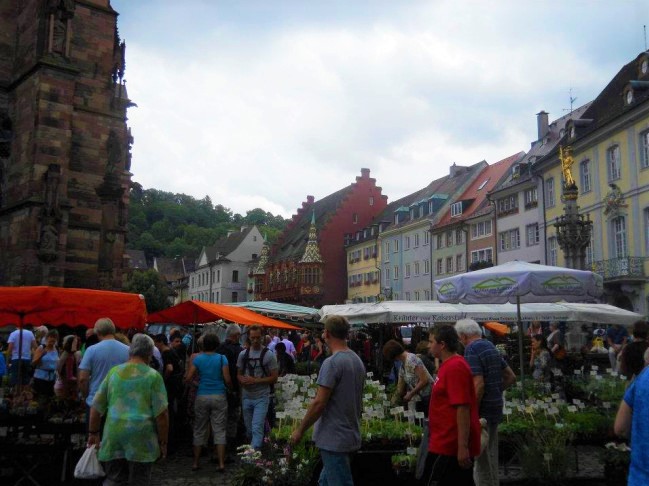
A few days of moving southwards later, I ended up in Freiburg im Breisgau, where I would spend a few hours of the morning before heading back to Heidelberg. The town is famed for its Minster and for being Germany’s sunniest city. Sunlight wasn’t out on show today though. Thick clouds created a sense of lethargy as I dawdled through the large hoard of tourists and students in the university town. It was market day and I squeezed and side-stepped past people looking at various cheeses and vegetables and wines, feeling like a mouse amongst the mania. Elbows knocked me and I looked around dazed as the air was filled with rapid German chatter. The past few days had been filled with walking and my legs felt sluggish. The weather and the people were draining, and I suddenly felt a little overwhelmed by my surroundings. I needed to stop and recover for a minute.

Freiburg

An ice cream sign called me over. One scoop of mint choc chip – heck, why not two? I walked on past a row of picnic benches filled with tourists gorging on bratwurst and burgers. Suddenly, one of the munching men caught my eye. I realised it was the Canadian man I’d seen a few days earlier.

Without thinking twice, I bounded over to say hello, feeling a wave of respite from the mass of unfamiliar people. Caught unaware, the man looked up mid-ketchup-spurting-bite with wide eyes of surprised embarrassment. He’d see me standing in front of him holding an ice cream in my hand with a big grin on my face, like a little kid. We both laughed at how silly we looked. After a proper greeting, the man asked if I’d like to join him for a drink at a nearby beer garden that served only Swabian speciality beers. I said yes without hesitation.

My initial dubious impression of the man had completely vanished. In the last three days I had only uttered about 50 words. I was craving some human contact through which I would be able to have a fluid conversation in my own language for a few minutes. Having felt lost in and exhausted by the busy state of the town, the man’s familiar face provided an element of reassurance. So I went ahead and did something that would have probably been classed as ‘breaking a rule’ back home – going to have a drink with a male I hardly knew, and a much older male at that. But the man’s age wasn’t on my mind at all as we found a table on an upstairs terrace and chatted about Canada. He said I seemed to know the western side of the country better than him. His name was Kevin and he worked in the civil service, but loved cycling in his free time.

As he ordered and paid for our drinks, attempting some basic German with our waitress, I realised that Kevin was a genuinely good-natured person. I told him about my degree and my hobbies, and that I would be volunteering at the Olympics when I returned. With a big smile he said, “Well it seems like you have a lot going for you, Shannon.” Those words have stuck with me since.

Once we had finished our beers (I tactically ordered a half-pint so he wouldn’t have to wait for me), we headed back downstairs into the street. I felt rejuvenated, my batteries recharged. Kevin planned to spend a few more hours in Freiburg, while I needed to head back to the station. After a quick hug goodbye, we parted ways for the second and final time. There would be no sharing of contact details to keep in touch, as is so often the trend amongst young travellers who have spent a few drunken hours together. It was just simply an hour of shared company that made the day a little more interesting for both.

I’ll likely never see that man again, and so he will never know how valuable I found his company for that short time (unless, of course, he finds this blog!) I had never felt so glad to see such a familiar face whose owner I was so unfamiliar with.

My dad told me two things before I travelled solo for the first time: 1) that travelling alone makes one more open to new people and new experiences, and 2) that it makes one realise that people are nice. After that morning in Freiburg, I realised that I had underestimated the applicability of his statement. It’s something that is not just relevant to people you meet in bars or on a tour, someone sat next to you on the bus or sleeping in your dorm; it can also be relevant to random situations where there is no expectation of speech and interaction. If someone is alone abroad, they are likely to feel more receptive to the company of an unfamiliar person, if that person seems more familiar than the alternatives. And yet, if they were in their home country, they might not even consider approaching a stranger.

I now have a better understanding of why people in a foreign country sometimes crave contact with someone that speaks their language. It can be a form of comfort – a reassurance when one is feeling insecure in or disillusioned by their unfamiliar surroundings. There is no shame in craving some ‘home-away-from-home’ moments – everyone is bound to experience that need at some point whilst travelling alone.

The rare coincidence of seeing someone again in a foreign land made it seem silly for me to avoid approaching the Canadian man. It seemed like one of those moments that happened for a reason, to not only boost my morale but teach me a life lesson.

So if you’re overseas and an older stranger starts talking to you enthusiastically, go with your gut of course, but try not to make assumptions about their intentions and subsequently dismiss them off the bat. A few days later, you might appreciate their bold and unconditional friendliness.

Unknown's avatar

Sharing Cars with Strangers

What was one of the first things your parents told you when you went outside to play? I can imagine it was either “Don’t talk to strangers” or “Don’t get into a car with a stranger”. Well, now you’re older, you can be a little more flexible with that advice. If you’re on a trip at home or abroad alone and make a spontaneous decision to travel somewhere else located a few hours away, chances are that you will pay a pricey fee for a last-minute train. Buses may not run regularly and will take a long time, whilst planes can be an expensive hassle. So why not share a lift with someone? A stranger, that is.

I first became introduced to carpooling when I was in Germany. Help-exchanging at the home of a teacher in Hamburg for a week, I then had to make my way to a village in the Rhineland-Palatinate. As I searched for trains on my host’s laptop one evening, she suggested I try ‘Mitfahrgelegenheit’. I looked at her blankly. Advertising lifts was something that I hadn’t even heard of in my own country – hitch-hiking yes, but not organised car share. My host proceeded to show me a website where drivers offered space in their car to travellers heading in the same direction, in return for a contribution towards fuel costs.  Drivers were asked to state details including whether or not they smoked, the make of their car, their mobile number and a copy of ID. I was open-minded about travelling with a man, however my host, perhaps feeling responsible for my welfare, was insistent that I travel with a female. We soon found a lady heading in the same direction as me.

At this time, my German vocab was pretty minimal. Only a couple of sentences in my email to the lady were written in German. Her reply was written in good English, but it still ended with the line: “I’m sorry, I know that my English is not good. I hope you can understand me.” The lady asked for 27 Euros for this journey – about 50 Euros less than what a train would have cost. She gave me her vehicle registration number and asked to meet outside Hamburg’s Hauptbahnhof.

On a rainy Wednesday morning, I made my way to the parking lot outside the main station. I was quite excited for this new experience, but a little nervous too. What if the lady didn’t show up? What if she was a terrible driver? What if her car broke down and we were left stranded somewhere on the autobahn? What I didn’t worry about however was whether she would turn out to be different from her profile. The media will often feature horror stories of women being kidnapped by strangers posing as someone else, but I’ve had enough positive experiences to have faith in the kindness of strangers.

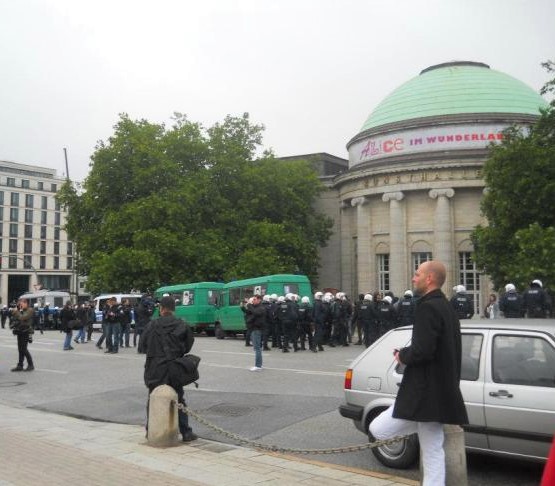
The street was bustling with chanting crowds. Police officers in smart blue uniforms formed barricades as they came closer to the station. I approached one officer to ask him what was going on and was told that it was a political protest.

531200_10151990417805495_244029214_n

I wandered along the pavement, feeling very conspicuous with my big rucksack as I scanned the cars parked along the side of the road. Suddenly I spotted a navy blue Renault Clio with the registration number I was looking for. Beside it watching the protest stood a rather large woman with a pixie haircut and scruffy trainers. I introduced myself and she shook my hand with a shy smile. There was little room in the boot and so I sheepishly squeezed my backpack onto the backseat amongst her own things before sitting down in the back.

A few minutes later, I heard a backpack being thrown in the boot behind me and then the passenger door in front of me opened. The smell of thick smoke, body odour (as well as a slight whiff of urine) swept through the vehicle as in jumped a male skinhead dressed in black, looking like he’d just run away from the police monitoring the protest. He turned to shake my hand and say hello with his stale breath. “Ich komme aus England,” I stated, trying not to wrinkle my nose. He nodded with an “Oh” and said no more.

As we set off, I had to bite my lip to stop myself laughing at the thought of what we must have looked like to other drivers – a bizarre combination of a rather masculine-looking woman, an emo-type guy with no hair, and a young woman with long bright blonde hair. An awkward silence suffocated the car. Eventually, the two Germans started to chat briefly whilst I stared out of the window, trying and failing to understand them. However, their conversation soon ran out of steam and as we joined the autobahn, the driver turned on the radio, flicking between radio stations sporadically as if realising that there was unlikely to be one which we would all enjoy. Smelly-skinhead-guy reclined his seat backwards so that his smell lingered closer and I became even more cramped. Desperate to avoid any awkward speech, I remained with my legs jammed tightly together to one side, wishing I could jam my nostrils shut too.

Two hours later, the driver turned off and I looked up disorientated. “We will stop here for 10 minutes,” she said to me slowly. While the guy lit a cigarette with jittery hands outside the car, I followed her into the service station to use the bathroom. I had to pay 90 cents to use the facilities. “You can use the ticket for food,” she explained again, pointing out a sign which showed a 50 cent discount on confectionary.

Smelly-skinhead-guy would leave us at Frankfurt Airport, from where he was flying to South America. I pitied the passengers who would be sitting near him. I jumped into the front seat and wound the window down with relief to remove his musty smell. I hoped that the driver and I would be able to speak more now. However, as is common with languages, the lady was less confident at speaking English than writing it. Carefully-phrased questions by myself in English would receive stammered and uncertain responses from her, upon which I would attempt the question in German, with no further success as I struggled to make myself clear. It became a rather frustrating process, until eventually the conversation fizzled out helplessly. In defeat, I turned to look out of the window at the wind turbines on the side of the autobahn, before we entered rural land and the views were replaced with fields lined with vines and Church steeples poking up out of small villages.

I felt bad, wishing my German was better so that I could make the experience more interesting for both of us. At the same time, my driver said apologetically, “Normally there would be more speaking.” She dropped me off on the street of my next location and I handed her the money, thanking her for the ride. Then she wished me a pleasant stay and I in turn wished her a safe onward journey, before we said goodbye with an awkward wave.

The experience was a reminder of the social restrictions that a language barrier can bring, particularly in such an intimate environment as a car. Now my German is so much better that, had I the opportunity to do it again, I would have got so much more from the journey. Nevertheless, whilst conversation between the three of us was limited, it was rare that I would find myself in that context with such different characters very often. It’s a story that I can look back on and chuckle over.

Carpooling in general is something I would highly recommend. It might not be the most glamorous form of travel, but it depends on your priorities; some people want luxury, others just want to get from A to B for as cheap as possible. By choosing the latter option, one has more money to spend on the more important things!

While I didn’t have much luck with this myself on this occasion, ride-sharing provides an opportunity to make interesting contacts, and the act of doing a favour for a stranger is a nice, refreshing prospect. As much as I joke about the guy in the car, carpooling is an experience which reinforces that strangers are not to be fundamentally suspected or feared.

Bensheim – my final destination

I would definitely consider using carpooling on future travels around Europe, and I’d hope other travellers would too. Something that can be regarded in this technological age as the modern version of hitch-hiking, carpooling is cheap, convenient and certified. Maybe just bring an air freshener with you as an advance gesture of gratitude…

Would you ever consider car-pooling? Have you any weird and wonderful carpooling experiences to share?

Unknown's avatar

Romance on the River | Summer Evenings in Germany

July 2012. My first year of university was complete and I was spending three weeks away on my own. Whilst back home in England, thousands of tourists from all over the world were being welcomed into London for the Olympic Games, I was following various rivers up, down and across west Germany. On the way I would encounter scenes of romance that would both captivate and torment me.

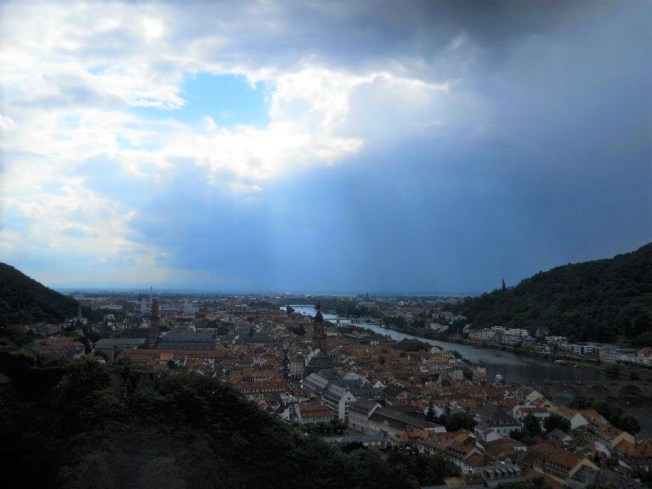
Heidelberg is the epitome of ‘charming’. It’s a town bustling with activity but it still manages to retain an intimate, personal feel. During one afternoon there, the sweet sound of Spanish guitar distracted tourists from admiring the cuckoo clocks in shop windows, causing them to stop with ice cream in hand, in order to watch a juggling act. The guitarist watched the juggler carefully, corresponding his chords with his partner’s fluid movements. Wedding bells rang through the town as I began the ascent up the 300 steps to the famous Schloss. Newly married couples had their photo taken here, with its charismatic backdrop of the town and River Neckar. Even cloudy skies couldn’t dim the glow of this place.

Heidelberg (2)

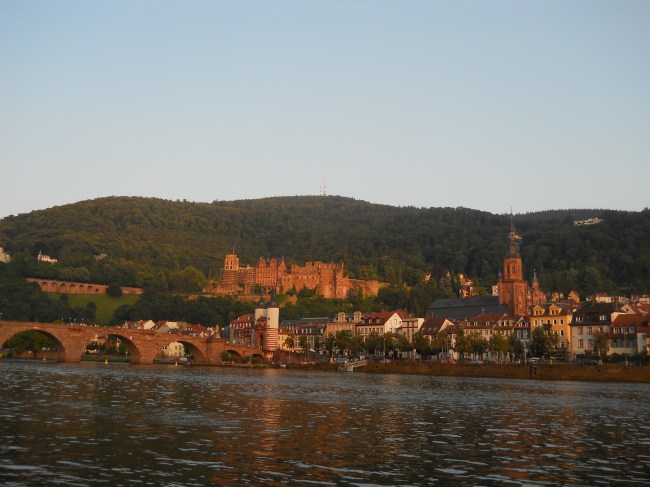
In the evening the sun came out. After casting a proud glance over the coverage of the Olympic swimming from London in my hostel’s bar, I ventured outside for a walk. Everything smelled fresh after the late afternoon rain shower. Squelching sounds of trainers on the puddled path recurred as chatting couples jogged past. Upon reaching the central hub of town, the activity picked up: boys and girls flirted over a game of volleyball; children charged around the water fountain, shrieking wildly in their swimsuits; elderly men and women chatted on benches, walking sticks by their sides, as middle-aged couples walked past hand-in-hand. The sun dazzled off the surface of the River Neckar and enclosed the Schloss in a perfect bubble of radiance. Groups of swans gathered together under the bridge near the river bank, before gliding off together towards the glittering path laid by the sun on the water, its cheeky twinkle promising excitement. They joined a sole rower slowly oozing his way down the river, his oars making faint ripples in the peaceful water. Topless boys on mopeds rode over the bridge, beeping at girls in short shorts in a way that made one laugh rather than feel repulsed. There was an infectious energy in the town, playful and cute.

Warmth from the evening sun on my skin made me feel relaxed and animated at the same time. I felt glad to be alone just so I could watch all the different people doing their different things, wanting to absorb all the activity around me. The moped boys came round on another loop of the bridge, whistling and calling out to the giggling girls. Normally I would have ignored them or made a face; tonight if they had offered I would have jumped on the back and rode off with them around town. It was that kind of evening – the ones that make you wish it could be summer all year round, when the sun is out and it feels like anything could happen.

Image

A day later I was in Mainz. On paper it’s pretty similar to Heidelberg – another river town that attracts plenty of tourists, runners and cyclists. But here I felt a completely different set of emotions altogether. An evening run took me through the Volkspark with its pretty flowerbeds and along the bank of the Rhine. Couples sat on the steps kissing, or snuggled up looking over the railings into the river. I crossed the Theodor-Heuss Bridge onto the other side, where the cosy couples continued. As my legs began to grow more weary, so did my patience. Suddenly it was no longer sweet and touching to see these scenes of affection. My shoulders were sagging as I reached the former Kaiserbrücke. Padlocks dotted the partition between the railway bridge, souvenirs left by travellers and etched with love notes – S.A ❤ T.H – and so on. I stopped to read over them pensively, wondering what the love story was behind each one. Cyclists would occasionally ride past, but there would be no interaction this evening. I turned to lean my elbows on the railing, chin in hands as I watched the sun go down wistfully. As it fell lower in the sky so did my mood, until I’d dropped into a lonely state of melancholy, the most alone I’d felt in a long time. My thoughts drifted off with the river current, and I felt sad.

We’ve maybe all been there once, experiencing that moment when you suddenly realise something about that person: that person whose perfectly-sculpted face with the dimpled smile had mesmerised you for so long, giving you butterflies every time you saw them, to the extent that there were times you couldn’t look them in the eye for fear of blushing; whose hot and cold behaviour was always excused by you out of desire to believe they felt the same way, telling yourself that you could help motivate them to become a better person; that person who you had waited on for so many months, only to be repeatedly disappointed; someone whose company could be so magical, and yet leave behind a curse of confused questions. Finally there comes a time when you realise that you were completely deluded out of desperation, and they never really had felt the same way ever. Your feelings had been governed by a vision rather than by reality. You realise how humiliatingly and obviously un-reciprocal the whole affair was. Then you think of the people in the past who actually did care, whose friendship you had possibly sacrificed because of your obsession with this other person who was so emotionally unavailable. And now, that loyal friend was perhaps no longer available either, just when you would have truly cherished their company.

I stood gazing down into the water lost in my thoughts. Suddenly a lone swan glided out from underneath the bridge, as if it had been left by its friends back in Heidelberg and come wandering upland on its own. It was a pitiful scene – a bit like those drippy ones in American films where the guy/girl has just been left by their loved one and everyone seems to ‘have someone’ apart from them. I wanted to laugh and cry at the fact that my state of being was essentially being portrayed by a swan. Any minute now someone would probably come up and implore me not to jump. I decided to leave before things got too ridiculous…

The next morning I felt completely fine again, as if I’d been spring-cleaned of some dusty, lingering substance by an emotion that had arisen purely from the environment around me. A long-awaited cleansing. Funny how two similar places can arouse completely different emotions in someone, with no apparent warning. Rivers are continuously flowing and changing direction, just like romance. It’s the extreme emotions on either side of the water that people look for, or run away from. People cross the bridges over rivers in search of a new direction to follow, or to return back to something out of need. The river below contains the memories that people try to ignore or forget about, because of the uncertainty that they create. When you’re alone and stop halfway over the bridge and look down, you might find that they come back to you unexpectedly. There and then can you finally confront the feelings that you’ve been repressing. And after you do, the current of life will carry on as normal. It will possibly be one of the most valuable experiences of loneliness and sombreness that you’ve ever felt.

Unknown's avatar

Travel & New Year’s Resolutions

I’ve been studying in London for almost three years. The more that I’ve gone home or gone travelling in this time, the more I’ve realised how life in London is so rigid. Every day I walk the same route to university, or the library, and every day I see the same scenes: businessmen in suits storming along the pavements, phone pressed to their ear, frowning with impatience as they deliver an order to someone whilst frantically waving their arms at a taxi; women in pencil skirts and high heels gossiping with their co-workers about that lady who works on reception, Starbucks lattes in hand, handbags perched on their lower arms pretentiously. Their lives seem so ordered – everyday they must go through this same routine. Some of my friends aspire to have this lifestyle when they graduate. They want the smart work clothes and the City jobs. But to me it just epitomises stress and restriction – something I don’t want to feel on graduating from university at the age of 22. Yes, it may also involve lots of money, but are these people actually happy? Are they content with the thought that this same daily routine may be their life for the next 30 years or more?

One day, I decided to walk home a different route from the library. It took a little longer than my normal route, but in doing so I discovered different sights and sounds, and that made it worth it. There were fewer people in suits and ties shouting down phones, fewer taxi beeps and red buses, no men outside tube stations trying to hand me leaflets I didn’t want. Instead I walked along quiet cobbled streets past quaint little private wine bars playing music, my route decorated with planted shrubs and couples walking hand in hand. It was a refreshing change. ‘Why be boring and go the normal route as always?’ I thought. The walk reinforced my idea that after university, there is no essential need to follow one path. Instead, one can be spontaneous, find a starting project, and go from there, seeing where it takes them. There are so many options, so why not start exploring them?

A key motive of this mindset of mine comes from my time in Iceland. My night in Selfoss was the last I’d have on my own before staying with a host in Reykjavík for a week. My plan the next day was to head back to Reykjavík and spend the day wondering around before going to meet my host. I could go visit a few of the museums I hadn’t been to, and maybe check my emails for the first time since arriving, in case someone had contacted me about something important. It seemed like the sensible thing to do.

In the morning I woke early to catch my 8.30 bus, dressing in jeans and normal trainers. The sun was out again. It was a shame my plans for the day involved being inside. I sat down on the kerb near the bus stop, leaning my weight on my backpack, and going over what I’d done so far whilst here. It seemed like a lot for four days – national parks, whale-watching, glaciers, waterfalls, volcanoes. I hadn’t been to all of the key areas, but the list seemed decent enough.

Suddenly a bus arrived around the corner. It was headed to Landmannalaugar, a place I hadn’t seen but had heard lots about. A couple next to me walked over to it with their backpacks. I watched them go, feeling curious. In my jeans pocket was my dog-eared bus passport. I’d paid a lot of money for it, and it hadn’t been completely used up. Landmannalaugar was one of its valid destinations. I sat upright and looked over at the bus again. The driver was stood outside, resting his head against the side in the direction of the sun, eyes closed. I was tempted to go, and there didn’t seem to be any reason not to, especially not financial. ‘But you already decided you’d go back to Reykjavik, and you’re not dressed for hiking,’ a voice in my head said. I slouched down again.

Then I thought about my plans for the day. Did I really want to be in an urban area, when I could be outside in a rural landscape? Was I really bothered if anyone had contacted me? Did I really want to wonder around a museum when I could do this anytime in London? I imagined my dad watching me now, and how boring he’d think I was. So I got on my feet, picked up my backpack and walked over to the bus. As I buckled my seatbelt and the bus got moving in the opposite direction to which I’d originally intended, I felt an almost rebellious sense of excitement.

The journey to Landmannalaugar takes a few hours. Most of that seems to be spent driving over gravel tracks as you get further into mountain terrain. You’ll pass the proud Mt. Hekla at one point. The ‘thud thud bang’ of the bus as it manoeuvres over the rocky surface, jolting you upwards every now and then, makes you feel like you’re making your way over a minefield. It’s amazing that the tyres don’t get punctured. Every so often you’ll think they have when the bus pauses, and for a second you’ll fear that you’re stranded. But fear not – it’s just the bus pulling over for another vehicle, and you’ll see the other driver looking nervous and sucking in their cheeks as if trying to create extra space on the thin tracks. The views will be quite unexciting for a while, as the bus twists it ways slowly around corners and up steep hills. Reading my guidebook to get some inspiration for something to do in my three hours, I soon felt queasy from the constant jolts and turns.

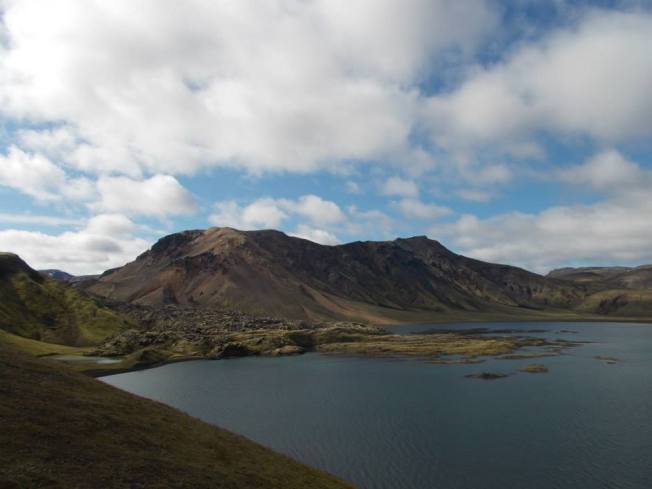
Then just as it feels like your head is forever going to be filled with the sounds of squeaks and rattles, and dusty gravel is all you’ll see for the rest of your life, a wave of soft green rises up into view. On your right you’ll see the idyllic sight of Lake Frostastaðavatn. Its calm face is lined with faint wrinkles and around it, conditioned by the air’s freshness, lie layers of soft brown tones of hair, primped by bounces from its natural character. From here the bus winds its way along twisty paths and splurges through a river crossing to take you to the campsite. People on the bus start collecting their hiking sticks and supplies together, as Landmannalaugar is the starting base for the 55km Laugavegur hiking trail to Pórsmörk.

1233630_10153290779590495_1352224387_n

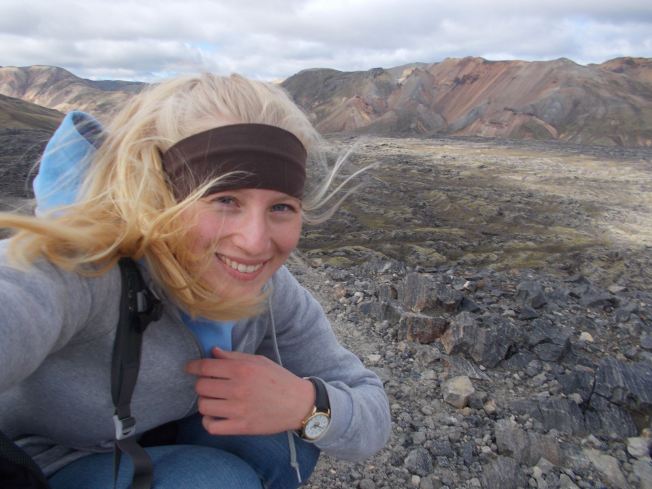
I got off the bus with no plan, but as I went to fetch my walking boots and another hoody from my backpack, the lack of organisation felt strangely nice. There was a tall mountain in view, and so I made my way there. Bláhnúkur mountain is 940m high, and very dusty. As I started my ascent I felt a bit like the bus, pulling over cautiously to let those coming down pass. It was so windy, but you have to keep looking down at your feet to make sure you don’t slip. I stopped halfway up the mountain, thinking I might go blind if I headed any higher. The views are wonderful. Lava fields lie in front of an patch-worked array of pastel-coloured mountains, tinged with soft greens and browns that run so smoothly like oil on a painting. The scenery here was a big contrast from most other places I’d seen in Iceland, evoking warmth and tenderness rather than cold wildness.

Iceland.jpg

As I stood gazing at the views, amongst rubbing my eyes free of dust, a girl my age came up behind me, and we got chatting. She was French, and this was her first time travelling alone. We ended up spending the remaining hour and a half together, walking over to the hot springs where people bathed lazily, as sheep grazed around them. She was the first person I’d met on the trip who I’d actually like to keep in contact with, not just because I felt I should after spending a few hours with her. And I wouldn’t have met her had I not jumped on that bus.

The day had brought me a new visual perspective to Iceland, allowing me to see a different side to the country, just like taking the different route home from the library allowed me to see a different view of London. The day had signified freedom and impulsiveness, and my trip had been replenished as a result. I knew that had I simply gone on to Reykjavík as originally planned, the day would be nowhere near as interesting and fulfilling.

If people were more spontaneous in life, they’d get so much more out of it. As we approach 2014, my New Year’s Resolution is not really new as such. I just want to keep exploring the unknown and not play safe, but take a new opportunity that arises and see where it takes me.


Unknown's avatar

Travel Connections | The Weird & Wonderful Westmann Islands

One of the things I soon learned after travelling on my own for the first time was how small the world is. One can make so many random or unlikely connections between home and the new country. As the number of coincidences increases, it becomes difficult to believe fate can’t exist. The place where these ideas hit home most was in Iceland, when I visited the Westmann Islands (Vestmannaeyjar).

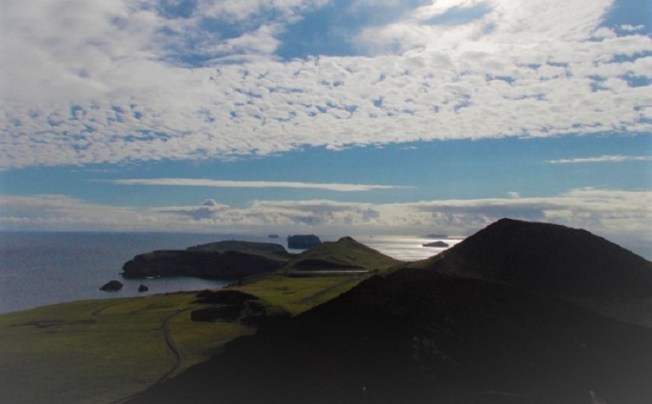
The majority of these 15 little islands clustered just off the south coast of the main land were formed by volcanoes under the water around 11,000 years ago, with the biggest and only inhabited one, Heimaey, previously being the home of Keiko: the famous orca whale from the ‘Free Willy’ films. With many hours of my childhood spent wishing I was Jesse swimming with this orca whale (until I realised with immense disappointment years later that those scenes had actually used an animatronic one),  I knew not going wouldn’t be right. Heimaey is also famous for the immensely destructive eruption of 1973 that smothered a third of the town in lava. Eldfell, or ‘Mountain of Fire’, was the volcanic memento that resulted, and I wanted to hike it.

Eldfell (2)

I was spending a second night in Skógar before heading to the islands. The American ladies from the night before were no longer around, and I felt relieved by the prospect of no more snoring. Instead I was joined by what looked like three generations of a Chinese family – the grandparents, parents and a young girl who watched me re-fill my backpack curiously, hiding behind her hair shyly when I smiled at her. She must have only been about eight, and the experience so new and strange. I’ve never been to China, yet I knew this country’s landscape was the complete opposite of what she would be used to, with the Northern European features of the people seeming so alien. I felt a little awkward as I brushed my hair before bed, feeling their eyes on me. Catching the grandmother’s eye in the mirror, she smiled at me fondly. Then she burped. I immediately stopped what I was doing in surprise,  wondering whether I should laugh light-heartedly to prevent any potential awkwardness. But the lady didn’t seem to have noticed, instead just looking around the room in a non-fussed manner. Then she did it again…and again a few minutes later. Suddenly snoring didn’t seem so bad…

The day ahead would involve a lot of connections. To get to Vestmannaeyjar, one needs to take a local bus from Hvolsvöllur to Landeyjahöfn, and then catch a ferry from the Herjólfur ferry terminal. By buying a ‘Beautiful South’ bus passport, you can easily jump on one of the early Reykjavik Excursions buses heading through Skógar to Hvolsvöllur. The Chinese family nodded and smiled at me as I called a ‘goodbye’ to them the next morning before leaving the hostel to catch one. The door of the bus opened and with a wobbly jump off the bottom step, who should appear but ‘Timmy’, the driver from two day’s before! I watched admirably as he proceeded to ask two good-looking girls where they were from, only to raise his eyebrows at them cheekily and remark with a goofy grin: “Italy..? Bonjourno!” We took a slight detour to go pick up some passengers from a bus that had picked up a fault, and began making our way over a narrow gravel road riddled with potholes that eventually takes one to Pórsmörk. At one point we had to turn around, and the coach was pretty big. Getting off the bus to assess how much space he had, poor Timmy looked nervous. His funny comments in the microphone to the passengers stopped as his attention was focussed completely on the task at hand. I willed him on silently. But he made it without causing any damage, turning round in his seat afterwards to flash the Italian girls a flirty nod.

Hvolsvöllur is a handy connection town as it has a bank and a supermarket where you can stock up on supplies. Other than that, there really isn’t anything to do. With the clouds leaking open again after managing to hold themselves in yesterday, I went to sit inside the petrol station for the remaining hour long wait. 10 minutes later the door opened and the room became a vacuum of jabbering Spanish. I looked up to see a flurry of white and blue infiltrate the room, and a group of about 12 young men moped along the aisles, looking for chocolate and magazines and calling across to each other loudly.  Their presence caused quite a stir, with old ladies gazing at them like children admiring gifts under a Christmas tree.  Once they’d stocked up on sufficient supplies the men came over to the seating area and pulled up chairs around me, to the extent that I was effectively surrounded. An elderly lady eventually came over to ask what they were up to. “We play football,” one replied simply, as he slouched in a chair leafing lazily through a magazine. She continued to look at him, nodding absent-mindedly with a dazed smile of admiration on her face. I kept my head down reading as they chatted boisterously around me. They didn’t seem to have noticed me, and I felt a bit like the plain, quiet kid in American films who never gets picked for the baseball team. Then my bus arrived and I stood up to put my backpack on. Suddenly the footballers stopped their incessant rambling and turned to look at me with perplexed intrigue, as if they’d just spotted me for the first time. Hoisting a heavy rucksack onto your back is never an attractive motion, and I felt my cheeks go bright red as they continued to stare at me and my backpack with baffled faces. ‘Thank God I’m never seeing them again!’ I thought as I hurried through the door feeling like a 12 year old girl.

Whilst the drivers of Reykjavik Excursions coaches speak excellent English, don’t expect the same on local buses. My incoherent mumbling of Icelandic received a bemused look in response and a ticket with lots of figures on it that I didn’t understand. The journey to Landeyjahöfn takes 30 minutes. Raindrops pattered against the window pane. I paid 2520ISK for a return ticket at the terminal and found a seat in the waiting area. Five minutes later, impatient Spanish chatter filled the air again as the flurry of blue and white reappeared. Ah crap. The footballers were obviously heading to Vestmannayejar too. But I couldn’t understand why – it seemed like the most unlikely place for a bunch of young men from the Mediterranean to visit. This time however they were joined by one or two blond-haired players who I assumed were Icelanders, and one of them was very good-looking, with some of the bluest eyes I’d ever seen. Not a great day to be wearing tracksuit bottoms and no mascara. A few minutes later Eye Candy got up to go to the bathroom, and I watched him go with dreamy eyes. As I lowered them I caught the eyes of a woman who was instantly recognisable – it was the mother from the Chinese family in my dorm. I involuntarily grinned and waved at her, as she patted the arm of her mother eagerly. Upon seeing me the grandmother’s eyes lit up and she greeted me with a delighted smile…followed by a burp.

But it was a touching moment all the same – I felt like I’d made some sort of connection with a bunch of strangers, without having even spoken more than a few words to them. We were simply united in that moment by the shared familiarity of the other. And it was a nice feeling; one that I’m not convinced could be acquired as strongly if it happened with a stranger of the same nationality in one’s home country.

The ferry crossing to Vestmannaeyjar takes 40 minutes. Wrap up warm if you decide to go outside! Rain whipped at my cheeks like ropes flailing wildly from a wicked sky, leaving a sting as I gazed over the side of the boat at the roaring waves below. The blue and white swarm of Spanish wasps transcended around me again, buzzing away in sulky tones as they shivered in their tracksuits, glaring at the sky above and wondering how they’d diverted so off-course to end up in this climate. Occasionally one or two of them would look at me with the same baffled facial expression, as if I had two heads. I finally broke the ice by offering to take a photo of them when someone got their camera out. “What are you doing on the Island?” I asked one, who nudged his friend and nodded at me, muttering “English”. His friend proceeded to tell me that they were playing football. Shocker! “But why here?” I asked him, wondering what point there was in flying to Iceland for a training camp. He shrugged and said simply, “There’s a game.” I looked at him, still not understanding. Then he asked if I supported a team, and following the male contingent in my family I replied with “Manchester United.” He smiled and said “Do you know David James?” I was pretty sure he had never played for this team, and rolled my eyes slightly as I said yes. Then he asked why I myself was going to the islands and I told him I was travelling. “But why here?” he asked with a frown. I shrugged and said simply, “Just to look around.” The man looked at me in slight disbelief. We both couldn’t comprehend why the other would want to come to such a small, random place for such activities. But I knew there was more I could have said about my intentions that would justify my coming to the island; it’s not everyday you see a volcano, but a football match could be played anywhere. I couldn’t see how the two could be of similar significance. When he said “Are you coming to watch the game tonight?” I made a face and replied “Probably not.” ‘Why would I bother watching a bunch of guys kick a ball around?’ I thought to myself sceptically.

On arrival at Heimaey, an untidy jumble of square white houses with red and blue roofs are littered out in front of you, like dirty socks left lying around a room carelessly. It’s not a sight that exudes much character. I left the footballers and wondered up an empty street to find my accommodation for the night – Guesthouse Heidrid. A few seconds after I told someone outside that I was looking for a lady called Ruth, a door opened and a lady with frizzy hair appeared, looking a little flustered as a large dog squeezed between her legs to get out. “Yes! I’m Ruth,” she said breathlessly, and before I’d had a chance to properly introduce myself she’d handed me a key to my room, saying over her shoulder, “You can pay me later tonight, I’ve just got to go to the other house,” before shooting up the road. I’d got the impression from a few website features on Vestmannaeyjar that Ruth was quite a big name on the island, being responsible for the running of the town’s Volcanic Film Show. She also seemed to be a big fan of puffins – photos of them covered the walls of my cosy room. But I liked how laid-back she was – it made me feel welcome.

A must-see on the island is the House Graveyard – the resting place of 400 buildings buried under lava in the 1973 eruption. Amongst large piles of rock, wooden signposts indicate the name and position of each deceased establishment. Reading from a sign that a swimming pool was situated under your feet 30 years ago is an inconceivable concept – I can’t imagine how terrifying it must have been, and there’s something quite haunting about the area, as if the spirits of the building are still lurking around you.

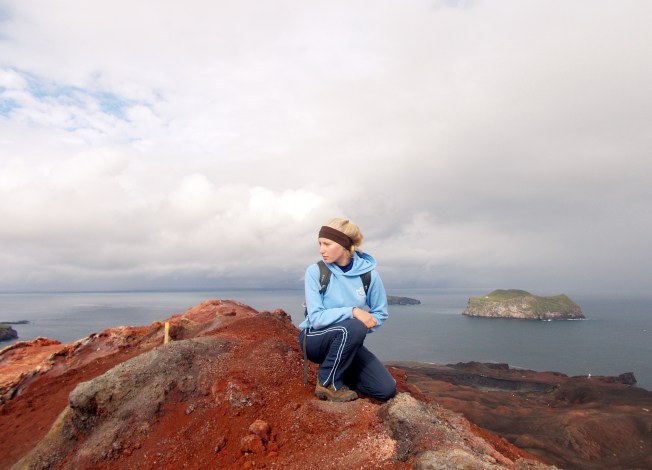
The base of Eldfell is about 10 minutes away, and teasing drops of rain fell every now and then as I began the ascent. Just as I was beginning to feel grateful for my sturdy hiking boots, I spotted a group of three teenagers ahead, walking over the crumbly reddish terrain in normal trainers and carrying nothing but what looked like a newspaper between them. Their casual dress seemed to undermine my perceived significance of the activity I was undertaking. The final 100m of the hike is quite a thigh-burner, made worse by the wind and rain slapping your cheeks mockingly. But when you get to the top and gaze at the volcanic cone of Helgafell in front of you before the ocean to the south, it’s a great feeling. There were a few others up on the summit, but the moody skies around seemed to put them off staying too long. I wanted to give the weather a chance though, and sure enough, a window began to open slowly, letting sunlight gradually stream through. Tuffets of cotton-wool clouds formed in the sky and the ocean began to shimmer as the sun finally broke through determinedly. I’d made the right choice.

I wondered over the narrow ridge at the top of the volcano, only to see the three teenagers sat in a crevice, reading the newspaper. They seemed to represent the standard teenager: bored and frustrated. As someone who’d just experienced something completely new, I found it difficult to understand their emotions. Afterall, it’s not everyday anyone can casually go and read the news on a volcano. One of them then got out a lighter and set the paper on fire, watching it burn with a disinterested expression on his face. I wondered how the three of them felt about tourists from all over coming and invading their tiny homeland. Suddenly I was reminded of my own thoughts growing up in my tiny hometown, when I’d see a collection of cars parked up on grass verges, or walkers trampling over the heather. Sometimes I’d resented it, as if I felt they were rudely intruding on my private property.  As I’d got older I’d craved a change of scene, struggling to grasp why people wanted to visit the area much, simply because I’d lived there my whole life and it was all I was used to. And that was maybe how these kids felt too; they’d forgotten the significance of this place, from taking its constant presence in their life for granted.

A few minutes later the teenagers lumbered back down the mountain, and I was left to myself. I felt like a lone wolf at the top of a mountain, surveying the land and sea below for approaching enemies.  Thinking about home after seeing the teenagers prompted me to turn my phone on, and I sent a text to my parents with the line ‘Greetings from the top of a volcano’. Reading those words was so bizarre, and I kept wondering to myself, ‘How dangerous is it that I’m up in this volcano alone..?’ I stayed up there a while longer, until I heard a hissing noise from a hole in the ground and started to get a little nervous…

114 - Copy

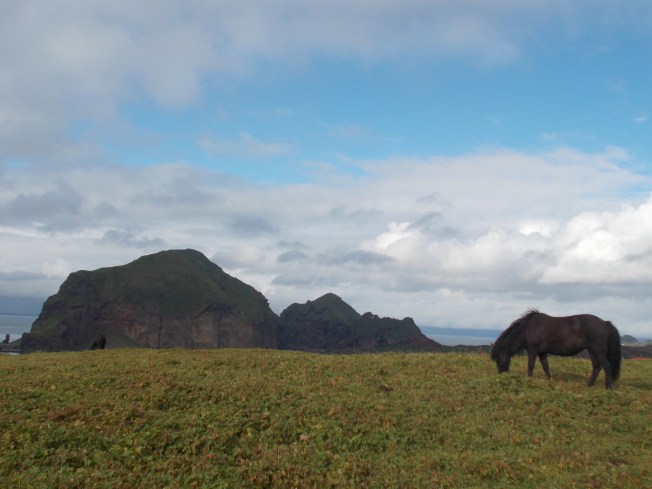
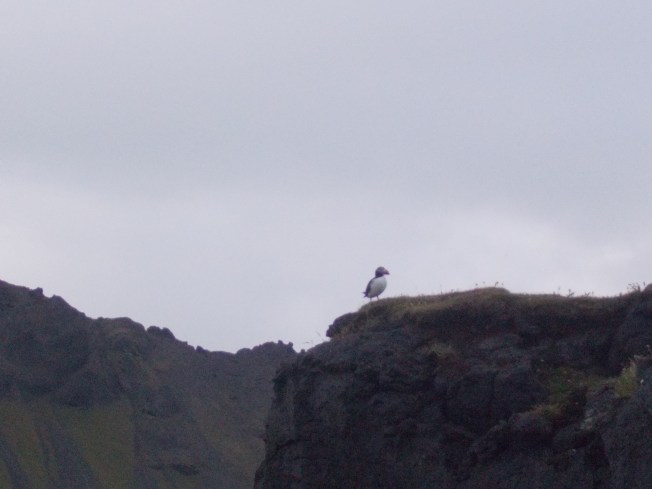
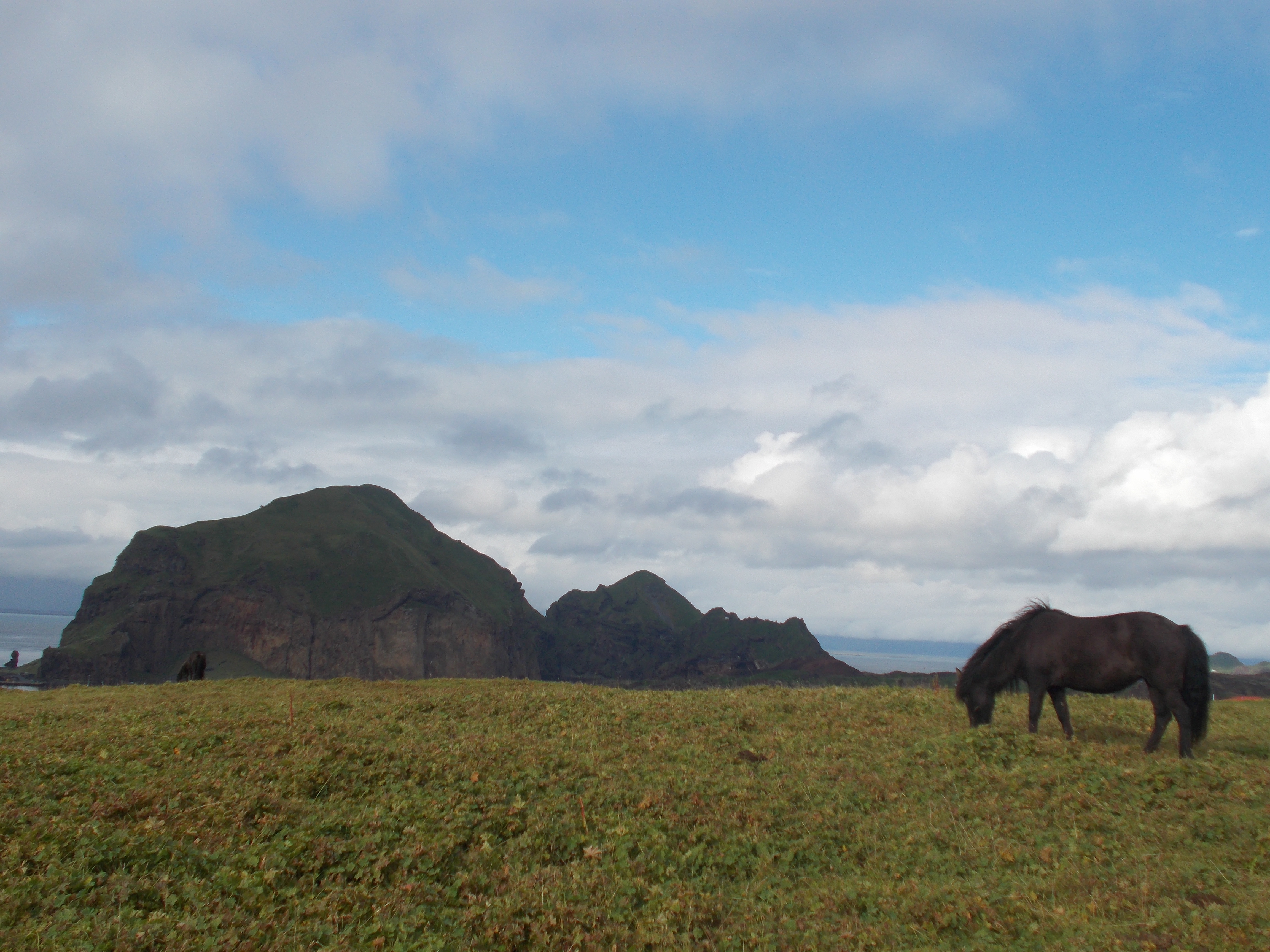
When you reach the bottom of Eldfell, head further south to the coast, making sure you say hello to the Icelandic ponies on the way (just beware of the electric fence). On the coast near the gold course, you’re bound to see puffins sitting nobly in the cliff crevices. These animals are a national symbol of Iceland, and a popular dish too! The rain began to fall again, and I made a mad dash for cover in what seemed to be an empty workshop just off the golf course, wondering whether this counted as trespassing. Cheering sounded from the distance, and I suddenly remembered what the Spanish footballer had said about a game. ‘Sounds pretty rowdy for a kickabout,’ I thought to myself, and I decided to have a quick look once the shower ended.

123

127

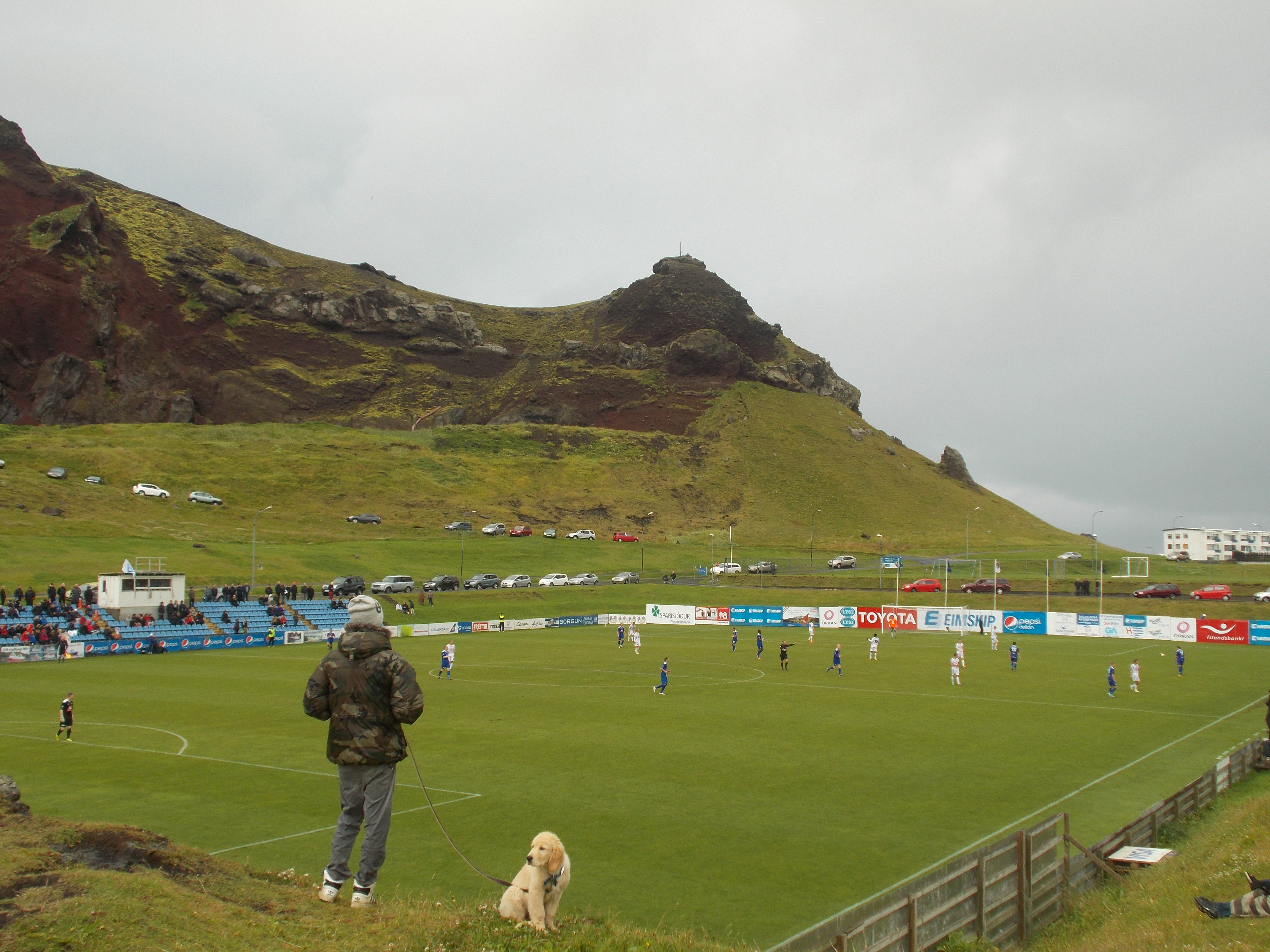
English-style chants in an Icelandic tongue grew louder on approach, and I looked around in bewilderment as I saw small groups of people clustered on the banks outside a tiny stadium. A boy with a yellow-coated dog stood in front of me, occasionally making excited comments to a guy with a ponytail smoking nearby who, with his fluorescent jacket, I assumed was on security. Feeling liked I’d just turned up to a small house gathering only to find that it had been gate-crashed, I scrutinised the players on the pitch. One team was in white, the other blue. Suddenly I recognised the Spanish player from the boat who’d referred me to the English speaker. ‘But what is this for?’ I asked myself in confusion. The boy with the yellow dog seemed too focussed on the game to ask, since his dog was busy getting its lead caught around its legs without him noticing, so I approached an old man instead. “Afsakið, talar pú ensku?” I asked uncertainly. He nodded with a warm smile, and I continued “What is this match for?” He gave the names of two teams, and seeing my blank expression said, “It’s like the Icelandic Premier League.” Ohhhh. I looked on the field again. The Spanish guys had just scored, and the boy with the dog swore furiously. I watched the goalkeeper get to his feet. He looked familiar, even from the far distance. I turned to the man again, as it slowly dawned on me. “The goalkeeper for the Vestmannaeyjar team…is that..?” The man smiled, “David James, yes!”

Suddenly everything clicked into place, after I’d previously missed the connection. A few seconds of feeling sheepish for being so cynical about the Spanish guy’s comments were followed by a burst of self-deprecating laughter. As the match finished and hoards of people filtered out of the stands,  I walked amongst them back to the guesthouse, almost in a daze as I ran through the bizarre events of the day. This experience had been so surreal and unexpected. Of all the things I thought I might come across in Iceland, this link back to England wasn’t one of them, especially as a follow-up to me chilling on top of a volcano by myself for two hours. I’d gone from an experience that felt so weird – because of it being completely unusual in my normal life and surroundings – to something that seemed even weirder because of its stark familiarity with home in contrast. Never before would I have put volcanoes and footballers in the same sentence. For some reason, the idea that Iceland would have a similar sports institution to England had gone over my head. Just like the teenagers on Eldfell struggled to appreciate the remarkable value of their hometown’s natural monument to tourists, I’d assumed there couldn’t be any significance in a game of football, because it was such a familiar element in my life.

It’s moments like this that make travelling such a fantastic thing – the weird coincidences that you experience on the way supplement the wonderful sights that you see. And most of the time, these links occur during the process of locomotion. Getting around on different forms of transport can be tiring and tedious, but events like this add entertainment and make what one assumes to be the most boring aspects of travelling become an open ticket to another special memory. Even though I would have still finished that day able to tick ‘Hike a volcano’ off my life to-do list, the state of having an awesome experience on the Westmann Islands wouldn’t have been reached without the various travel connections made during the day. 

131

Unknown's avatar

Iceland’s Golden Circle | First Impressions vs Land Expressions

I’d been curious about Iceland for a while before I visited it in August 2013, simply because I knew so little about it. It seemed like such a quiet country with its remote location and modest geopolitical influence, yet so loud too with its unique ecological landscape capable of causing so much trouble –  a reserved teenager constantly bubbling up with hormones of fire and ice that could be released at the most unexpected moment. After booking a cheap flight in June with no specific plans apart from to see a whale and climb a volcano, I received further inspiration after glancing over some of my late paternal Grandfather’s memoirs from WW2. Keflavík served as an air base for the Royal Air Force, and on a break from service, Grandpa Jack had gone on a road trip with two friends around the south. A simple sketch showed the places he’d visited, and I made it my aim to retrace his footsteps. But I chose not to read his descriptions too much, wanting to go there with a fresh opinion. As a result, I had no idea what to expect from Iceland. People who had been before would tell me about the lack of things: the lack of people; the lack of industry; the lack of activity outside Reykjavík, leaving me wondering what exactly there was there.

The first week of my two-week trip would be spent touring around the south of the island. Despite only being set to last a week, this part of the trip took a lot of organising. There are no railways in Iceland, so people get around by bus, car or sometimes plane. Reykjavík Excursions is the country’s most popular tour operator, offering both transport services and guided tours.  Their bus passports are designed for independent travellers who want to see many places rather than stay in one area. But the strict bus schedule made it hard to co-ordinate some of my plans, meaning on some occasions that I might miss a bus connection by 10 minutes. I momentarily considered renting a car, before deciding this would be too expensive and more stressful than fun. Car-pooling websites are great but in my case I had no luck finding anyone heading my way at the same time. These transport issues, combined with accommodation options, made things pretty complex.  In the summer months hostels get full very quickly, leaving only expensive hotels or campsites as an option. I didn’t intend to lug a tent around with me for two weeks, but some places I really wanted to visit either didn’t have hostels in the vicinity, or they were full. Finding couchsurfing hosts outside Reykjavik is a laughable concept, and consequently I had to sacrifice some destinations from my itinerary. One of these was Skaftafell National Park.

All these peer reviews and practical complexities led to me feeling unsure of what to expect from the trip. But I wasn’t just unsure of how good it would be; I also wasn’t sure how I’d get on alone. Watching documentaries and reading about Iceland highlighted how the sudden change in weather and unpredictable terrain in isolated landscapes could catch hikers off guard. ‘What if that happened to me?’ I kept thinking anxiously. I knew I had to be realistic about what I could do alone, unable to rely on the prospect of meeting a travel companion whilst there. As I packed my backpack I felt more than I ever had before that actually, my opportunities were going to be limited because of travelling alone.

***

On August 15th my plane was received reluctantly by a bed of grey clouds, and my faint sense of pessimism was reinforced.  Raincoats rustled as tourists boarded a bus that would take us to Reykjavík. I looked out of the window, the rivers of raindrops that flowed down the glass imitating my declining mood. I’d hoped to be instantly revitalised by a land of youthful vibrancy. Instead the landscape looked so barren and bleak – almost medieval, as if it was still 871 and the Norwegians were arriving. There seemed to be no cultivation whatsoever, the only signs of human intervention being the stone piles that popped up every now and then. ‘There really is nothing going on here,’ I thought to myself, thinking back to what I’d heard my peers say.

My first night would be spent in Reykjavík, and the bus driver directed me to my hostel with perfect English.
“Halló! Ég er frá Englandsi,” I said confidently to the lady on reception. She looked at me blankly so I repeated myself more slowly, but she still looked confused.
“Oh! Englandi” she suddenly exclaimed with a laugh. “Are you learning Icelandic?”
‘I guess not,’ I thought as I laughed with her awkwardly.

The lady let me leave my backpack in reception, and I put on my walking boots and set off to the bus terminal, the rain still pouring. The streets were so quiet, the only real sounds being the occasional splursh of a car’s wheels driving through a puddle. There were hardly any people around, and as I walked to the bus terminal I felt like a kid who’d turned up at a birthday party only to find I’d got the time wrong and it had already finished.

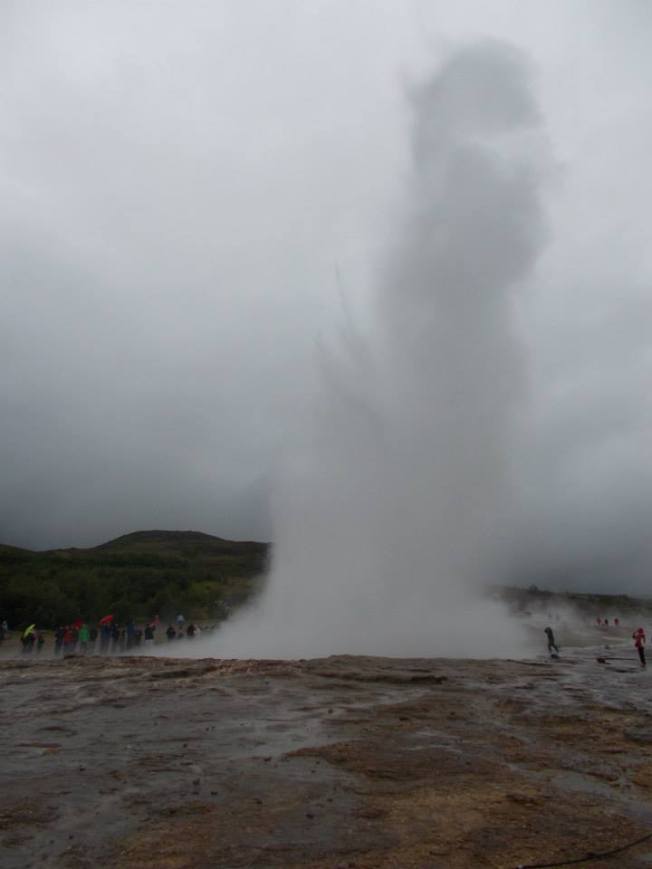
I’d booked an afternoon tour of the Golden Circle for my first day, but it looked like there was no chance of gold appearing in the sky anytime soon. A softly-spoken man in his sixties was our tour guide. His calming voice made me suddenly feel tired, a lack of sleep at the airport from the night before catching up with me. When I woke we were in Haukadulur, a valley home to many hot springs. We were left to explore the area on our own, and I got off the bus groggily only to be startled into life by the strong smell of sulphur from the geysers. Bubbling bogs of hot water hissed at me deviously, daring me to come closer. I managed to avoid falling in their trap and walked towards the famous ‘Strokkur’, which spurts out a huge column of water every 5-7 minutes, teasing tourists who wait with cameras in hand to capture its moment of projection. After two sightings my attention was diverted towards people walking up a stony path to a lookout point, and I followed them tentatively over the slippery mud, picturing myself falling over without a change of clothes. Rainclouds stopped me seeing anything special and I continued to feel quite underwhelmed by the overall landscape as I walked back down to the bus, completely drenched and hoping the driver wouldn’t notice my dirty boots too much.

1185532_10153290751840495_466715604_n


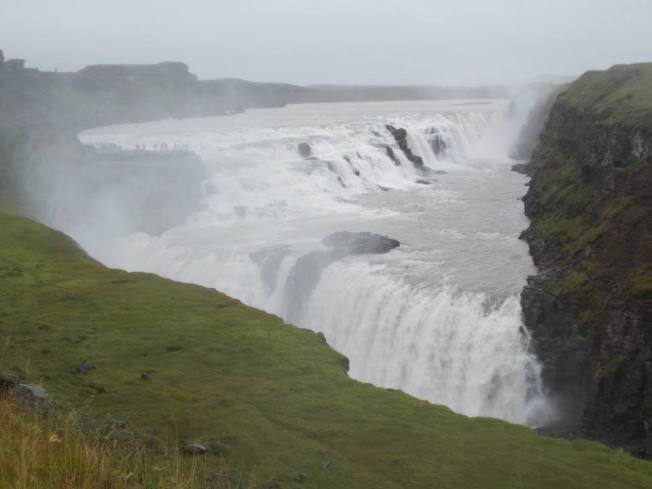
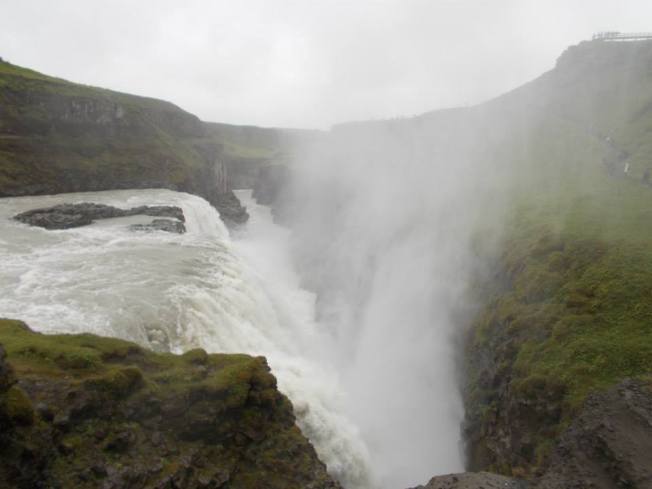
Bare fields and the rocky slopes of hills continued to dominate the scenery as we drove onto our next stop. I was starting to feel bored, wondering if this was the only sight I’d see for two weeks. Then we arrived at Gulfoss and my mood lifted immensely. Even if they didn’t have the sheer velocity of Niagara Falls, something about the ‘Golden Falls’ with their continuous gushing of water over a vast area was really captivating. The area was so natural and untouched, contrasting immensely to the commercial-frenzy that one is greeted with at Niagara. There the water collapses into a pool, ending so abruptly, but here the torrents continue to surge onwards as if on some eager journey; different sections of water cascade precariously onto lower levels, but all with the same purpose of mixing together again in the river. From here steam rises up through the narrow ridge like fizz from a potion – a chemical reaction of natural elements. I thought of Grandpa Jack coming here all those years ago and appreciated that the view would have probably been the same back then – an untouched phenomenon that just lets the human eye enjoy what it’s seeing: the satisfying sight of nature running its course.

1150364_10153290752235495_257561036_n1239423_10153290752665495_1650539238_n

We next drove onto Pingvellir National Park, passing a large building on the way which the tour guide in his slow wise voice told us was an old housekeeping school for women, back in the days when “they learned their natural trade.” The bunch of American women sat opposite me gasped in offence, obviously not realising he was being sarcastic. The two Italian men sat behind them on the other hand looked rather approving of the idea. I soon learned that Icelanders are big fans of mythology. The tour guide gently explained how one could tell the weather would improve tomorrow by looking at the change in behaviour of the horses, who he said had a ‘sixth sense’. Icelandic horses are a symbol of pride in the country, famous for their ‘tölt’ which is said to be the most comfortable gait in the world. Groups of all different colours could be seen grazing on the grass, not enclosed by fences but just left to roam freely, completely at one with the land. Efforts to maintain their features are so tight, that once exported, a horse is not allowed to re-enter Iceland. And don’t even think about calling them ‘ponies’…

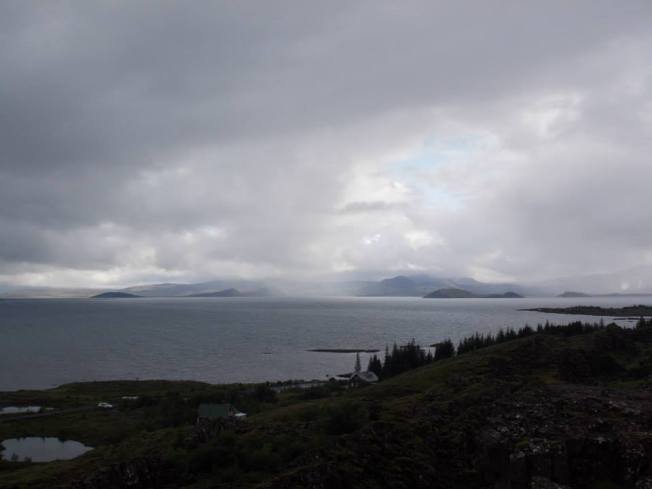
Pingvellir (pronounced ‘thing-fet-ler’) means ‘Parliament Plains’ – a reflection of the fact that the general assembly of Iceland was established here in 930 until 1798. Through soothing tones the tour guide explained that major events of history had occurred here, meaning that it’s a highly cherished area of the country. I looked out over the huge silver shield of Lake Þingvallavatn, its unperturbed surface reflecting the sun’s arrows of light through the grey clouds. Steam rose from the geysers on the mountains in the distance like smoke from the battlefield. If I closed my eyes I could easily picture such a scene from centuries ago. It’s perhaps its potential for stimulating historical imagination that led to the park being designated a UNESCO World Heritage Site in 2004, 60 years after the Republic of Iceland was declared here in 1944 (a year after my grandfather was in Iceland).

The Eurasian-North American tectonic plates move past each other in South Iceland, with it being estimated that the plate boundaries move apart from one another by 2cm each year. The last earthquake to be caused by such movements was in 2000. At Pingvellir, the two plates split, caused by a burst of pressure that had accumulated over a long time.  The end result is a substantial rift between two large segments of rocky land. I walked through the gap trying to get my head around the concept of walking unassumingly on top of so much underworld activity. Who knew what was going on underneath my feet? I was becoming more and more mesmerised by the paradoxical landscape. There was something so ancient about it, yet so youthful at the same time; an old man with the heart of an 18 year old, or a child wearing the clothes of an 80 year old – I couldn’t decide which way round it was. It was a land constantly undergoing explosions of activity underneath a serene and humble surface; a land storing its poisonous chemicals in a secret cellar, but unable to control their sudden leakage.

1185788_10153290752970495_2021288566_n


As the bus took us back to Reykjavík, I developed my own meaning behind the tour name of ‘Golden Circle’. Gold can lie undiscovered for years, only to be found and cause hysteria, just like a geyser or earthquake can erupt unexpectedly, causing gasps of surprise. Gold is a pure element found in the earth, and there was something very pure in the sights I saw that day. They were like young princesses who forever maintained their chastity, refusing to be corrupted by the demands of the foreign prince greedy for financial and territorial conquest.

I realised that it’s this fantastical element of Iceland that is making it more and more of a popular destination for tourists. People come here to remind themselves of what nature really is, and in the process are transported back to a time when the environment is left to enthral its audience on its own, without being spoiled by commercial additives. The ‘laissez-faire’ approach adopted by the country’s tourism industry means that the unique value of the subtle landscape may be under-appreciated by some visitors who don’t take the time to really think about what they’re seeing and what it represents. It was such a fresh change to have a day tour that didn’t involve an eccentric guide emphasising through sensationalist language why everyone should be completely astounded by what they were seeing and take lots of photos, before asking for a tip in return for the ‘service’. Instead it was up to the tourists to learn these things by looking at and listening to the land themselves, as it should be.

When my grandfather was in Iceland, there would have been no opportunities for ‘guided tours’ like today. The thought of him discovering these places (perhaps unintentionally) with his friends in his Jeep and being stood in the same place as me made me smile. I wondered whether he too had started with a pessimistic outlook, only to gain greater curiosity and appreciation throughout the duration of the day. I felt bad for feeling so discouraging at the beginning, but I can imagine it’s an emotion that many people experience on first visiting the modest state of Iceland. Just like it takes time to get to really know someone, it takes time to absorb the significance of some things you see here.

I ended the tour feeling not completely blown away by what I had seen, but certainly a lot more intrigued about the country. I was still unsure of how the rest of my trip would go – (would the sun ever shine?!) – but in the space of 10 hours I’d been reminded that sometimes, less really is more. It was the perfect lesson in how unjustified it can prove to be to make first impressions before giving the relevant object a chance to express itself. In my case, the old warrior had risen from his chamber below the ground and shown me that rather than lying dormant as I first believed, he still possessed the same fresh and unpredictable powers of a young soldier. I went to bed determined to be more positive about the rest of my trip, blissfully unaware of just how much better it was going to become.

Unknown's avatar

10 Reasons to do a Help-Exchange

When planning a trip, I tend to split it into two sections – part of it involves true hostel-loving backpacking, the other a help-exchange. We’re living in a day and age where students and ‘gap yah’ kids will spend huge amounts of money to volunteer in an orphanage in a developing country for two weeks, in an attempt to boost their CV with extra credentials. Personally, I’m not a fan of this organised travel; partly for the reason that I believe it does little to encourage independence and travelling skills; partly because I’m not convinced that continuously passing young children onto different groups to be ‘cooed’ over and have photos taken with is beneficial for their mental well-being and social development. (This article sums it up brilliantly). Students may also be lured into paying extortionate amounts of money for holiday package tours, where they only mingle with fellow tourists and essentially see the country for five minutes.

If you do a help-exchange in contrast, you’ll spend so much less money, yet probably get so much more out of the experience. The system is simple – you register with a website, pay an £18-£20 membership fee that’s valid for two years, and create a profile for yourself. You can then scout the website’s host listing, or hosts can contact you. The idea is that you do four-six hours of work a day for your host in return for free meals and accommodation, so that you’re both doing each other a favour. In your free time you’re free to go off exploring on your own. A help-exchange can be done in any country on any continent, with an incredible range of options on offer – from helping an Eco camp in Africa build a school for six weeks, to looking after huskies in Norway for one week. Below are ten extensive reasons why you should consider doing one yourself!

1. Develop social skills & independence
The process of organising a help-exchange requires the sole effort of the applicant: you yourself have to find an appropriate host decisively but considerately, noting their requirements whilst taking into account your relevant skills and other travel plans. Instead of filling out an application form, you have to contact the host directly either by phone or email, ensuring you come across as friendly, coherent and suitable in a few sentences without referring to your ‘exceptional’ A level results. You have to organise how you get to your host – sometimes you might be asked to turn up at the door – in which case you need to plan travel arrangements. And finally, you have to introduce yourself to your host using communication skills that convey your genuine personality rather than the one you might use to impress someone in a job interview, and conduct yourself aptly for a guest. The process is like a less formal version of applying for a job – there are fewer competitors, no strict deadlines and no daunting interviews. Help-exchanges are also a great way to boost one’s confidence at meeting new people.

 2.  Save money & recuperate
A help-exchange is budget travel at its best. Even staying in hostels that only cost £17 per night starts to add up if you’re on a long trip. The particularly great thing about a help-exchange is how spontaneous it can be – you can contact somebody even when you’re in the country having commenced your travels – ideal if you’ve suddenly found yourself short of funds or there’s been a problem with your current accommodation. Staying in one place for a while also allows the weary traveller to rest their body and mind – it’s nice to have some time off lugging a backpack around everyday, or constantly thinking about public transport timetables and hostel bookings for the day ahead. Saving money on the practicalities of food and accommodation also means your pennies can be put towards more exciting activities in your free time. Plus, being given free meals in return for your help makes a nice change from a cheap ‘on-the-road’ diet of cheese-sandwiches, bananas and biscuits…

3. Develop new practical skills
The wide range of jobs that hosts advertise for help with means that you can guarantee learning a new skill, ranging from knitting to carpentry. Sometimes I’ve not contacted a host whose description sounded perfect in so many ways, just because I had no experience of the specific work they needed help with. But one occasion where I didn’t let this feeling of inadequacy put me off was with a family on Vancouver Island. They owned a vineyard, and as much my mum might have tried to encourage me over the years, I had no experience of pruning. As I was shown what to do on my first day thoughts of: ‘Oh crap, I’m totally going to ruin this guy’s vines, he’s going to be annoyed with me!’ filled my head. Then I remembered that it wasn’t a test, and I wouldn’t be judged for asking questions, but was actually more likely to be respected for trying to ensure I did a decent job.

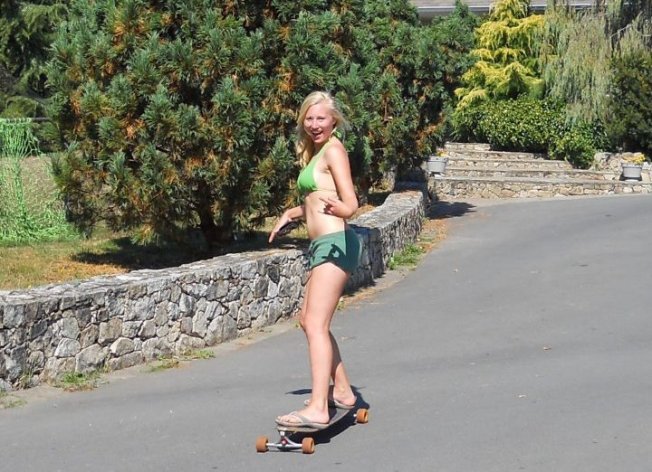
Even when you’re not working, you can still learn new skills in your free time from family members. The first time I went fishing was during a help-exchange in southern BC (I wasn’t very successful). On another exchangeI learned the basics of lacrosse and after a few attempts (and one fall) had (almost) mastered the art of longboarding. It’s unlikely I would have accessed such activities so easily when travelling around alone.
317846_10150818528330495_967448782_n

4. Inspire youth
Being the youngest of five children, I’ve never had much of an opportunity to be a ‘big sister’ to anyone, but taking part in help-exchanges has changed that, as I’ve been able to become a confidante to those a few years younger than me. Being trusted by an adult you’ve never met to take a position of responsibility over their children is a humbling gesture, and as a result makes you determined to live up to the duty and set an example. In my case this has mainly involved listening to problems, sometimes of an everyday form and sometimes more serious, and using my experience to give advice for the short or long term. With young teenage girls I think, being female myself, that it’s a particularly rewarding process. They’re going through a stage when older authority can be resented, and being a good role model without alienating them can be quite challenging. But if you get the balance right, you’re likely to see reserved body language become more confident and bored facial expressions develop into expressions of curiosity and familiarity, as they realise that the new girl in their house is actually not that bad, even though she travels by herself/is single/wearing scruffy clothes and no make-up/into running/a bit of a geek. I hope that as a result of this, most of the girls I’ve stayed with have decided that they too would like to embark on their own independent travel adventure one day. Help-exchanges demonstrate that you don’t have to be in a less-developed country (or pay lots of money) to have a strong impact on someone’s life.

5. Expand human knowledge
Taking part in help-exchanges has made me become a better reader of both individual people and families, reminding me in the process that despite any cultural differences, certain human emotional dilemmas occur universally. As a result I feel like I’ve gained greater maturity and sensitivity, which can be applied to everyday life. It’s something that can’t be taught, only obtained through observational experience. An example is from Canada, where I lived with a 15 year old girl whose life, at the insistence of her mother, revolved around horse-riding and ice hockey. Most of the time she was reserved around the household. Then at the end of the week the two of us went to the cinema and I saw an excitement in her that I hadn’t seen before, realising that it was simply because she wasn’t used to going out for social events. Away from her normal routine and slightly domineering mother, she felt freer and more open. Meanwhile on an exchange in Germany, the 18 year old daughter started tearing up as she said goodbye to her parents before they left for their holiday. She wouldn’t see them when they got back as she would be on holiday herself. “I just feel bad because by going away and doing my own things I see them less, and they’re only getting older,” she explained to me after they’d gone. I could completely empathise with her, having experienced similar feelings of guilt in relation to my own parents. It was an irrational feeling that I hadn’t considered might be felt by others. Doing a help exchange can make a ‘foreigner’ seem more familiar, while also giving you something to take back to your own family; be that a greater appreciation of or the inspiration to change its dynamic!

6. Practise a language
The best way to learn a language is through immersion – visit the relevant country and spend time with native-speakers, listening to their conversations and attempting to initiate ones yourself. Even if you’re not planning to learn the language (mastering Icelandic in two weeks would have been asking a bit too much), it’s nice to simply listen to the different sounds and watch people interact through it, sometimes being able to guess what they’re talking about from their actions. While staying with a small family in Germany, I would carry a notepad around with me, at times randomly asking the daughter, “How would I say this?” or “What does that word you keep saying mean?” She would also ask for clarification that her English was okay too, so that both of us were benefitting. I was then able to use what I’d learned after I moved on from the family. It makes a nice change from hostels and charity volunteering camps where, on the whole, English is the international language. And even better: the tuition is free.

7. Learn about other cultures
Living in a family’s home creates an intimate environment where you can witness the everyday native lifestyle – it’s the best way to learn about the values and norms of the country, either through conversations or general observation. Whilst on my Icelandic help-exchange I was told about Christmas traditions (including a detailed description, involving a picture book, of the 13 different Santas), as well as the less obvious and random traits of the country’s culture. For example: when trying to establish ages, an Icelander will always ask for year of birth over the actual number; a wife doesn’t take her husband’s surname – instead it is always the father’s name, ending with the prefix ‘dottir’ for girls and ‘son’ for boys; names of all residents are written underneath the house number next to the door; dried haddock is a popular snack, and so forth… Staying with locals gives one a greater awareness of and access to the signature brands and dishes of that country, such as ‘Tim Hortons’ in Canada and Skyr yoghurt in Iceland.

Doing a few help-exchanges in different areas is even better, as you get to witness the variety of the country for yourself, just like someone travelling to England would notice changes between London and Yorkshire. For example, I could sense varying attitudes towards immigration, marriage and careers in different areas of BC which, as a History student, I found really interesting. What’s more, if there are other foreign helpers staying at the house, you can learn more about their culture too. The first time I had a proper conversation with someone from China was during a help-exchange in Canada, while meeting a few Germans there partly inspired my decision to travel there the next summer.

8. Integrate into a family and community
In previous posts I’ve written about the overwhelming effect of being welcomed into a host’s life so warmly. Sometimes the ‘click’ won’t happen, either inevitably from significant differences in outlook, or as a result of events during the exchange. But when it does, especially in such a short period, it’s a very touching experience. This, combined with getting to know the local area well, can make you really feel ‘at home’. Doing errands for a host in Germany such as going to the post office and doing the shopping required me to familiarise myself with the area, making me feel like part of the community by the end of the exchange. By the end of my week with a family in Reykjavík, I was on greeting terms with an old man who walked his pug at the same time as I walked my host’s border collie. At family dinners or parties, I’ve been involved in the conversation almost, at times, like a member of the family. Such moments can lead to a bond with a family – a long-term bond that hasn’t been formed through the influence of alcohol and consolidated by the desire for a companion to provide temporary convenience and security, as is quite often the case with volunteer-travel friendships.

For me having no younger siblings, forming a bond with a child or young teenager is particularly special. At first introduction they are often quite shy and making conversation isn’t so easy. My Icelandic help-exchange also involved babysitting an eight year old. His English was exceptional, but there still seemed to be a barrier as we sat eating breakfast on my first morning. After getting a shrug in response to “What’s your favourite subject at school?” I asked if he wanted to walk the dog with me: “Nahhh”; or go swimming: “No thanks.” Hmmm. ‘It’s going to be a long week,’ I though despairingly. “Maybe you’d like to play a game?” I asked hopefully. The boy said nothing. Then suddenly his eyes lit up: “Do you like Star Wars?” Ermm… “Yeahhhhh!” I replied enthusiastically. I know nothing about Star Wars. The next two hours was spent playing a game with no idea what I was doing. But it was worth it, because by the end of it the boy was interacting with me more. Within the next few days I was making him laugh as we played toy soldiers or football, and chatting animatedly with him. Then came the day when he asked “Will you be here this time next week?” followed by a sad “N’owhh” when I said no, and upon hearing that I welled up.

One might say that the same emotion can be experienced after looking after an orphan as part of a charity project, but I would disagree. A charity scheme essentially requires a bond to be formed, by expecting volunteers to devote complete attention to a child who is not already emotionally attached to a regularly-present biological relative. In contrast, children from a host family are less likely to require or crave a new bond, simply because they already have a strong and satisfying connection with their family.  The process of forming a bond is therefore more contingent on both characters involved, which subsequently makes it feel more treasurable.

9. See incredible places & do amazing activities for free
They say that guide books shouldn’t be relied on as source for travel ideas, and help-exchanges prove it. A key reason I’m such a big fan of them is because of their potential to help one discover a phenomenal area of the world, or be given a rare opportunity to do something wonderful. For example, one of my help-exchanges in BC involved working on an Andalusian horse farm, where I helped care for and exercise the horses. Being allowed to ride such beautiful animals as ‘work’ made me feel so lucky, as I thought about what some people would give to be in my position. Another family took me tubing down the Similkameen River, and on my final night with them we drank beers and ate ‘smors’ around a campfire in the Okanogan forest, giving me a true rural Canadian experience. This was an area that I would probably not have considered visiting had I been touring the area independently, because of both the lack of tourist accommodation and lack of attention given to it in my guide book. On Vancouver Island, my hosts lived five minutes from the beach, from where I could admire some of the most enchanting sunsets I’ve ever seen. I was given a tour of Victoria and taken out on the family’s boat for an evening cruise. Meanwhile in Germany I was taken on an afternoon sight-seeing tour of Frankfurt with all the benefits of local knowledge, and in Iceland I got to experience the brilliant Culture Night celebrations with native company. For just a few hours work a day, you can receive something back in return that no salary, no matter how big, could buy.
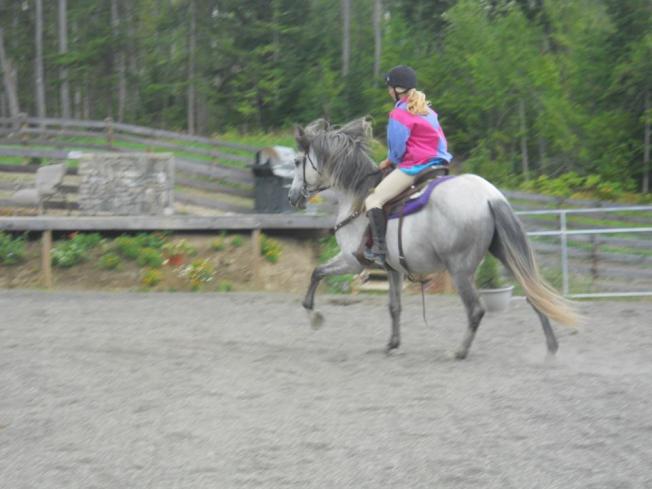
296149_10150810495360495_1363672671_n

10. Form special memories & valuable contacts
The sense of accomplishment after discovering or arriving at a stunning place completely on my own is what makes me love travelling alone…but I’d be lying if I said that some of my favourite and strongest memories from trips haven’t come from help-exchange experiences. Some of them are from the examples stated in #9, while some weren’t necessarily so treasured at the time but in hindsight have provided extraordinary tales of great humour that, without a help-exchange, I probably wouldn’t have experienced. Take the time I went to a house party in Canada, only to find myself constructing a sling out of a tea towel for a guy who broke his collarbone after falling off his quad-bike whilst riding under a very very large influence; or the time a host asked me to give her daughter a lift to a bonfire party in her car (as if having to quickly adjust to driving in an opposite way to what I was used to without damaging her car wasn’t enough, I then had to reverse half a mile along a dyke in the dark after we took a wrong turn); and last but not least was the time one family’s 12 year old daughter jokingly drove a lawnmower towards where I was sunbathing on a downhill slope before parking up, only for someone to start screaming at me to move (she’d forgotten to put the handbrake on…)

Then of course, there are the friends that can be made from a help-exchange, either host’s children or fellow helpers, who themselves account for many of the memories formed. I’m still in regular contact with many of those people I’ve been fortunate to stay with, one of whom I visited in Germany after meeting her in Canada, and one of whom I travelled around the USA with three years after first meeting. These people provide a travel contact either for at the time of the exchange or in future, and meeting them has inspired me to become a host one day myself, in the hope of meeting even more special people and creating even more special memories.

***

Being involved in a help-exchange is beneficial for a range of reasons: the potential to help a person develop for the better whilst allowing them to have an impact on someone else; the potential for new knowledge, exciting opportunities and significant experiences; the potential to form strong friendships; and simply for the potential to produce a fulfilling sense of knowing you’ve done someone a favour, whilst also feeling extremely grateful for what they’ve done for you. And the best thing about it is that these elements can be attained without having to spend thousands of pounds.

***

Been convinced? Check out some of the websites below and get your own help-exchange adventure started!

http://www.workaway.info/
http://www.helpx.net/
http://www.wwoof.net/
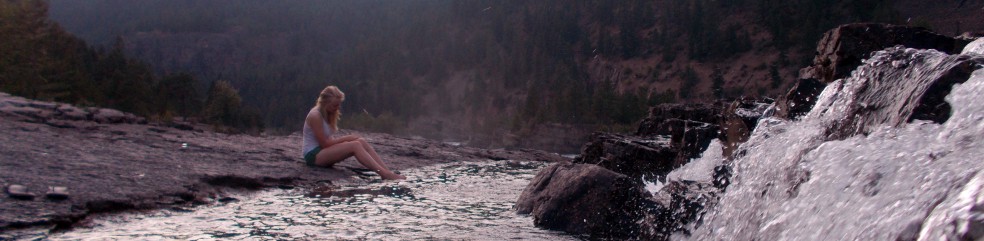
Unknown's avatar

Disappointing Travel Experiences | When Materialism and Travel Collide

We’ve all had those anti-climactic experiences where we’ve been really looking forward to seeing something, or had high expectations about it, only to feel slightly disappointed afterwards. It’s a common case when travelling – guide books marvel about how wonderful a place is and the websites only show photos taken in the sun. But I’m not just talking about realising that the sights aren’t actually that impressive; sometimes your experience of the people around you can tarnish your views.

***

I experienced this feeling after visiting the Blue Lagoon in Iceland. Possibly the country’s most famous place to visit, I decided to go and check it out en route to the airport. My bus left rainy Reykjavík at 9am and we drove through a barren black sea of lava fields, until about 50 minutes later the bright blue water appeared in sight, bringing instant energy to a bleak morning. In a building situated next to the car park, one could store their belongings for a non-returnable fee of 500ISK. The receptionist said “Enjoy your stay” with the same upbeat tone to every customer, as if programmed like a machine.

A return bus journey and ticket to bathe in the hot springs costs 9800ISK from Reykjavik Excursions, but being low on cash and uncertain I’d have enough time to get sufficient bathing value for the price, I decided I would just pay 1600ISK for the Visitor’s Pass once there, which equates to around £8. “You can keep this,” the receptionist said, sliding a loose blue rubber band onto my wrist as the lady next to him patiently dealt with a ditsy customer. “And just come back if you change your mind about bathing.”

As I walked onto the viewing deck and looked over the huge pool, I nearly did. The large baths of blue water sat amongst the mass surroundings of dark lava fields like a rose amongst thorns. The heat radiating from the water was so inviting and there was plenty of space to lounge around daydreaming. The perfect end to a trip, surely? There wasn’t really much you could do with a Visitor’s Pass apart from watch other bathers enviously from this deck, feeling like a bit of a pervert – a sly method to get you paying more. I stood watching the shoots of steam in the distance, the constant swapping of my weight from one foot to the other reflecting the constant changing of my mind.

1186157_10153290782005495_1121783091_n

Then I was suddenly distracted by the sound of haughty laughter, and looked down to see a whale of a man conversing loudly with his friends in the water about some sort of business matter, waving his champagne glass around carelessly. Right then something told me that my original decision had been the right one. I averted my gaze from his large belly only to see other people behaving in a similar fashion – talking loudly and uttering fake laughs that seemed to epitomise money and privilege.  I found myself asking, ‘Is this what coming here does to people, or is it just these people that it attracts?’

Unfortunately the man’s arrogant laughter continued to fill the air, just as the rain continued to fall. I couldn’t stand hearing anymore, but the ‘Yorkshire Lass’ in me was determined to get as much value out of my entry fee as possible, so I headed downstairs to the cafe to read.  As I purchased a smoothie that would taste purely of diet, the staff stood around looking fed-up. I soon learned the cause of their moods, gritting my teeth as the abrupt deliverance of the question “Is there WiFi here?” continually flooded my ears. Women and teenage girls in designer clothes would then proceed to stare non-stop at their iphones for their remaining stay.

Whilst I don’t own an iphone myself, I’m able to realise how in this day and age, Facebook updates to show off the really cool thing so-and-so just did can’t wait. And of course, working people need to check their emails regularly. But there was something so empty about these people, as if they literally had no essence of human inside them – only a piece of technology for a soul and bank for a heart that constantly churned out money like oxygen.

A few minutes later a member of staff around my age looked bewildered as a customer explained to her that she must make her own latte. The lady finished reeling off her special recipe instructions with a patronising “Thanks, honey.” I looked at her, feeling both stunned and repulsed as she ran her hands through her perfectly conditioned hair, nose in the air as she looked down to scrutinise the finished product. Suddenly her face turned in my direction and I looked down at my scruffy jeans and walking boots, make-up free face reflecting in the window, realising just how odd I must have looked compared to everyone else here. As I stood up to deposit my empty carton in the bin, immaculate women looked me up and down with a facial expression that seemed to suggest I should be apologising for something, as if my clothes offended them.

And yet how ironic that a few years ago, my outfit would have been regarded as completely normal. Only now in an era of advanced social technology did it matter to these people that I wasn’t carrying a Louis Vuitton handbag and wearing a cream blazer. The ability of people to stay in constant contact with friends and colleagues while travelling across the globe, by updating everyone and his wife about their every move with tweets and photos, means that nobody is free from judgement about how they look, or what possessions they own. As a result, travel has started to become less about backpacks and dog-eared journals, and more about luxury hotels and strong WiFi on buses. Where’s the sense of adventure and escapism gone?

When I think of genuine backpacking, I think of counting waterproof mascara as ample make-up; wearing my cheapest, scruffiest clothes and not caring if they get torn or muddy; accepting that I may have to go a couple of days without a shower; checking my emails every few days on a slow computer in an internet cafe; and spending my food budget at the supermarket on biscuits and bread. But now it seems that even budgeting backpackers are expected to constantly conform to high standards of appearance, financial expenditure and socio-technological mobility.

It is common that people will stop in Iceland just for one night, en route to a destination in Europe or North America. Being situated only 20km from Keflavík airport, the Blue Lagoon therefore makes sense as a place to visit for some pampering time. Many of the people who come here will not be interested in learning about or seeing anything else of Iceland. It is simply another place for them to spend their money in and post a photo to Twitter from, before heading back to their hotel for a fancy dinner and spending the evening in their suite browsing the internet. The boost to Iceland’s tourism industry that comes from the bulging wallets of such people means that unfortunately, the strong presence of businessmen and bankers; trophy-wives and spoilt children, is set to linger on in the Blue Lagoon as the features of the resort continue to be catered towards their ostentatious demands.

One consolation is that the heat of the lagoon isn’t a natural occurrence, instead being produced by geothermal energy usage, so at least an innate wonder of the country isn’t being contaminated by such a pompous bunch.  However at the same time, one can argue whether native Icelanders would even want their country’s energy to be used to feed the hungry desires of such strong representatives of capital, especially when this is something they themselves can relate little to.  As debate grows (in the context of proposals to build more hotels in Reykjavík) about whether Iceland’s government is neglecting its public expenditure in favour of developing the tourist industry, it is not surprising to note that few Icelanders themselves seem to visit the tourist-haven that is the Blue Lagoon, especially if this is the kind of snooty atmosphere they’ll be greeted with.

Before I start sounding like a boring draconian, let me clarify that I’m not at all immune to the idea of sipping champagne in a relaxing hot bath outdoors. Who wouldn’t enjoy that? But you can enjoy such pleasures without trying to make other people feel inadequate for the simple reason that they aren’t sporting the latest materialistic goods and designer names. I could have told those snobs the names of all the renowned natural wonders of the country that I’d seen during my travels. Then I realised that in this day and age, I wasn’t actually sure which names would be regarded with higher value.

For a moment I wondered if it was just a case of me feeling intimidated about bathing amongst these people with all their commerce-and-capital-orientated chat. But actually, it was simply that I didn’t want to be amongst these people with their plastic cards and plastic faces, lending my support to their arrogantly flamboyant lifestyles. Like any girl, I of course like to look good, but whilst I’m travelling the tomboy in me would rather I spend my day lifting my feet up a notorious mountain than having them rubbed in a resort’s spa. I could do the latter in my own country. And yet evidently because the habits of the image-obsessed celebrities women ‘follow’ on Twitter would disagree, the ‘outdoors’ aspect of the former is becoming viewed as an unattractive activity for the female traveller.

As I walked towards the exit past ladies sauntering around in their white robes, I felt immense relief that I’d decided to come here last on my trip. Had I visited the Blue Lagoon first, it might have damaged my expectations of what was to come for the remainder. But luckily for me, I knew this brief experience was an exception to the real Iceland that I’d been fortunate to see for myself.

***

I disliked the Blue Lagoon not because of its purpose or how it looked, but because of its association with high socioeconomic status.  To the majority of the people I saw there, the pool of water mayaswell have been a pool of money. This is what their minds were purely drawn to – the acquirement of it; the spending of it; and the display of it. Just like demand for five-star hotels leads to the chipping away of old concrete, the Blue Lagoon represented how materialism has begun to chip away at the old values of travel. Young people are now growing up influenced by implications that travelling is about exhibiting their clothing collection and taking photos of a popular place on their iphone, ready to show off straight to their friends back home with the click of a button. Travel money is spent on expensive perfume at the airport, not cultural mementos from the country they’re visiting. In ten years will young people even be using backpacks?

Located in the middle of nowhere, surrounded by nothing but lava fields, the Blue Lagoon has sadly become trapped in a spider’s nest of capital-fixation, with little choice but to please wealthy foreign visitors if it wishes to help liberate the economy, in a land where the high cost of living is lamented. As a result, the Blue Lagoon for me unfortunately represents the negative effects of the modernisation of travel.

So if you decide to visit Iceland someday, please don’t make seeing the Blue Lagoon your priority. There is so much more this country has to offer, often for free and often in unexpected places. It is, of course, a cruel irony that you will however be doing the country’s economy a favour if you do go. In which case, please wear your backpack and walking boots with pride.

***

Another blogger recalls 5 disappointing experiences…

Unknown's avatar

Good Things Come in Small Packages | Reykjavík Culture Night

If you were to ask an eight year old where Iceland is, they would probably start giving you directions to their nearest supermarket branch. Realistically, Iceland is a country that many people of my generation probably didn’t think about that much until the infamous 2010 eruption of Eyjafjallajökull (I’ve officially learnt how to pronounce it properly), angry that it had cancelled their family holiday. Apart from that though, they would probably know little else about what goes on in this weird and wonderful land, or the name of the capital for that matter (it’s Reykjavík by the way, meaning ‘Smoky Bay’). Only recently whilst here did I hear from a lady about how when visiting Alton Towers in England some years ago, she was unimpressed to see that Eskimo people had been drawn on a world map to represent Iceland. And yet in a country that has around 320,000 inhabitants compared to the 60 million or so of the UK, it might be easy to assume that Icelanders live a basic life off the land, where fishing is classed as a party.

If a Londoner was to visit Reykjavík, they wouldn’t even class it as a city. There is no underground system and there are no skyscrapers; no smelly fumes and sounds of beeping as taxi drivers yell at each other; and no huge crowds of people in high heels and fancy suits dominating the pavements as they rush off to work, talking too loudly on their mobile. The word ‘capital’ does not apply here – try ‘simplicity’ instead. Capital of a country deeply affected by the 2008 global recession, Reykjavík can be described as a timid child, reluctant to follow in the footsteps of other big and bold European cities. But if you visit Reykjavík on its annual Culture Night (Menningarnótt), you will see a very different side to the city, when the shy child comes out to play. It’s a side that shows you don’t need millions of people and a load of money to show just how vibrant your country’s culture is.

***

I’ve spent the second week of my trip to Iceland doing a help-exchange with a family who live in the capital. On Saturday August 24th my host bought me a copy of the ‘Reykjavík Grapevine’ – a magazine written in English for tourists to find out the latest news and events in the capital. Three of its pages were filled with free events going on all day as part of the cultural celebrations. I highlighted those I was interested in seeing, getting giddy with excitement when I saw that one event included the chance to ride around on the back of a Harley Davidson…unfortunately I would be too late to make that though. The list of options seemed endless: dressing up in vintage costumes; wood carving classes; make-your-own-Viking soap demonstrations; photography exhibitions; boat-making workshops; Icelandic calligraphy lessons; poetry readings and outdoor concerts. My host played me some Icelandic songs as I read the magazine. One band was called ‘Retro Stefson’ and one member had been in her eldest daughter’s class at school.

The family and I packed our umbrellas ready for the rain and squeezed onto a bus heading downtown. They were running for free today and took us on a slight detour as the roads were closed of traffic. Red bunting draped from the trees as we walked along Laugevegur, brimming with people consulting the events list. Soon we heard the sounds of a drum beating behind us as a group of men and women dressed as Vikings marched along the road. A policeman on a motorbike followed behind, stopping to flash a thumbs up at a little boy dressed in a Superman costume.

1176377_10153297319855495_1310954289_n


Smells of raspberries and chocolate sauce greeted us as we walked off the main street. Certain houses were offering waffles to passers-by for free and my host’s eight year old son shyly approached the table to ask for one. After managing to avoid a second helping we went to my host’s cousin’s house to set up for a second-hand sale. As we stuck poles into the ground to set up a tent, the cousin’s three year old son pranced around in the garden, showing off the medal he’d received for walking 5km in the city’s marathon that morning. A small Icelandic flag hung from the porch steps.

Guys in their mid-twenties in skinny jeans flocked to see my host’s collection of old records, jokily reminiscing with her when they saw the likes of Duran Duran and Wham!. Elderly ladies next to them nosied over the shoe collection, whilst pram-pushers gazed with interest at children’s books and an old Karate kit. My host asked me to swap a 1000krona note for some change, so I jumped into the hustle and bustle of the main street once more. The sweet shop was packed with little children wearing face paint and begging their parents for treats. On the way back, salsa music began to fill the air and people gathered to form a circle as a couple danced in the middle, before grabbing others from the crowd. “That’s my teacher!” my host’s 15 year old daughter exclaimed with embarrassment. Teenage boys on bikes stopped to watch then blushed as they were called to join in.

1238786_10153297320155495_1199312402_n

The atmosphere was alive with anticipation and excitement. As I went off for a wander alone, people were walking around with a purpose that I hadn’t seen before whilst here. Choir singing sounded from the Hallgrímskirkja, the large Church, and provided a calming comfort from the wet weather. I walked down to the Skúlagata near the harbour, passing groups of people coming to and from the Harpa, the big music hall. The ladies looked like they were attending a fashion show, heels clacking on the concrete as they paraded through town in their woolen coats without a care about the rain. They clearly saw the day as an opportunity to dress up and put on a show. Forget Paris or Milan, today it was time for Icelandic women to hog the limelight.

1005818_10153297318700495_1104581091_n

I walked up from the harbour with no idea where I was going or what I was heading towards. It didn’t seem to matter – there was something going on everywhere. To my right I saw a stage being set up, and a small crowd of people stood around chatting with friends as they waited for the gig to start. Suddenly I spotted one of the guys from the music video my host had shown me that morning – a lucky coincidence! As the music began the size of the crowd increased until it had formed a mosh pit of umbrellas. People of all ages came to watch, standing on the grass banks and making space for others. A group of pram-pushers gathered in one corner, chattering away. The singer motioned for everyone to jump up and down, and children and adults alike joined in. You couldn’t help but smile seeing it. The music was so youthful but it was as if all the parents felt like they were 16 again, and yet nobody was embarrassed by their behaviour.

1233489_10153297320400495_1980221143_n


Back at my host’s cousin’s house they were grilling steaks. We turned the TV on to watch the 10 Year Anniversary Concert of one of the country’s main radio stations. It was being held ten minutes down the road but we didn’t fancy standing in the rain. “Ahh I hate these presenters!” my host said indignantly, as a pair resembling the Icelandic version of Phillip Schofield and Holly Willoughby came on our screens. Then a band came on that were popular when she was a teenager and she sang along happily again as a greying singer attempted some sort of hip motion that he soon looked to regret.

Around 10.30pm, we set off through the rain to go and see the fireworks that would be held near the concert venue. People swarmed through the streets like a bunch of crazy flies and I got caught in a web of laughing and shouting as people lost their friends in the crowd. Little boys almost took me out as they sped through the streets on their scooters, hyper from the candy floss that had been selling all day. Suddenly dance music filled my ears and I saw a  massive group of people in front of me having a random rave in the middle of the street without a care in the world about what they looked like. ‘This…is…mental,’ I thought to myself, as I almost got my eye poked out by someone’s umbrella.

A huge mass of people was gathered on the grass above the concert stage, some of them dancing around the statue of Ingólfur Arnarson, the first official Icelander to settle in Reykjavík. It felt like the whole population of the city had gathered there, determined not to let the rain put them off. 99% of everyone there seemed to be wearing Icelandic jumpers with their lovely striking patterns, as if wanting to show pride in their country and its native products. Children perched on their dad’s shoulders and couples snuggled up under their umbrellas. A boy came round handing out free sparklers to young children, and in the light they cast you could see the sparkle spread to their eyes. Then the music stopped and everyone chattered in low voices excitedly, only to gasp as the sky lit up with a stream of red. And then green. And gold. And purple. Then they rocketed into the sky behind us and everyone turned around in fascination, mouths wide open like little kids in front of a sweet shop.

The fireworks lasted ten minutes, and then at ten past 11 it was time to go home. The buses were still free and extra services were being offered from the airport coach terminal. Hoards of people trudged through the puddles in the same direction, absent-mindedly kicking the occasional beer can as they cheerily reviewed the evening with their peers. Suddenly I felt freezing cold. The energy of everyone around me had warmed me up before, and now I was feeling exhausted, as if the batteries had run out with the last screech and bang of a firecracker.

1003058_10153297320920495_1490680901_n

We squeezed on a bus that soon got caught in a traffic jam – a rare sight in Reykjavík – watching as people clambered into their cars, some of them probably still drunk. Finally we got moving, only for me to wince as someone trod on my foot, losing their balance after the bus jerked to a sudden halt for another jam. Then I heard a retching noise behind me and looked back to see a girl my age in ripped tights slumped in her seat, vomit on the seat in front of her. Her boyfriend mumbled “takk fyrir” sheepishly as some people handed him tissues, with kids making “urghh” noises. We got off the bus with me breathing a sigh of relief, ready for my warm bed.


But as I lay snug under my covers, picturing that poor girl with her head down a toilet, I couldn’t help but smile thinking back over the day’s events. For such a small city, Reykjavík sure knows how to throw a big party and what it lacks in human numbers it definitely makes up for in its giant character. There was something refreshing about seeing people of all ages take part in events together – a genuine sense of community spirit as the people proudly showed off Iceland’s origins and trademark features. The culture night was for everyone, with all interests recognised and catered for. I have no idea how much putting on all the events during the day will have cost, but there was definitely a big voluntary aspect involved, and much co-operation between different organisations and societies, all with the aim of making people, Icelandic and foreign, have a good time.

It made me wonder how often you can use the word ‘community’ when talking about London, or England and the UK as a whole. It seems that the closest our country gets to a united national celebration is when Liz has reached another Jubilee or the royal baby has popped out, but even then these aren’t events that everybody is willing to celebrate. Yes, the 2012 Olympics were a great cause for celebration, but why should we have to wait four years for something to celebrate as a nation, and why should it just have to come from sport?  Danny Boyle’s one-off Olympic Opening Ceremony display is essentially the kind of thing that Icelanders celebrate every year – the historical stories and cultural traits that make the country what it is. You can’t just blame Alec Salmond or Plaid Cymru for our lack of cultural celebration – if we’re just talking about England, does anyone even remember when St George’s Day is, never mind do anything about it?

The only thing England seems to have over Iceland in relation to national celebrations is a bit more money to spend on them. Snobs could say that the firework display in Reykjavík was too short and nothing spectacular in comparison to our annual New Year’s Eve display, but that’s not important. I’m not Icelandic and yet even I could immerse myself in the community spirit. Even without fireworks, there would have been enough pride and happiness in the small city that night to light up the whole sky.

And so next time you want to poke fun at this sparse island for only being good for puffin-eating and shutting down European air travel, go along to Culture Night and see for yourself how actually, Icelanders have a lot more to laugh about.

***

Details of the event can be found here.

Unknown's avatar

A Bus, a Backpack, and a Blessing in Disguise

528077_10151625041290495_589838579_n

 “Don’t lose your passport” must be one of the most-heard pieces of advice given to the young person by their parents before they begin their travels. The gateway to one’s adventure, it seems like the most obvious and significant item that could go missing. So what about the backpack? It is, afterall, the locker to your life during your time away. The love-hate relationship you develop with it from acquiring achy shoulders after walking with it all day, combined with your sigh of relief at seeing it emerge on the conveyor belt, make it almost indifferent to a human travel companion.

This is something that’s particularly true when one is travelling alone. Your backpack becomes your loyal friend who you love to see when you wake up in the morning, but occasionally grow frustrated with for following you everywhere for the rest of the day. It only takes a week of its sole company to appreciate it so much that you begin taking for granted just how important it is. Whilst losing backpacks in transit is common, the location of the traveller in the airport means that on the whole, one can expect to find experienced guidance and a swift resolution of the problem. If someone is with other people, there is the emotional and practical support present to help dry their tears of stress and lend them clothes for a few days.

But when you’re on your own in a random part of the country, who will be there to support you? This was the exact question I found myself asking outside an empty bus station when I lost my backpack, halfway through my first sole travelling experience, aged 19.

***

I’ve mentioned in previous posts how I viewed travelling alone as a more do-able prospect after meeting someone who was doing a help-exchange with my family friends in Australia. The system was simple – you did around six hours work a day for the family and received free food and accommodation in return. It seemed like a great way to save money whilst learning about a country’s culture first hand. Seeing this guy become a valued member of the household was touching and I liked the idea of it for myself.  Inspired by his experience, I began planning some for myself in Canada.

However, being biased I assumed my new friend had simply been lucky – surely not all families could be so welcoming? To invite a stranger into your home with your children and possessions seemed risky. After the increased media-hype about child abuse in care homes, I couldn’t help but feel unconvinced about the ability of a family to welcome someone they met through the internet so easily into their life.

I had a week of sleeping in hostels before I would experience this for myself though. And indeed, that one week was enough to confirm to me just how important the backpack is to an independent traveller. Being my first time alone in a foreign country, I was borderline obsessive-compulsive about its security for the first couple of days while in Toronto. I doted on it like a baby, making sure I was super-careful doing up the zip so as not to strain it, and reluctant to get any dirt on it. Then I landed in Calgary to explore the Rockies and embraced the knocks and scuffles the backpack would inevitably receive from various rural activities. Hoisting it onto my back every morning before a hike, its company made me feel like I was on a real adventure. I was experiencing huge senses of personal achievement and my backpack was the one consistent partner who understood. What had begun as a protective arm over it as it sat by my side evolved into a gesture of fondness and appreciation for the feelings of support and security that its presence produced.

***

My first help-exchange in British Columbia was on a horse farm. The week went fast and by the end of it, as pleasant as my hosts were, I still felt separate from them. I’d been so busy working that I hadn’t had a chance to immerse myself in their way of life. And yet I sensed that this wasn’t something they looked for from the scheme, instead viewing it as the share of a practical favour, with no strings attached. How included I was seemed completely contingent on how useful I had been, and my sceptical beliefs were reinforced. ‘What was I expecting from one week’s stay anyway?’ I thought as I filled (and refilled) my backpack.

It was a sweltering hot day on August 16th as we arrived late at the bus station. I hurried through the depot and gave my backpack to the bus driver to store without even thinking about the need to tag it, since my journey was direct anyway. Our friendship had reached that stage where I was taking its constant company for granted, and I presumed I’d see it again in a few hours. The family thanked me for all my help and then walked back to the car without looking back. Feeling like I’d already been forgotten, I boarded the bus with my smaller bag.

The bus picked up a fault, so we had to change at Kelowna. I went to retrieve my backpack but the driver assured me it would be put onto the correct bus, so I left him to it. I was the only person getting off next and began feeling excited about my second home-stay as the driver went to fetch my luggage. “A green backpack?” he asked uncertainly as he rummaged through. “I don’t see one here.” Silently blaming his eyesight, I went to look myself. But it wasn’t there; my companion wasn’t there. There was no feeling of comfort at the sight of its bulky shape. Butterflies began to flood my stomach. He asked if I’d put a tag on it, and shook his head disapprovingly when I blushed and said no. “Where do you think it could be?” I asked with panic rising in my voice. The station was closed, so he suggested I ring the Kelowna bus depot.

I frantically slotted dollar coins into a phone box as the driver stood waiting awkwardly beside the bus. The lady in Kelowna’s office couldn’t see a backpack anywhere and suggested it was on the bus to Vancouver. I dialled the number she gave me immediately as sweat drops gathered on my forehead – a mixed effect of the heat and my sudden stress. The bus driver came over to check my progress. Nobody was picking up. He scratched his head and hesitated before saying “I’ve gotta go,” with a shrug of his shoulders. I watched the bus turn the corner and disappear out of sight, leaving only clouds of gravel-dust behind. Suddenly everything seemed quieter. That was the point where it hit me that I now really was on my own. The apprehensions I’d had a year earlier about travelling alone were unfolding and the tears began falling. I felt like the stupidest and unluckiest girl in the world at the same time.

30 minutes and a list of furiously-crossed-out unsuccessful numbers later I reached the correct number for the Vancouver office, only to find it had closed for the day. Frustrated, I crossed the road to buy a drink from the gas station and sat on a bench outside this empty depot, thinking to myself ‘Mum and dad can’t help you now.’ Trying to be rational, I told myself that most importantly I still had all my essentials, including my passport.  In the meantime I’d just have to find my hostel for the night and try the Vancouver office again in the morning. But I was meant to be meeting my second hosts tomorrow. What use was I going to be to them without any clothes? I couldn’t work outside in the peep-toe sandals I was wearing. I had no number to contact them on, so I had no choice but to turn up simply to say that I couldn’t work for them anymore, because I had to go to Vancouver to find my backpack.

The next two hours waiting for my next bus were the loneliest two hours of my life. When it did arrive the driver asked if I had any luggage for the hold, so I told him what had happened. But my brave face had returned in the presence of others and I said with a laid-back manner that I’d ring the Vancouver office tomorrow – “it’ll be probably be there.” Climbing the steps onto the bus however, my face burned as behind me he exclaimed ‘Good luck!’ with a sarcastic snigger. That comment stuck in my head and I struggled to sleep in the hostel that night, filled with unease knowing that my travel companion wasn’t by my side. Wearing the same clothes from the day before, I rang the office early only to hear that nothing there fitted my description. My heart sank and I boarded my next bus reluctantly, anxiously anticipating my next host’s reaction to meeting me, luggage-less.

A blonde lady in an old VW was parked outside the tiny bus station. I felt like a child as I introduced myself with a squeaky voice and explained my problem.  With a drawl expressing both surprise and calm, she recalled never hearing this happen before and led me to the office to speak to the staff. A man and woman inside greeted her with a casual “Oh hey, Lisa”. It turned out they were her daughter’s neighbours. They gave me the numbers of potential stations my backpack could have been deposited at. I rang one of them and hesitated on the pronunciation of my new location. Lisa corrected me with a wink, adding, “You can give them my number to contact, honey.”

Lisa lived in a small town five minutes away. Bare trees dotted the dry brown hills that overlooked the sparse valley like bristles on a hair brush. “I’ve lived here my whole life”, she said proudly. Whenever a car did pass on the bare road, it was likely that Lisa would recognise them and flash a wave. We stopped by her daughter’s place to say hello. I went in for a handshake but she gave me a hug and said “Don’t worry, you can borrow anything,” when hearing about my backpack. They didn’t seem bothered at all. Lisa’s lovely house was a few minutes down the road. The sweet aroma of banana muffins filled the air in the huge kitchen. Country songs played on the radio, soon drowned out by the sound of her pug greeting me with yelps of excitement. I was shown upstairs to my room and offered a shower. “Just chill out today and make yourself at home,” Lisa said with a warm smile.

I collapsed onto my new bed next to my fresh towels and stared into space, overwhelmed. Only an hour ago I’d been fretting over my next move, biting my nails as I wondered where I’d be sleeping tonight. Now I was sat in a room with a toothbrush and clothes lent to me by the younger daughter, as if nothing had happened and I was a regular guest. The sudden change of situation stunned me. I’d never felt so grateful in my entire life. And I wanted to show it. So I put on the clothes and started weeding the garden, determined to show my appreciation and make myself useful no matter what.

In the evening the whole family came round and we sat outside drinking beers. They spoke about the latest town gossip, with me wondering how there was so much to say about such a small place. It was like being at home, only thousands of miles away. The next morning Celia and her fiancé offered me a lift to a second-hand store in Penticton. She sang along tunelessly to ‘Under the Bridge’, with Ben resting a hand on her leg. They planned to marry in Lisa’s garden. In the evening we took the pick-up down to the Similkameen River and spent a few hours fishing and shooting at tin cans, with Celia laughing at her photos.

I don’t know whether it was because I was wearing new clothes, but something about being in this place, with these people, made me feel like a new person. They lived in such a close-knit community and yet I knew that as long as I had a heart and a sense of humour, I would be welcomed into it. At first, losing my backpack had made me feel like I was missing part of myself, but now its loss brought a strange sense of new identity. With a greater dependence on other people had also come a greater willingness to integrate and share my experiences with them. Out jogging later on in the week I waved absent-mindedly at a passing car being driven by a guy I recognised from a house party I’d gone to a few days earlier. I’d been here less than a week and already felt like part of the neighbourhood.

I imagined turning up my previous hosts’ house with no clothes and knew they would not have been as sympathetic. My incentive to help this family out wasn’t from knowing it was a compulsory condition of the agreement, but from a desire to help in return for their generosity. Likewise I could tell that Lisa didn’t simply view me as a temporary employer. She was curious about my life and family, asking questions about us as if wanting to compare. In the car she sang along to Joni Mitchell on the radio, like my mum would.  And I really did see her that way – like a temporary mum. Help-exchanges aren’t necessarily meant to produce that feeling. They might cook for you, but the mothers of the house aren’t required to treat you like a child of their own. But Lisa did just that for me, when I needed that sense of comfort and care. On my last day I went to do my washing, but she said “Oh just leave it, honey, I’ll do it.” The only other person who had done my washing was my real mum. As we hugged goodbye at the station she said, “And remember, you’re welcome any time.” Sometimes I think people say that because they feel they have to. With Lisa, I knew that she genuinely meant it.

I only spent a week with the family in that small town, but it was enough to restore my faith in the compassion of people from around the world towards others they have only just met. Some people will re-define the ‘rules’ of a certain agreement for the sake of helping another human being. I spoke of a backpack almost being like a backbone. When I lost mine, Lisa replaced it and restored my confidence in continuing my trip with an adventurous mindset. I really valued my backpack, but without losing it, I’m not sure I would have got so much out of this travel experience. I never did see my backpack again, yet the trip went on to become my most treasured to date.

***

Help-exchange websites: www.helpx.net / www.workaway.info