Unknown's avatar

Discovering Colombia’s Charming Town of Santa Cruz de Mompox

For our honeymoon trip to Colombia in October 2023, I wanted to ensure we spent some time exploring a smaller, somewhat lesser known town instead of just staying in the bigger, touristic spots. The name Santa Cruz de Mompox came up on a blog I was reading. After seeing some photos, I was intrigued.

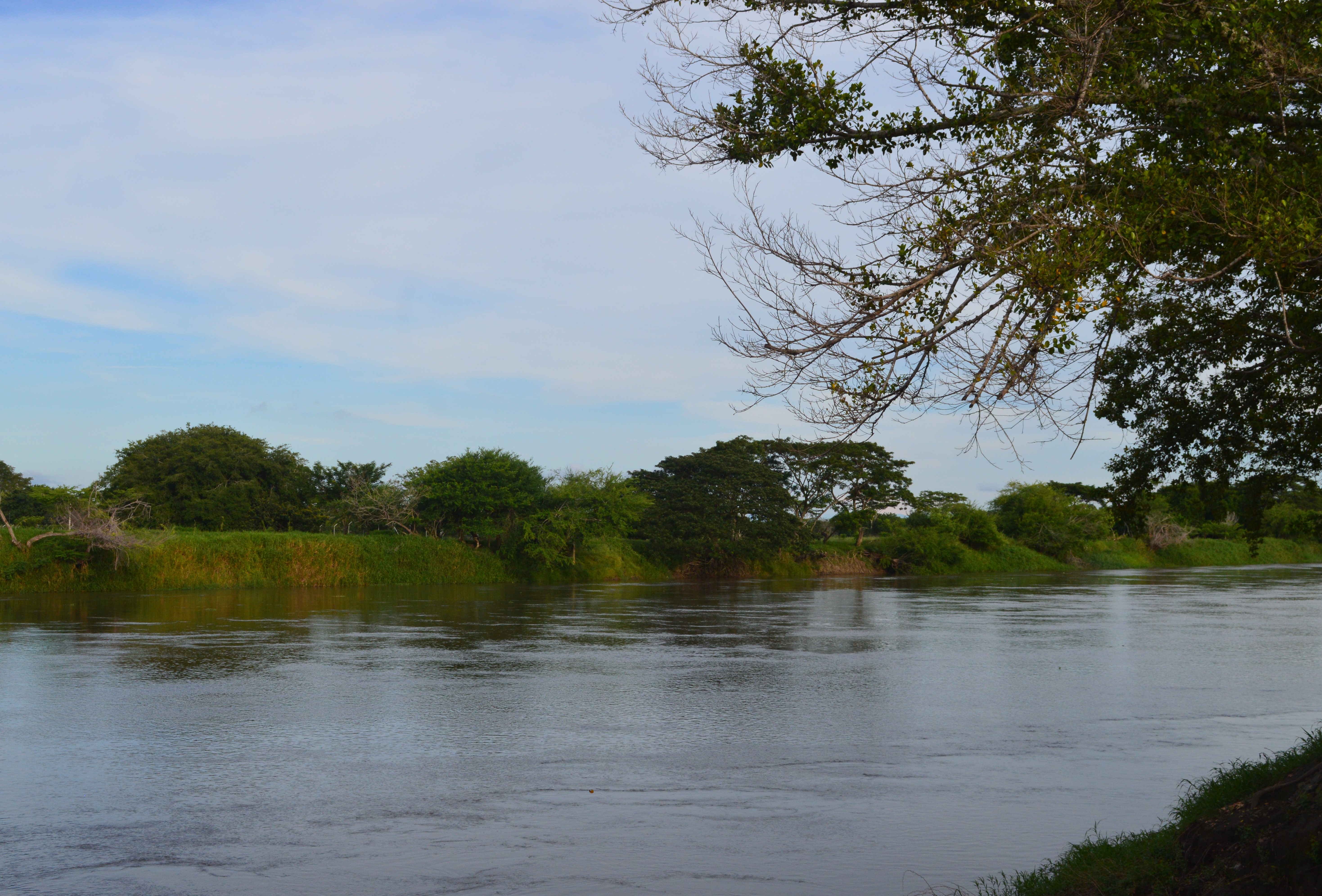
Located in the department of Bolívar, 272 kilometres away from Cartagena, Santa Cruz de Mompox is famous for being the first town in Colombia to declare independence from Spain, in 1810. Mompox sits next to the Magdalena – Colombia’s main river and a key transport link in the country’s history. The preservation of beautiful architecture helped Santa Cruz de Momox become designated as a UNESCO World Heritage Site in 1995.
To get to Mompox from Cartagena, we booked a private car ride with Toto Express. A small business with no official website, I heard of it after seeing its name mentioned in some travel articles (the email address is totoexpress2@hotmail.com). With the help of Google Translate, I emailed to request some dates. The cost of a private return trip for two people was 1,200,000 pesos, payable in cash at the end of the service. This lined up with what I’d seen quoted by other travellers. Equivalent at the time of booking to $380 CAD, this might seem steep to anyone who prefers travelling on a tighter budget. We went with this option because in terms of time and practicality, it was much more convienent than taking a public bus (and screw it, we were on honeymoon!)

Admittedly, because of how “unofficial” Toto Express seemed as a business, a small part of me wondered if the driver would show. Alas, at 10am sharp on a Friday morning in October, a smiling man named Arnoldo picked us up from our hotel in Cartagena, and we commenced the 5.5 hour drive. Horns beeped continuously as we made our way through the suburbs of Cartagena, passing dilapidated buildings and street vendors selling fruit. Motorcyles zoomed in between the traffic, females in skinny jeans calmly holding onto the back of the driver with no apparent fear of almost colliding with vehicles. Arnoldo was unfazed by the chaos, whistling along cheerfully to Latin music. His English was limited and our Spanish is basic so there could not be a ton of conversation unfortunately, but he was very friendly and would check in on us.

On the way to Mompox, we got a glimpse of the Colombia thta not every visitor will see. In the distance we saw rolling hills and lush valleys. Cows with rippling skin on their necks grazed on on verges. We passed through towns in which vendors sold handmade crafts and hammocks and habitants led tired donkeys. Some of the houses we saw had peeling paint, roofs made of corrugated iron, and what looked like mud floors on the inside. Despite the relative lack of wealth, people seemed content. Children played on doorsteps as mothers hung laundry and stray dogs sniffed around for scraps. Some children walked along the road neatly dressed in smart school uniforms. I got the impression there was a lot of pride in wearing them.

On a few occasions, we passed through checkpoints where police officers would stop and search large wagons for drugs and other contraband – a sign of how seriously the country views this and wants to reduce crime. As we waited at one checkpoint, an unhoused man banged against our car, trying to sell us his goods. It was at this point that I realized the car windows were shaded black and Arnoldo had kepts the doors locked. We could see the potential for danger, but we did not feel unsafe.

We stopped in a town called El Carmen for a washroom break. I asked a vendor for some empanadas and struggled to comprehend the number he gave for a price. Like every merchant we came across, he was honest in giving me change when he could have easily pretended I gave him the right amount and taken more money if he wanted to. As we drove through another town, I observed boys in school uniform playing soccer in a street park. Shortly after, the car came to a halt. I heard a window open followed by the sound of Arnoldo shouting at someone. My husband said a woman had been beating her son, and Arnoldo was telling her off. As we drove away, Arnoldo signed the cross and whispered under his breath. We noticed him do this everytime we drove through a run-down area.

After driving through the town of Magangue, we entered what appeared to be lake country. Long yellow bridges took us over vast marshes. “Veinte minutos!” said Arnoldo merrily as we drove through a small village with tired-looking buildings and neglected sheds. I began to feel a little hesitant as I reflected on some of the towns we had passed through. Perhaps the photos I’d seen of Mompox had been deceiving and it wouldn’t be what I expected. But as we arrived in Mompox, we could see how comparatively developed this town was, while still maintaining older characteristics from the colonial era.

We had booked two nights at Bioma Boutique Hotel located on Carrera 2. Accompanying us up the steps and through the gate into the cool lobby, Arnoldo hugged and kissed the hotel owner before confirming a pickup time with us for our return date and wishing us a nice stay.

Bioma Boutique Hotel was freshly renovated, with a pool and a rooftop terrace complete with jacuzzi. Rooms were minimalist and bright, with a rocking chair and refurbished bathrooms. Although cheaper than a nice hotel in Canada, it was clear that this hotel was tailored to more affluent customers, and although we were on honeymoon, this admittedly made me feel a little guilty after all the scenes we had witnessed en route to Mompox.

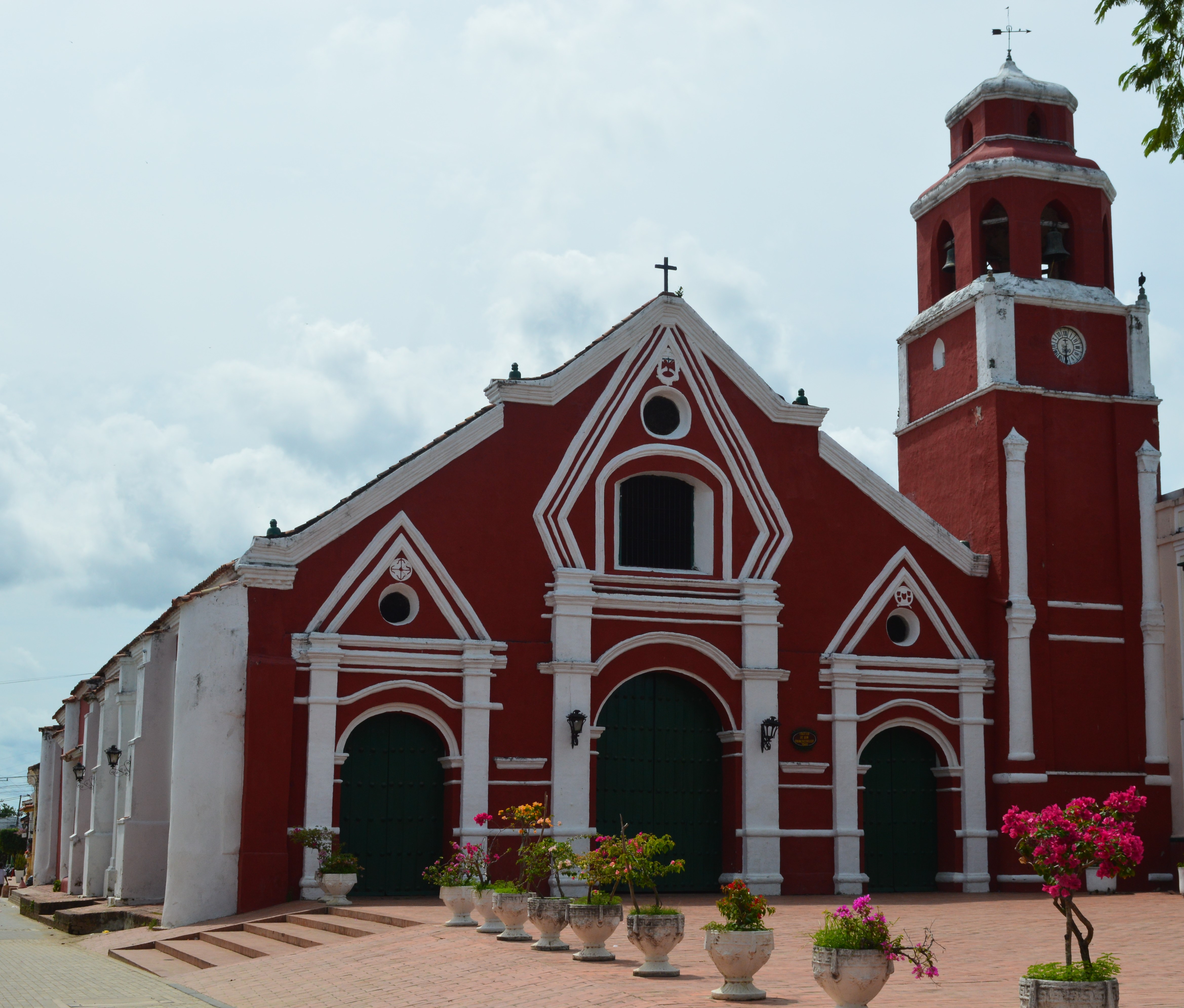
After dropping off our belongings, we went out for a walk. Turning left up Calle 18, we passed the leafy Parque de Bolívar where kids played and parents sat chatting on benches. Soon after, we came to the Oratorio Inmaculada Concepción – a Catholic church with a regal red steeple, located in the Plaza Real de la Concepción. Translating as the Royal Square of Conception, it’s in this market square that the first Spanish settlement of Mompox was developed, in the 1500s.
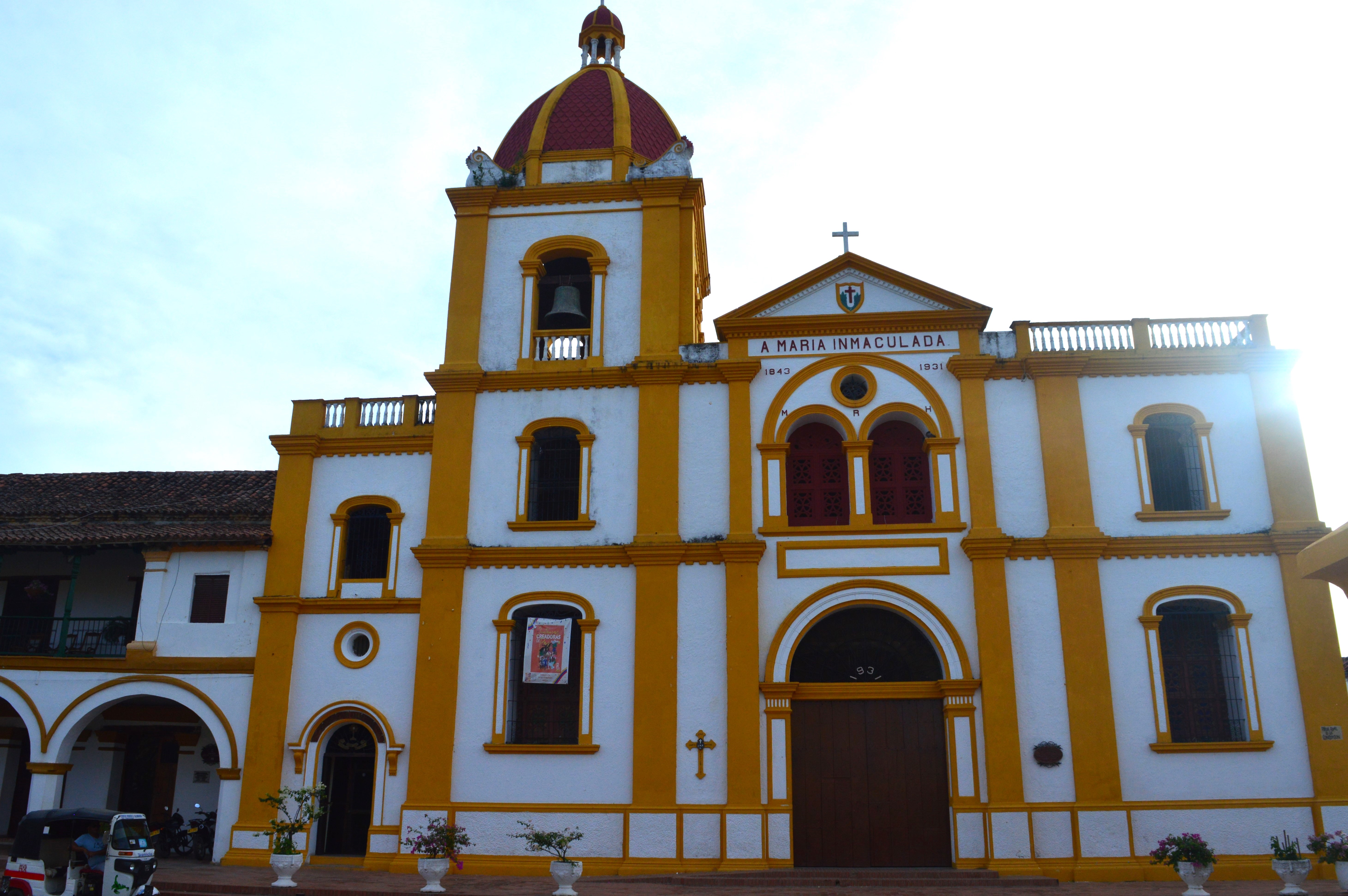
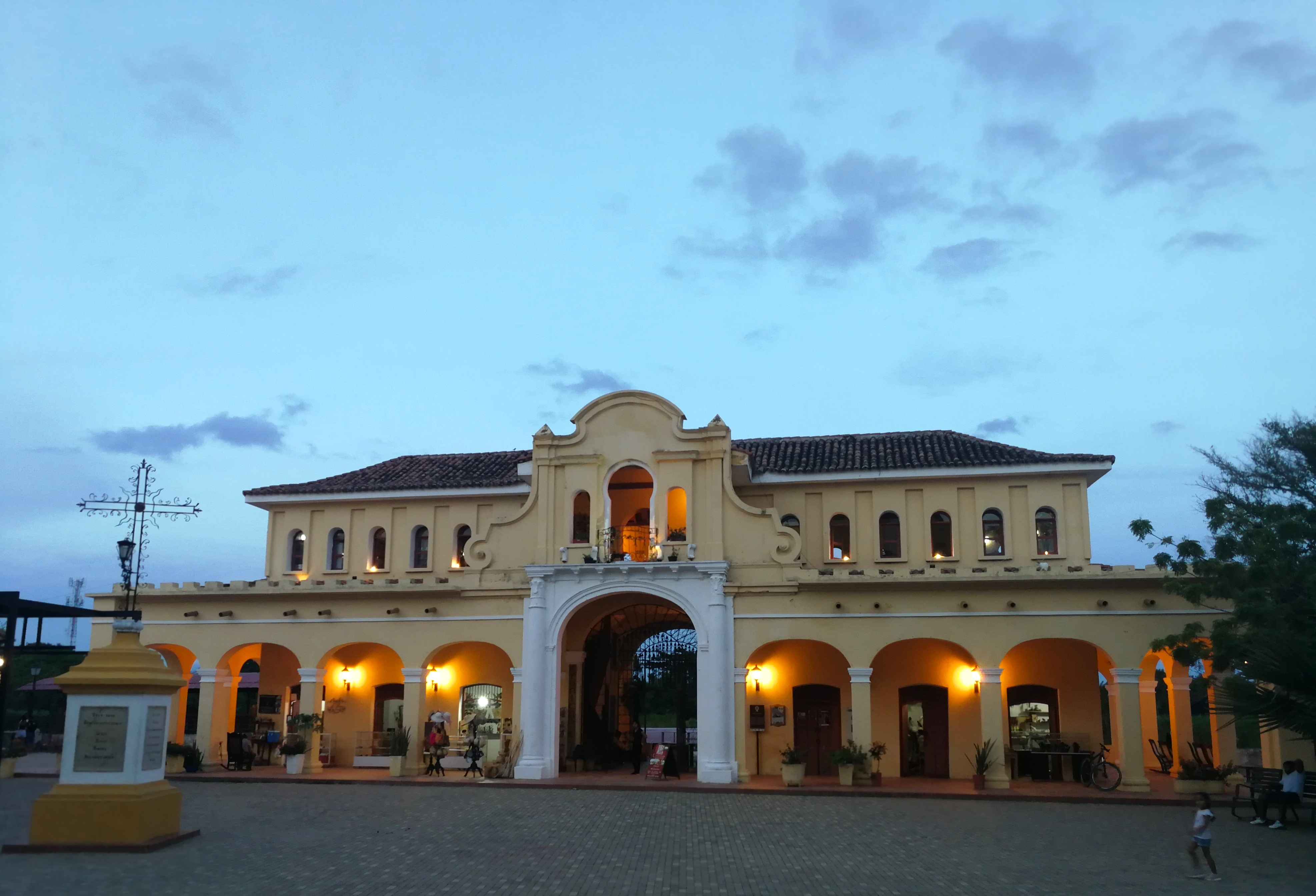
Opposite the church is the Plaza de Mercado, where shy women sat selling small trinkets, scarfs, and jewellery. The back of the market building has an exterior arcade to walk through, and through the arches you can see the Magdalena River flowing by. Boat tours are available – a good option for anyone who enjoys bird watching.
For dinner, we opted for Ambrosia Restaurante which was on the same street as our hotel. With its stone walls, open side entrance, and arched doorways, the building looked like it used to be horse stables. Fairy lights and flowers in hanging pots added to the nice ambiance. Something to note if visiting Mompox is that most menus will be in Spanish only. With no data plan for our phones and not wanting to request WiFi, we relied on my memorization of the Spanish translation for common food items. Thankfully, we got what we thought we had ordered! I could tell the waiter appreciated us trying to speak in Spanish only. Perhaps this is the reason he brought us each a bowl of delicious vanilla ice cream as a complimentary dessert…or maybe every customer is treated to this generosity. Our dinner cost 105,000 pesos with tip included – much less than the standard prices in Cartagena.

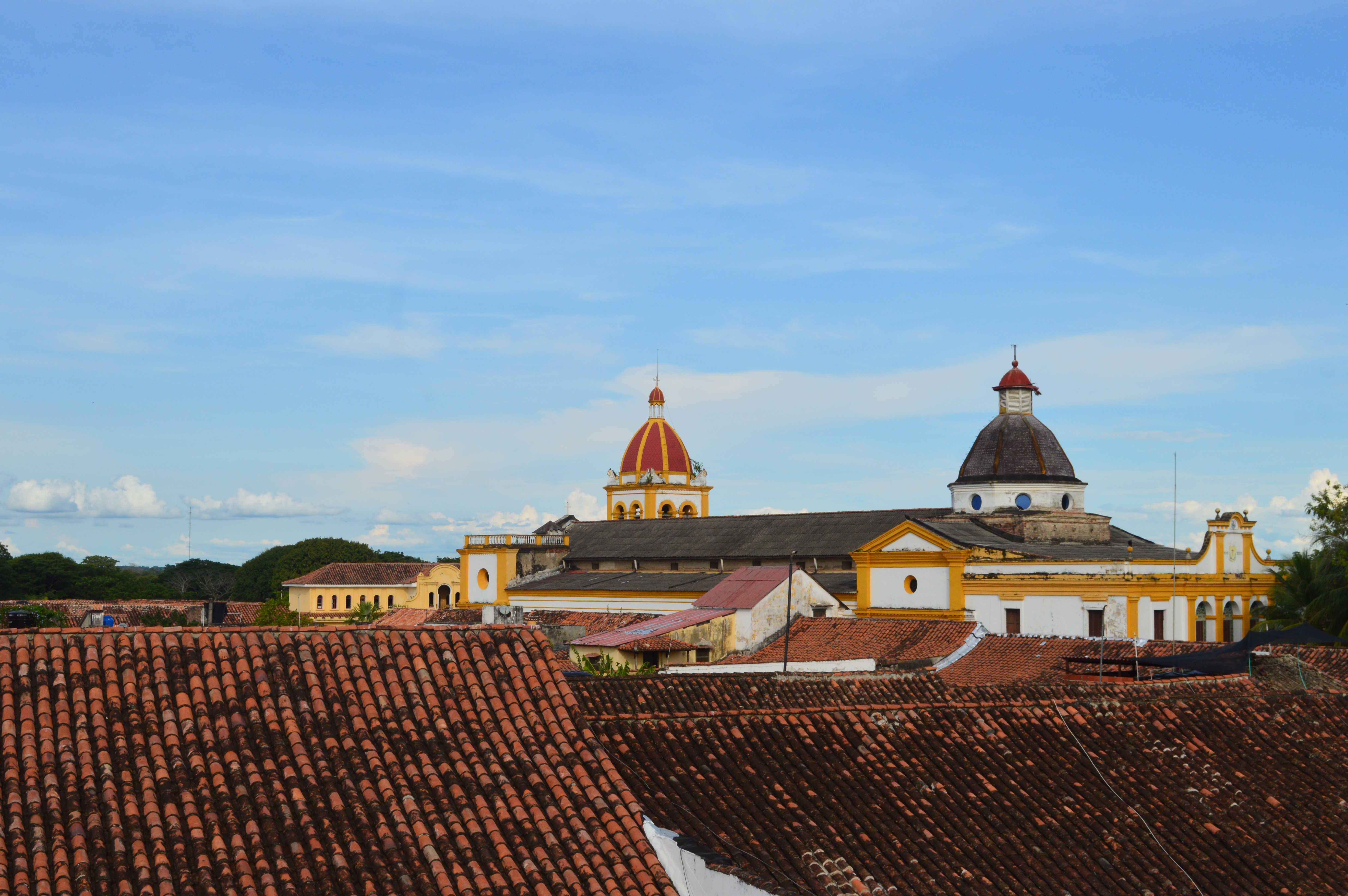
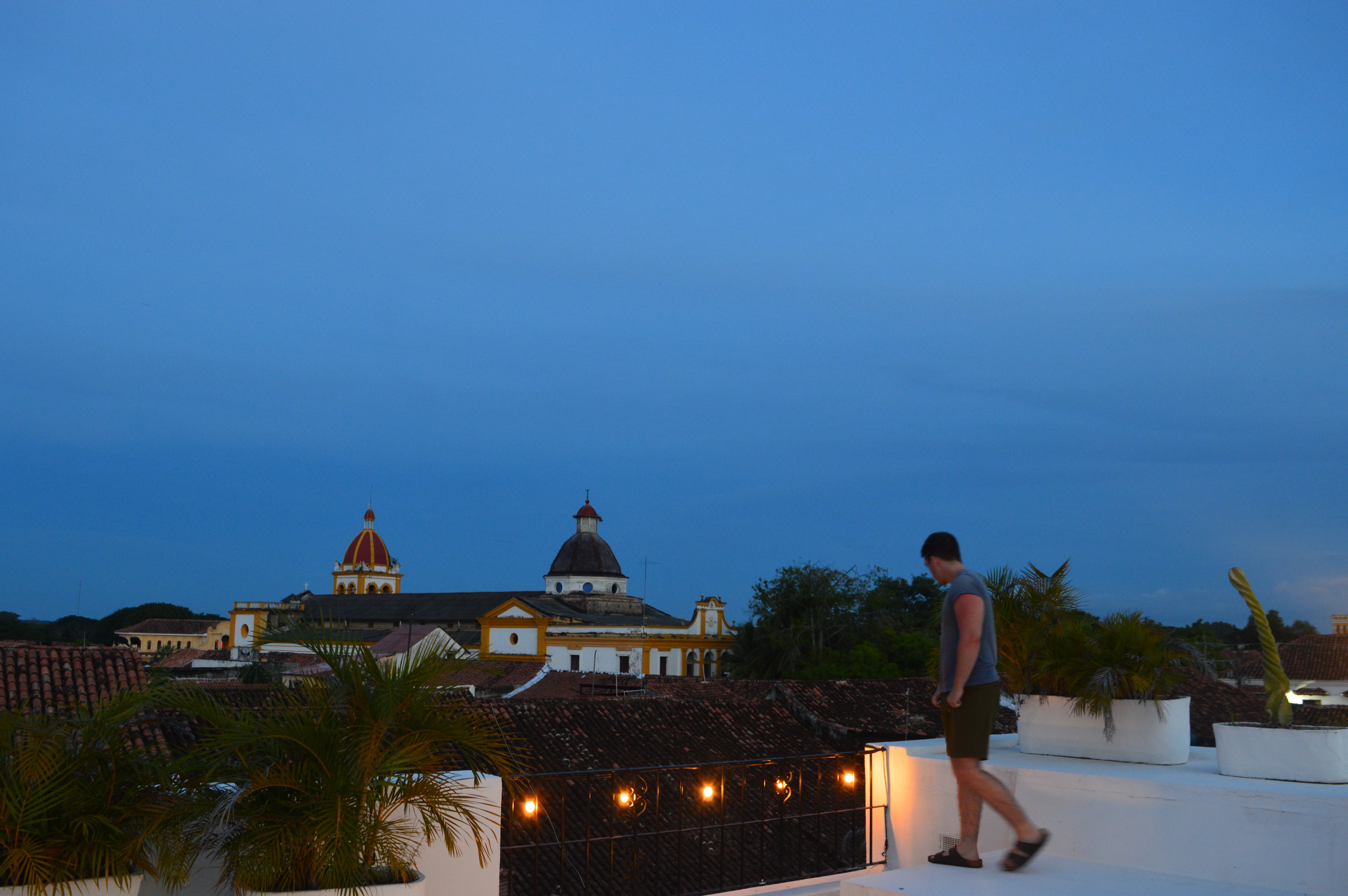
From the rooftop terrace of Bioma Boutique, we saw a sea of orange roof tiles. Colourful steeples rose up against a sky turning from blue to violet. Colombian turkey vultures landed on nearby building tops, treading awkwardly along the roof edges. The jacuzzi looked tempting, but we were already warm enough.
After having a traditional Colombian breakfast in the hotel the next morning, we walked down Calle 19 past the Plaza de La Libertad. A yellow building with a bell tower stood behind it – this is the municipal mayor’s office (Alcaldía Municipal) and it has a pretty courtyard with palm trees and flower beds.

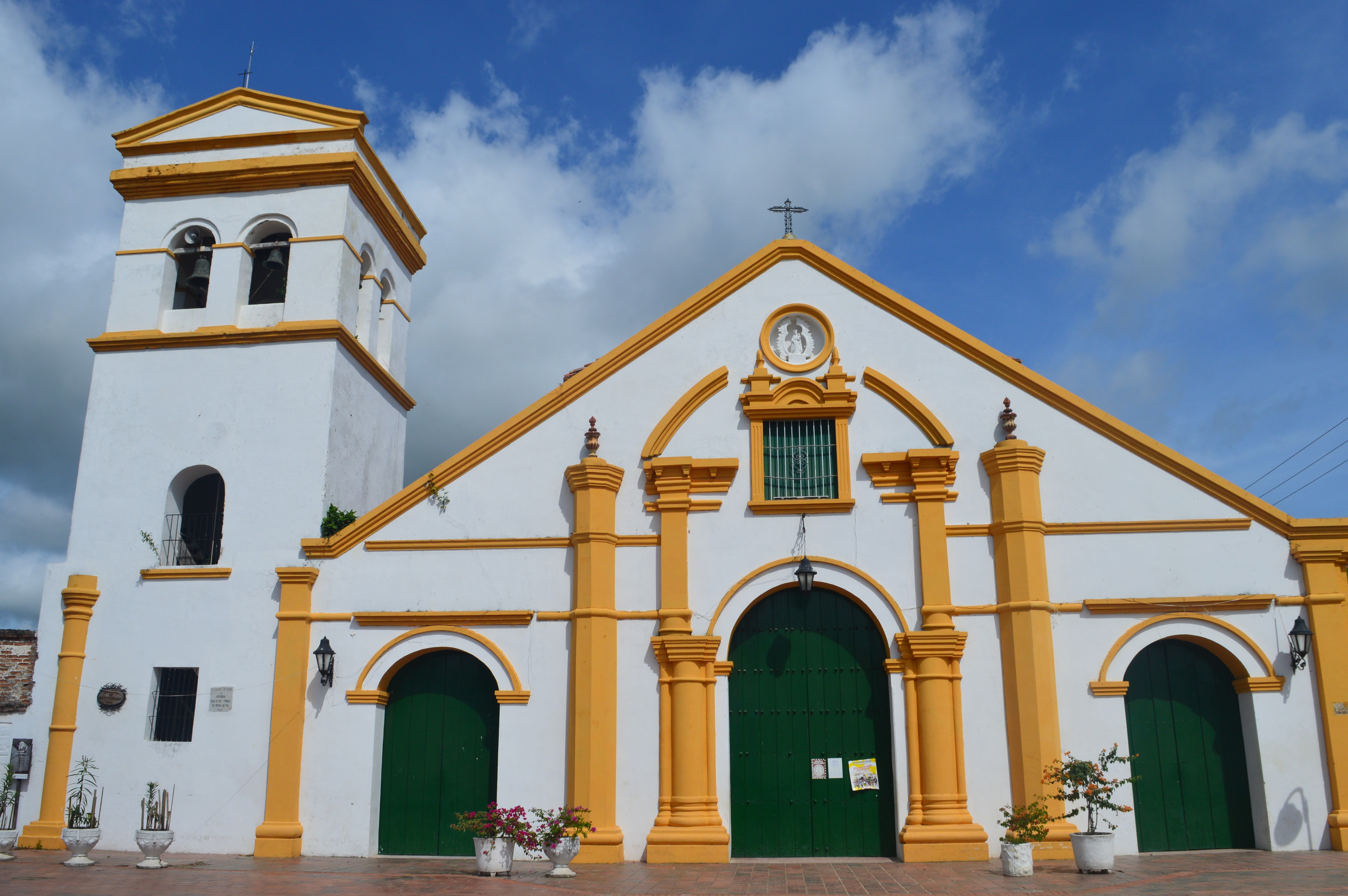
Shortly after turning left onto Carrera 3, the street walls were decorated with vibrant murals. We then came to the striking Iglesia de Santo Domingo, with its bright white walls and yellow trim.
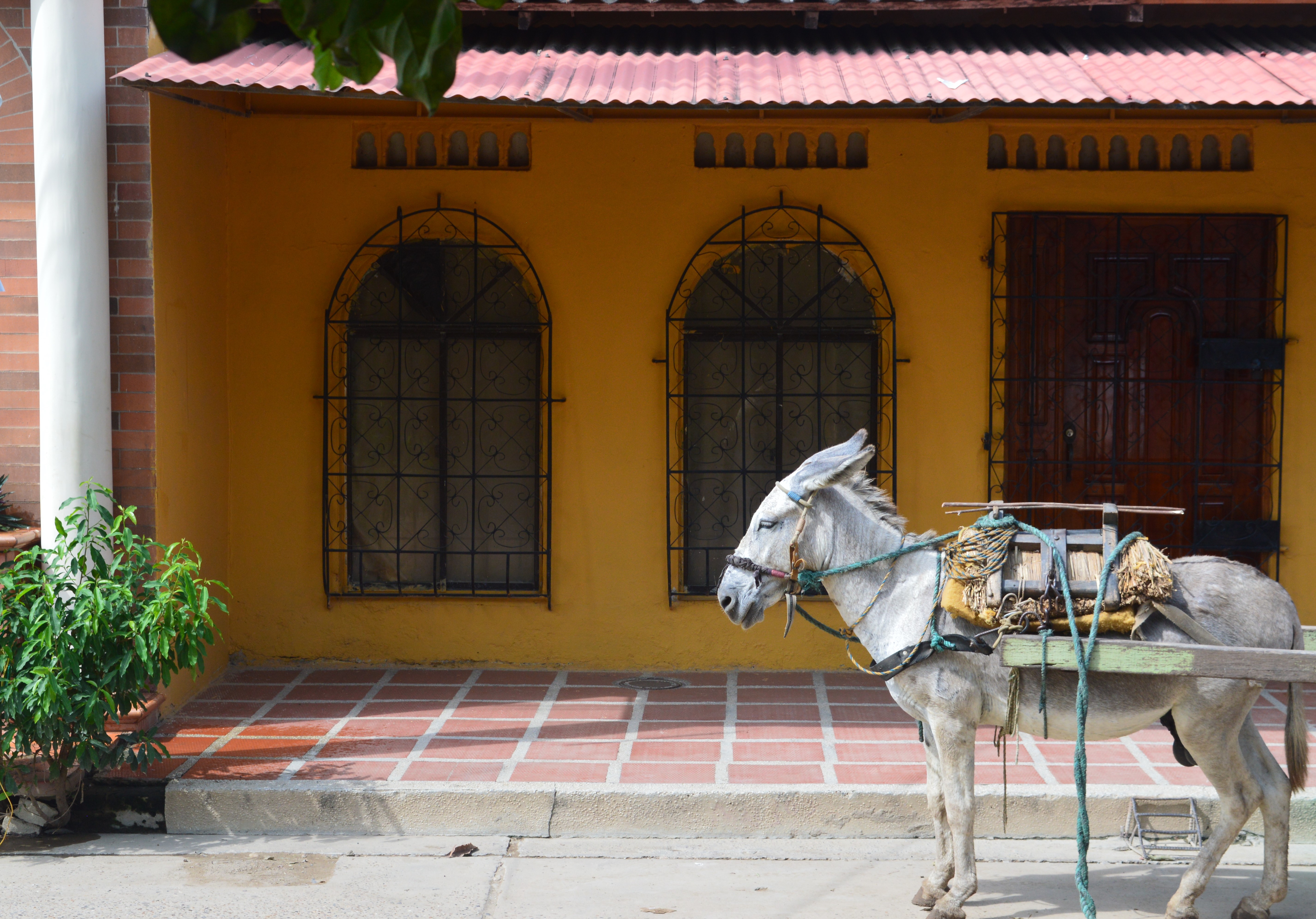
As we continued along the street, we passed a dozing donkey standing against a backdrop of yellow houses with orange-tiled roofs, waiting for its owner. Mopeds drove by casually, tooting greetings at familiar faces. Locals sat on dusty doorsteps smoking cigarettes with pensive faces.
An observation that stood out for us in Mompox was how pleasantly surprised the locals looked when we greeted them with a “Hola” or “Buenos días.” It seemed they were not used to pleasantries from foreign tourists. It was an observation that gave me a twitch of sadness, but I was happy if I added some brightness to someone’s day.

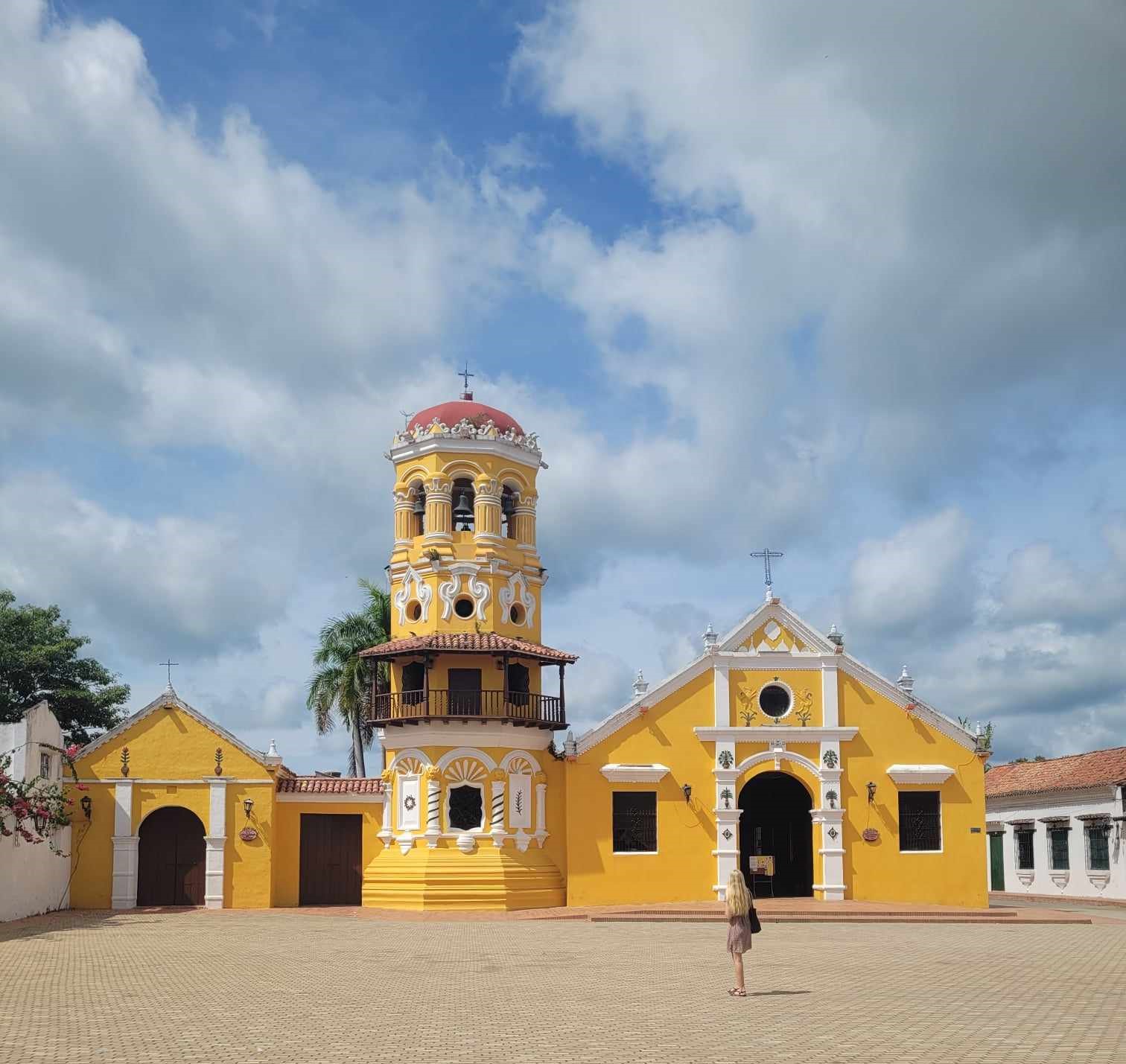
After turning left up Calle 14, we came to the Iglesia de Santa Bárbara. Initially built in 1613, it’s a beautiful, intricately detailed piece of architecture which makes it no surprise that it’s one of Mompox’s most photographed churches.
From here we walked along the promenade known as the Calle de La Albarrada, adjacent to the Magdalena River. Down the quiet Calle 16 was the Basílica de San Agustin, a yellow church with a distinctive square steeple.

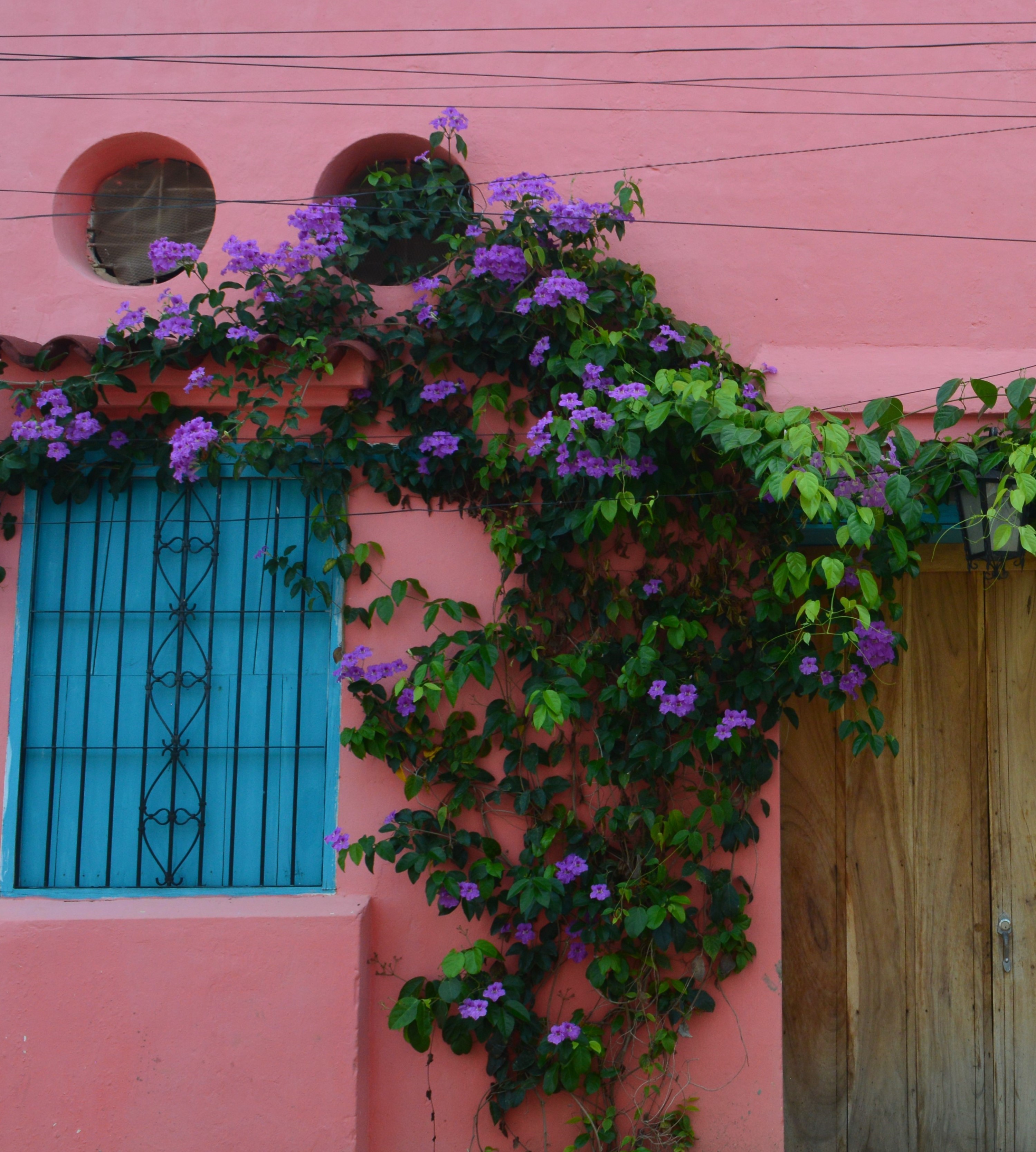
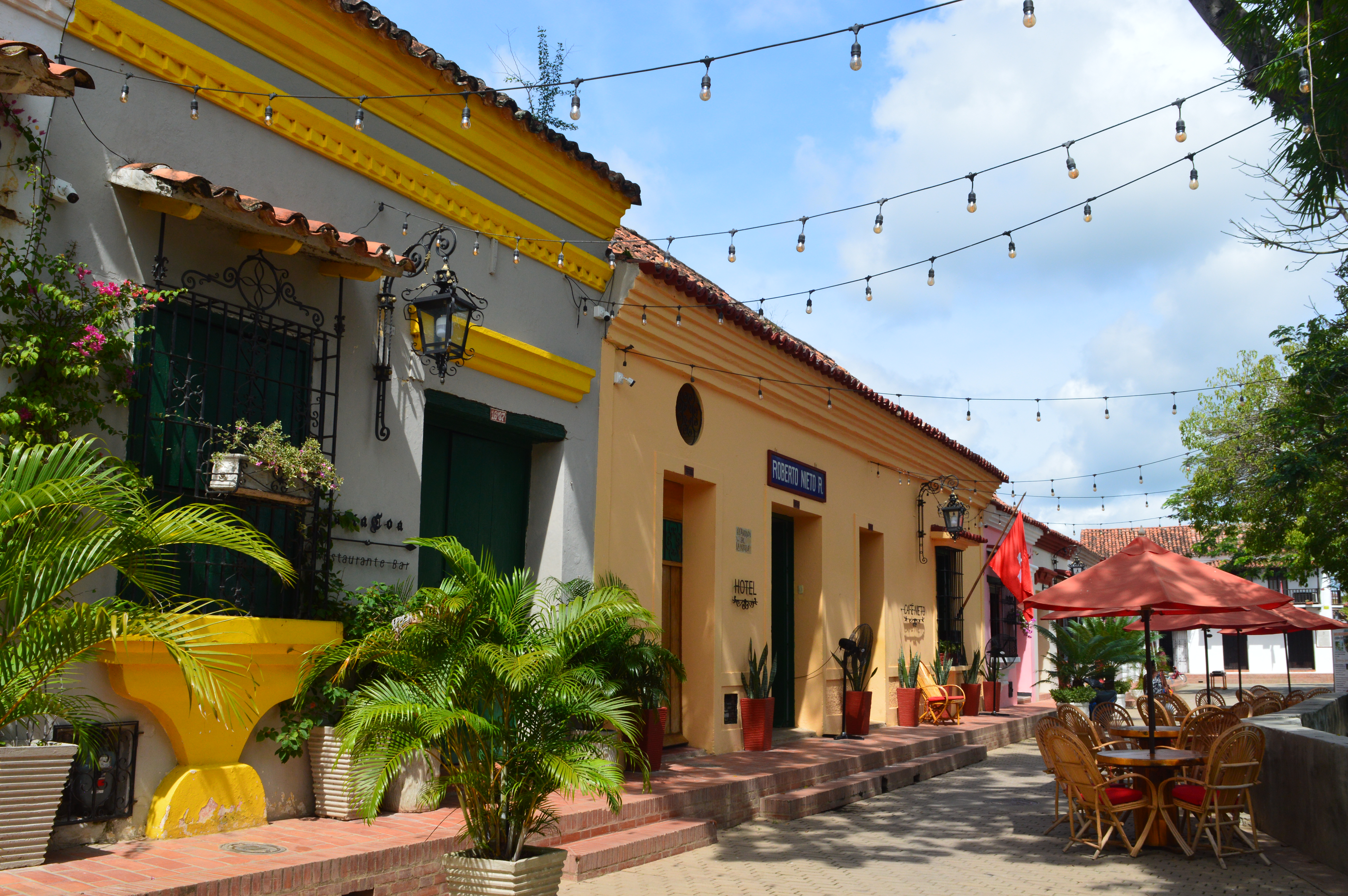
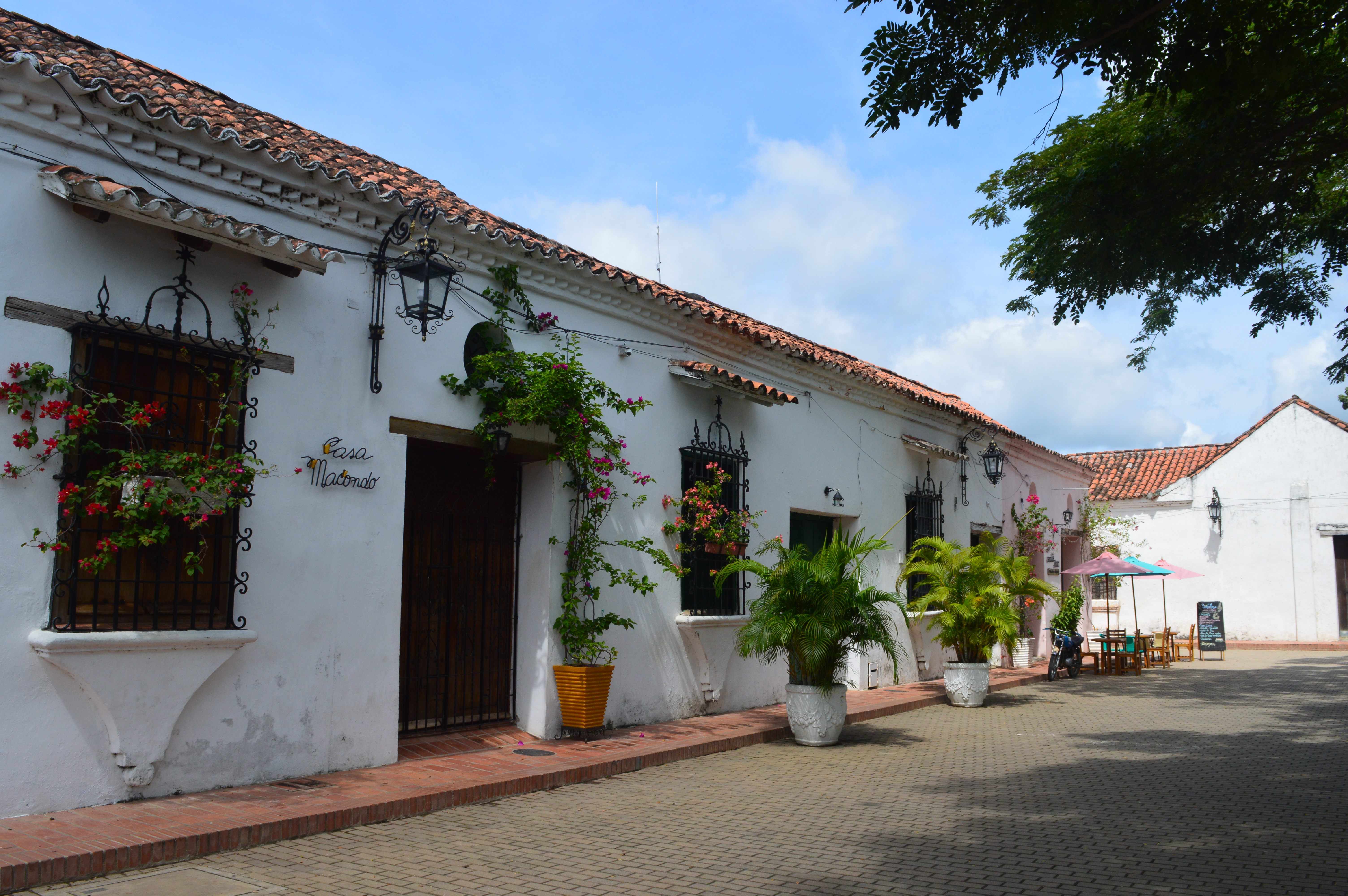
As we continued along the Albarrada, I was charmed by the continuous sight of pastel-coloured houses and small boutique hotels with traditional wooden doors. Gentle music played through the open windows of restaurants.
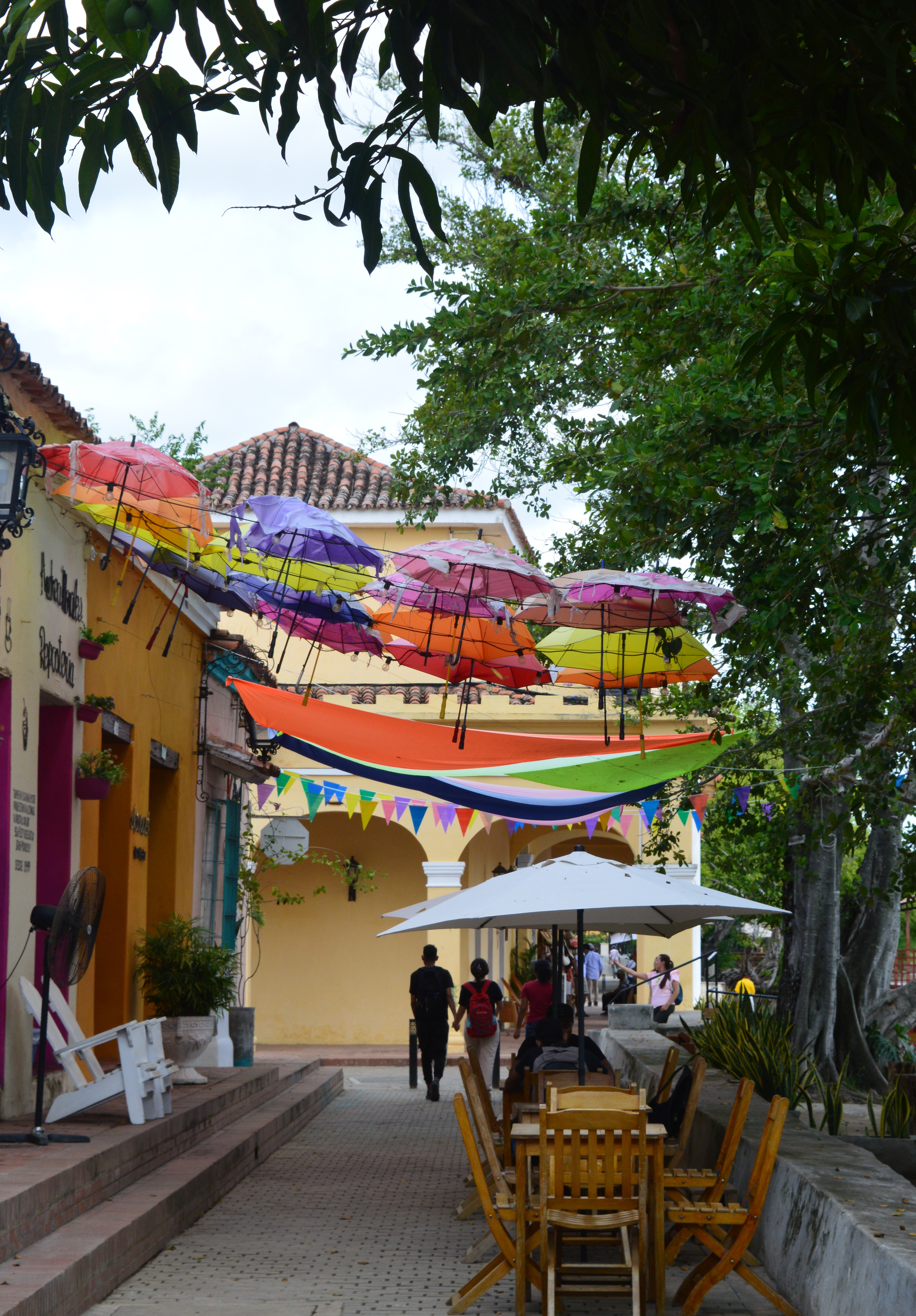
We walked under a canopy of colourful umbrellas before wandering through the market building again.
We chose to eat lunch at a casual eatery called Comedor Costeno. Without even asking, the waiter sat us directly under a large fan. I guess we looked pretty sweaty! Freshly made iced tea helped quench our thirst as we studied the menu. Without speaking any English and instead just listening carefully, we were able to work out the extras that came with our order and subsequently advise that we did not need the soup. Amazing what we can understand just by listening! I had fried red snapper with coconut rice and salad, while my hubby had barbecued pork.

Our bill came to 33,000 pesos, which didn’t seem enough. But when I checked the receipt, everything was there. I realized that the waiter had lowered the price to make up for us not having the soup with our meal. It was another unexpected act of generosity – an act that is perhaps the norm in this town, but was nonetheless unexpected by someone that lives in profit-driven, post-COVID North America.

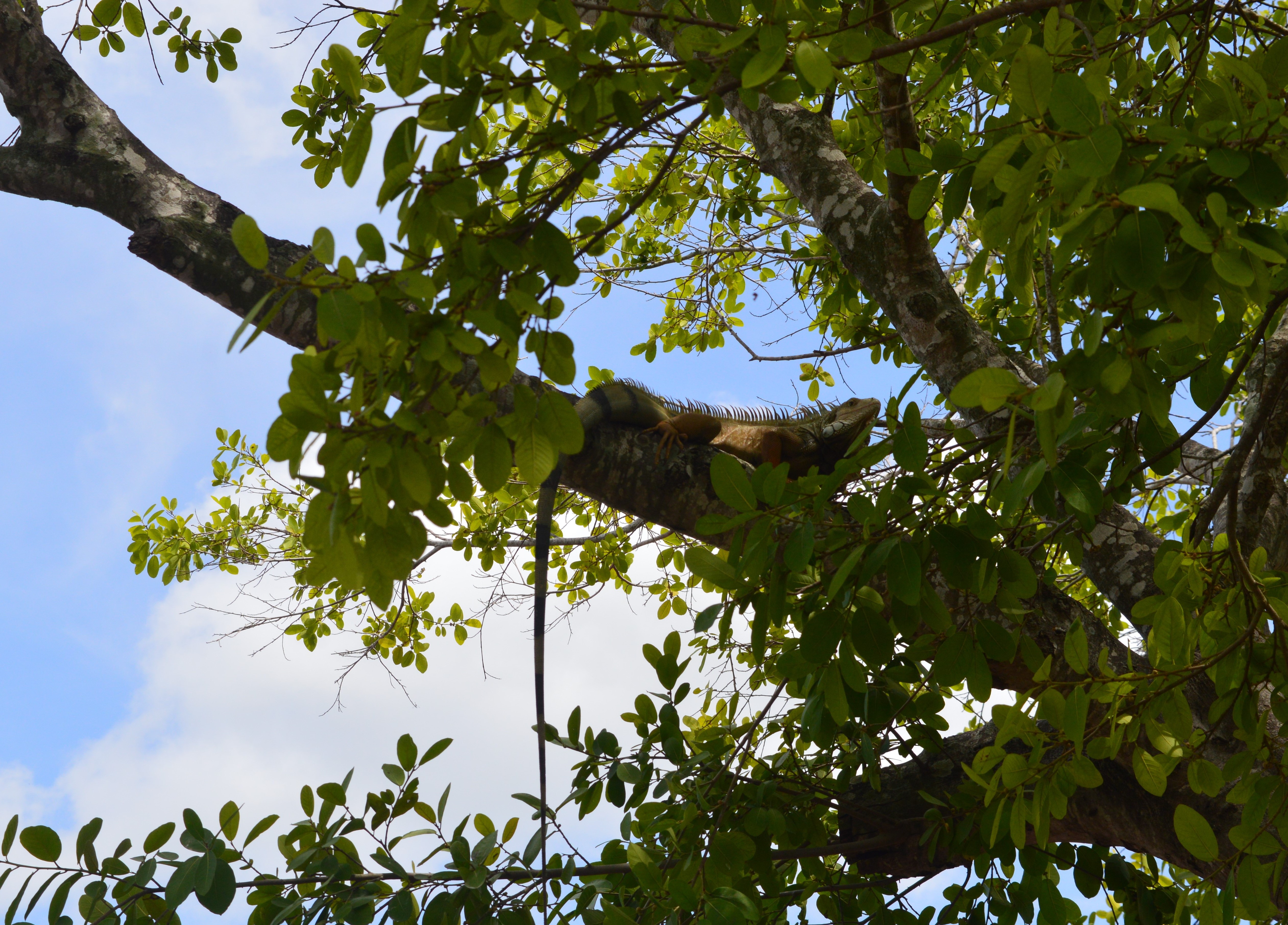
As we ate, I noticed a movement in one of the trees outside the restaurant. An iguana was slowly crawling down a tree. I went outside to look. A French couple had also noticed the animal. As we watched with excitement, locals continued eating, indifferent to the presence of this animal they were so used to seeing. Once on the ground, the iguana looked around slowly, aware of the attention he was receiving. He then proceeded to saunter nonchalantly past the chairs and tables, slowly increasing his pace as he got further away, as if trying to leave a crime scene unnoticed.
After lunch, we continued along the promenade past the Plaza del Moral. Walking through this quiet square, it was difficult to imagine that Simón Bolívar, “El Libertador”, once stood here rounding up hundreds of men to fight the Spanish a couple of years after the town had declared independence.
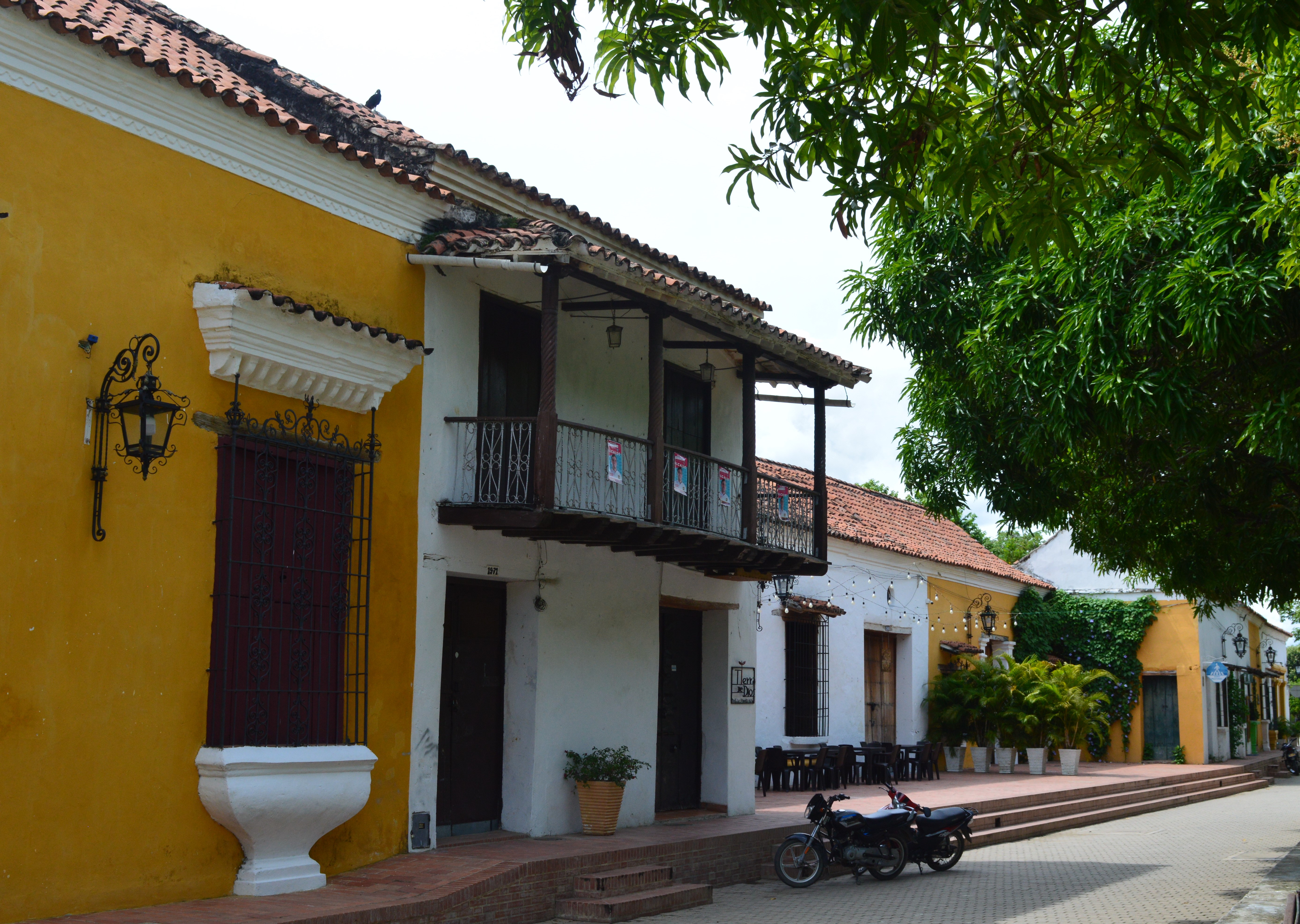
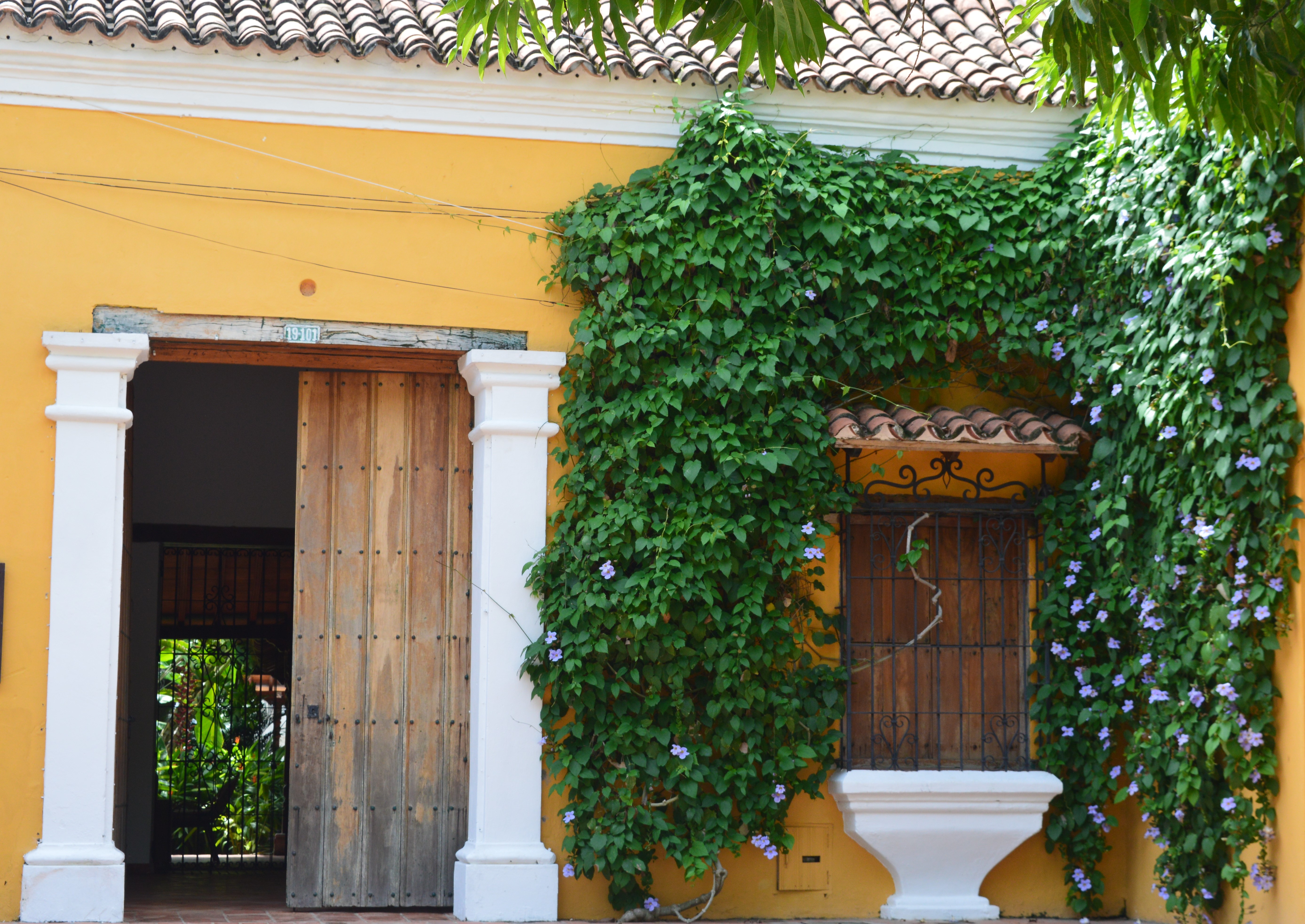
Lizards with a bright green skin scurried along the river bank as we walked along towards the handsome Iglesia de San Francisco. It was then back to our hotel for a break from the heat and an afternoon siesta.
As we headed out for dinner in the evening, we noticed a few female police officers stood around the Plaza de Bolívar, assumedly preparing for an upcoming event. All of them were short in stature, with slight builds and beautiful faces. We said hello to one we passed and she smiled bashfully, curling a stray hair behind her ear.

For dinner we chose Verde Oliva in the Plaza Real de la Concepción. It was another restaurant with a structure and decor that resembled former stables. We ate delicious woodfired pizza and drank freshly made iced lemonade. At 63,000 pesos, it was yet another great meal that reminded us how overpriced many restaurants in Cartagena are.

We walked back through the Plaza Real de la Concepción, seeing young kids running around under the softening sky. The heat of the day would make us fall asleep early, content with our time exploring this little gem in northern Colombia.
Santa Cruz de Mompox was a charming town in which we could enjoy beautiful architecture, explore areas of historical significance, and observe local culture at a relaxed pace. There is no rushing around in this town; instead, it’s a place in which you want to take your time soaking up the elements and small details. A place where you’ll want to speak as little English as possible, preferring to let your mind drift off in a daydream, escaping from your normal reality.

The journey to Mompox and our time in the town reminded us of our privilege, but also exemplified that having material things does not guarantee happiness and having wealth does not make someone a generous person. Here we encountered a collective spirit of kindness and generosity that will not be forgotten. Although we did not stay long in Mompox, our time in Colombia wouldn’t have been as special had we not visited it. The sights of Mompox are embedded in my memory, but the soul of the community is treasured in my heart.
*
Unknown's avatar

Colours of Cartagena, Colombia

The first time I saw photos of Cartagena de Indias, the port city on Colombia’s Caribbean coast, I knew I wanted to visit one day. Although Colombia wasn’t initially in our honeymoon plans, a deal on flights convinced me to visit South America for the first time, and my husband was up for the adventure.

Previously considered one of the most important ports for trade during the Spanish imperial era, Cartagena declared independence from Spain on November 11th, 1811. It is most famous for its historic walled city, the picturesque architecture of which earned it its status as a UNESCO World Heritage Site in 1984.

On every blog I had read about Cartagena, pretty much the same advice was given: October is part of the rainy season, so it’s best not to visit at that time of year. We went against this advice and arrived in mid-October. As we stepped off the plane at Rafael Núñez International Airport, bright sunshine made us cover our eyes and a blazing heat caused us to swiftly remove our sweaters. For the three nights we stayed in Cartagena, we wouldn’t see a drop of rain. Some would call this luck, others would call it climate change.

We caught a yellow taxi into the city centre. It’s about a 10-minute drive, with ocean views on the right. We watched, silenced with astonishment, as cars zoomed chaotically along the highway, narrowly avoiding mopeds that darted in between the lanes. Most of the mopeds carried female passengers on the back. They held on loosely, seemingly unworried as their driver sharply changed lanes without a glance over his shoulder. Signalling doesn’t seem to be a thing here; instead, drivers will frequently toot their horns as if to say, “Move it, I’m coming through.”

Approaching the history city walls, we passed Las Bóvedas, a former dungeon converted into a market. Entrance to the old town was through narrow archways. Traffic-wise, it was every man for himself. Cars from all directions bunched up, beeping incessantly, trying to be the first to go through. “Right of way” didn’t appear to be a concept!

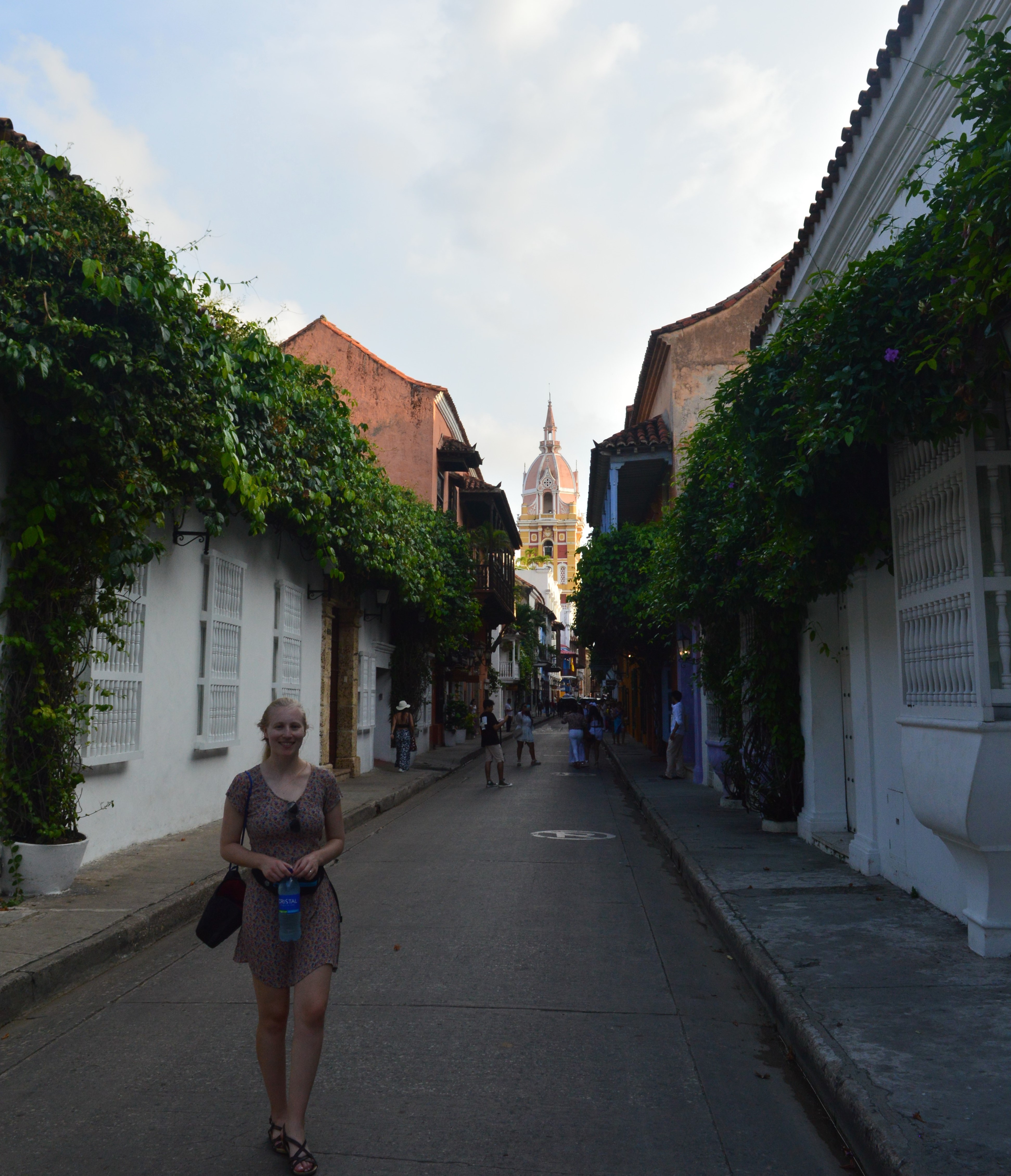
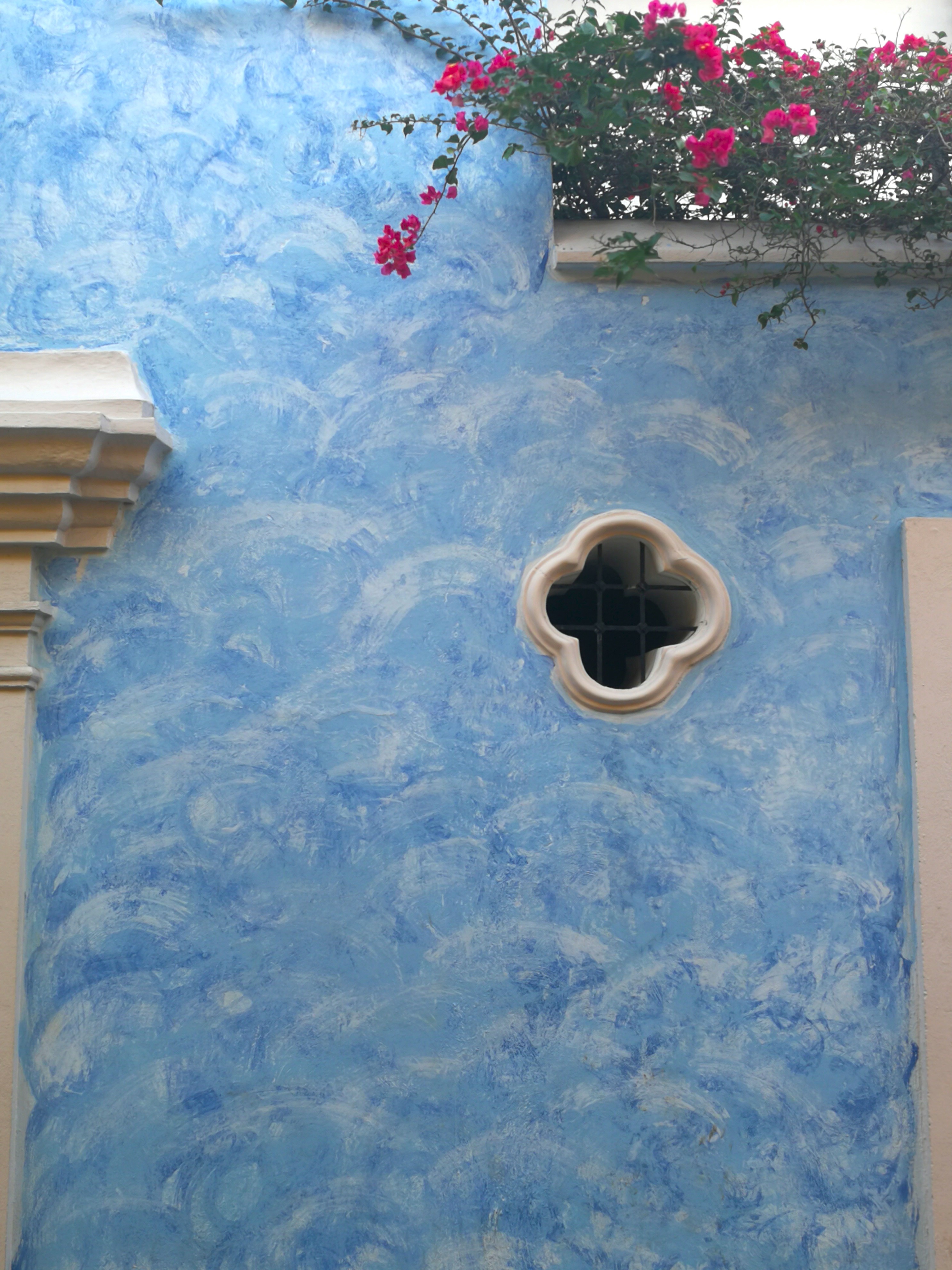
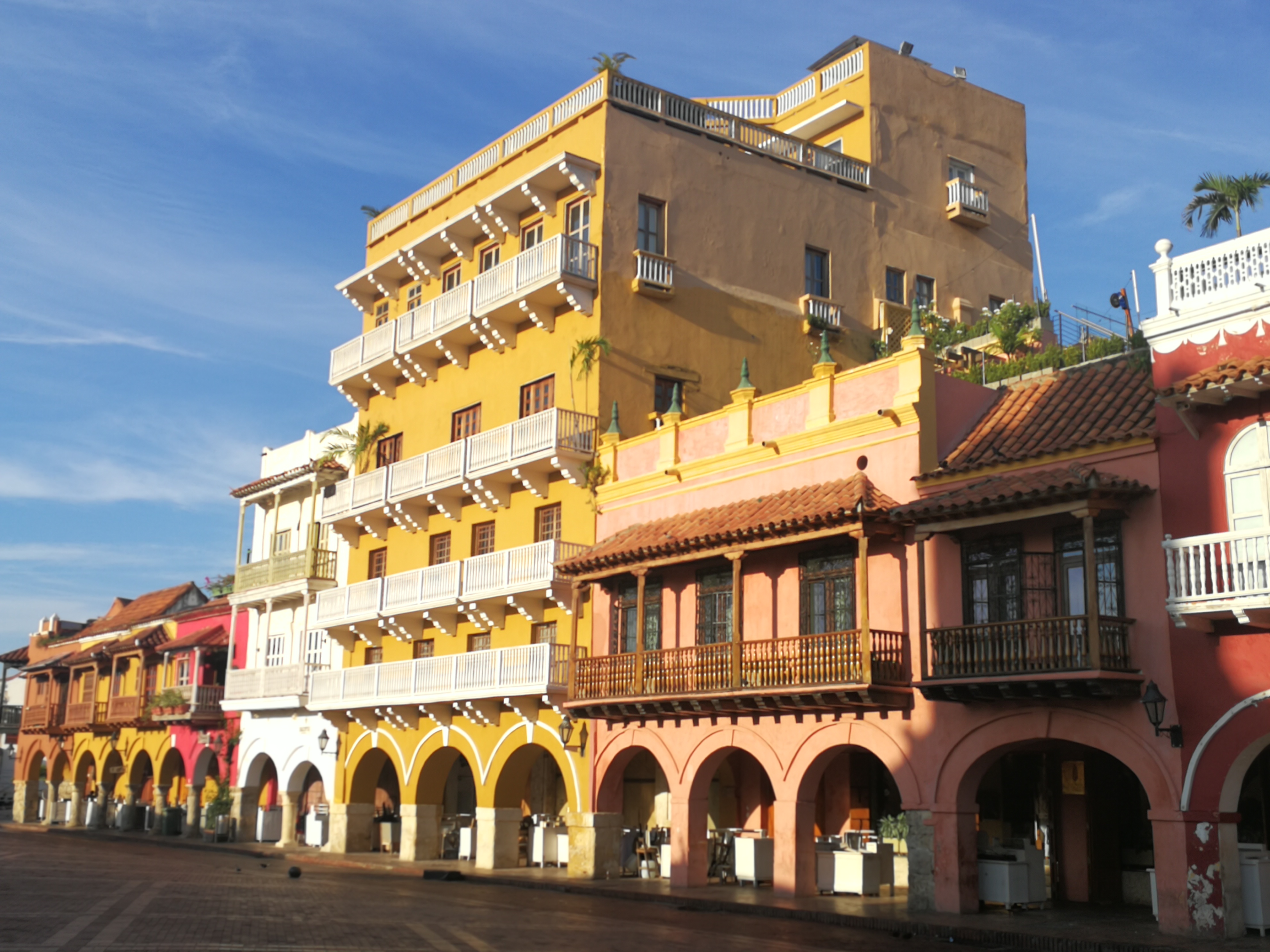
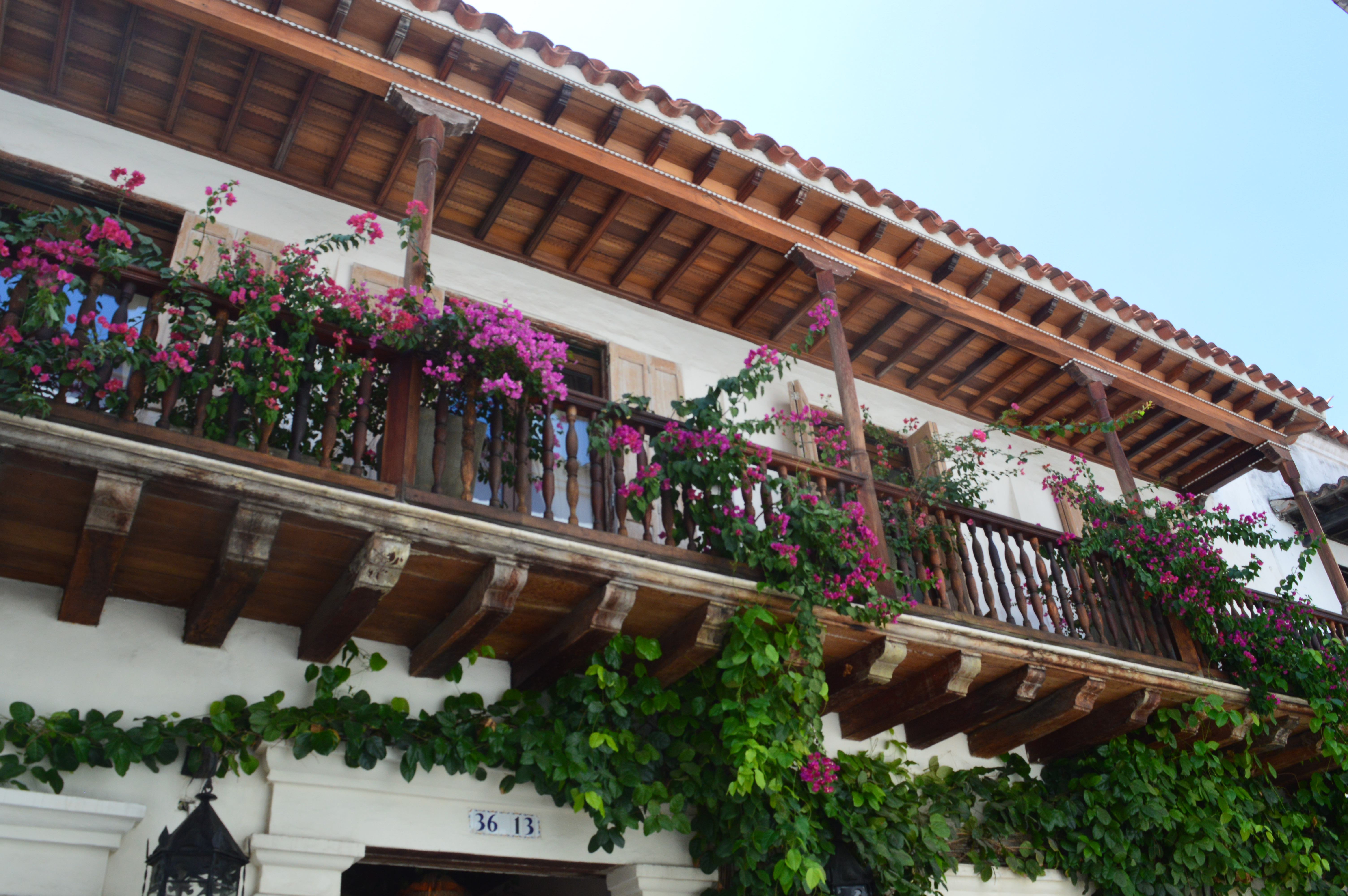
We drove up narrow, cobbled streets, passing pastel-coloured houses with flowers draping around balusters and vine plants spreading along the walls. Our driver mumbled to himself as he tried to find our hotel, and then made a satisfied sound after recognizing the Hotel Casa del Curato on Carrera 7.

Taxis in Cartagena don’t have meters. Some drivers will let you know what the cost will be at the beginning; others seem to wait to see what is offered and then let you know if it’s enough. I handed our driver 25,000 pesos and he looked very happy, which made me wonder if I gave more than necessary…

As we retrieved our bags, a man approached my husband rapping a song. I had read about these artists on a few blogs, all of which had advised to avoid engaging with them because they would ask for money. I had shared this with hubby in advance, alas, this appeared to be forgotten as he shook the man’s hand with a smile and answered when asked which country we were from. Soon after came the man’s open hand and a request. I watched, half irritated, half amused, as a look of realization swept across hubby’s face. Thankfully, a sweet doorman from our hotel came to the rescue and gestured us up the steps inside.

We walked into a cool lobby dotted with various plants. A house cat peeked out curiously from behind a pot. After checking in, we walked up the wooden stairs past a beautiful painting of a Caribbean woman. Our room was bright and airy, with white walls and a balcony that looked onto the street below.

I chose Casa del Curato because it seemed to be located in a slightly quieter part of town, and I have a fondness for independent, boutique hotels. It certainly had a lovely character, and it was cheaper than many hotels in the city, but as a 3-star hotel I also didn’t feel it was quite worth the approximately $200 CAD a night. I reminded my frugal self that we were on honeymoon and let it go.

Freshly changed, we walked down the street, passing the Iglesia de Santo Toribio at a junction on our right. We quickly learned that vehicles were not inclined to give way to pedestrians. On Calle de la Tablada, we turned left and crossed a few blocks until we came to La Mulata. This Carribbean restaurant had been recommended on a blog I read, and we were keen to try to some local food. A sweet lady brought us a complimentary bowl of soup as we glugged water, sweating heavily after only seven minutes of walking. We ate delicious fried fish and coconut rice before bracing ourselves for the humidity of outside once more.

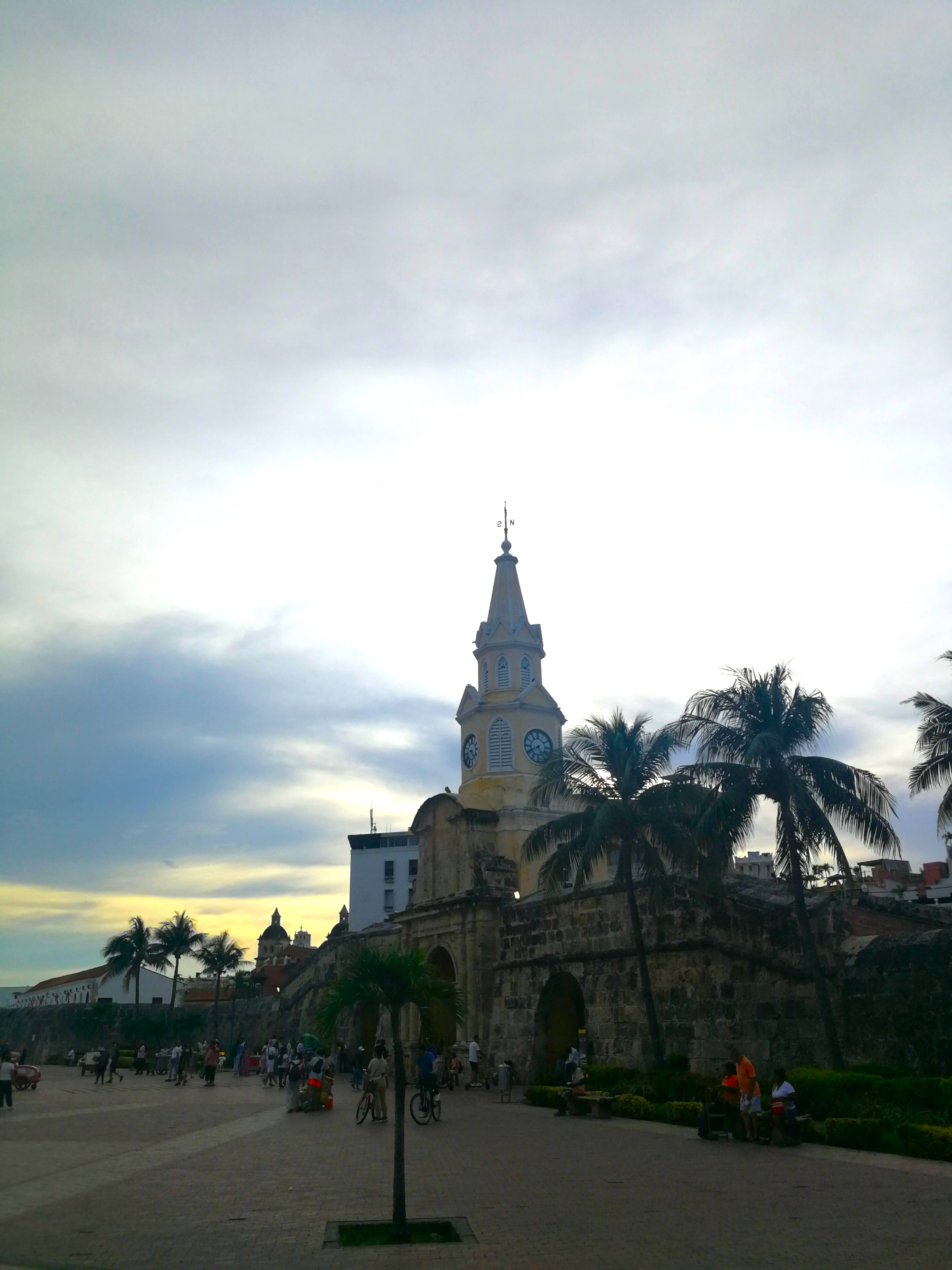
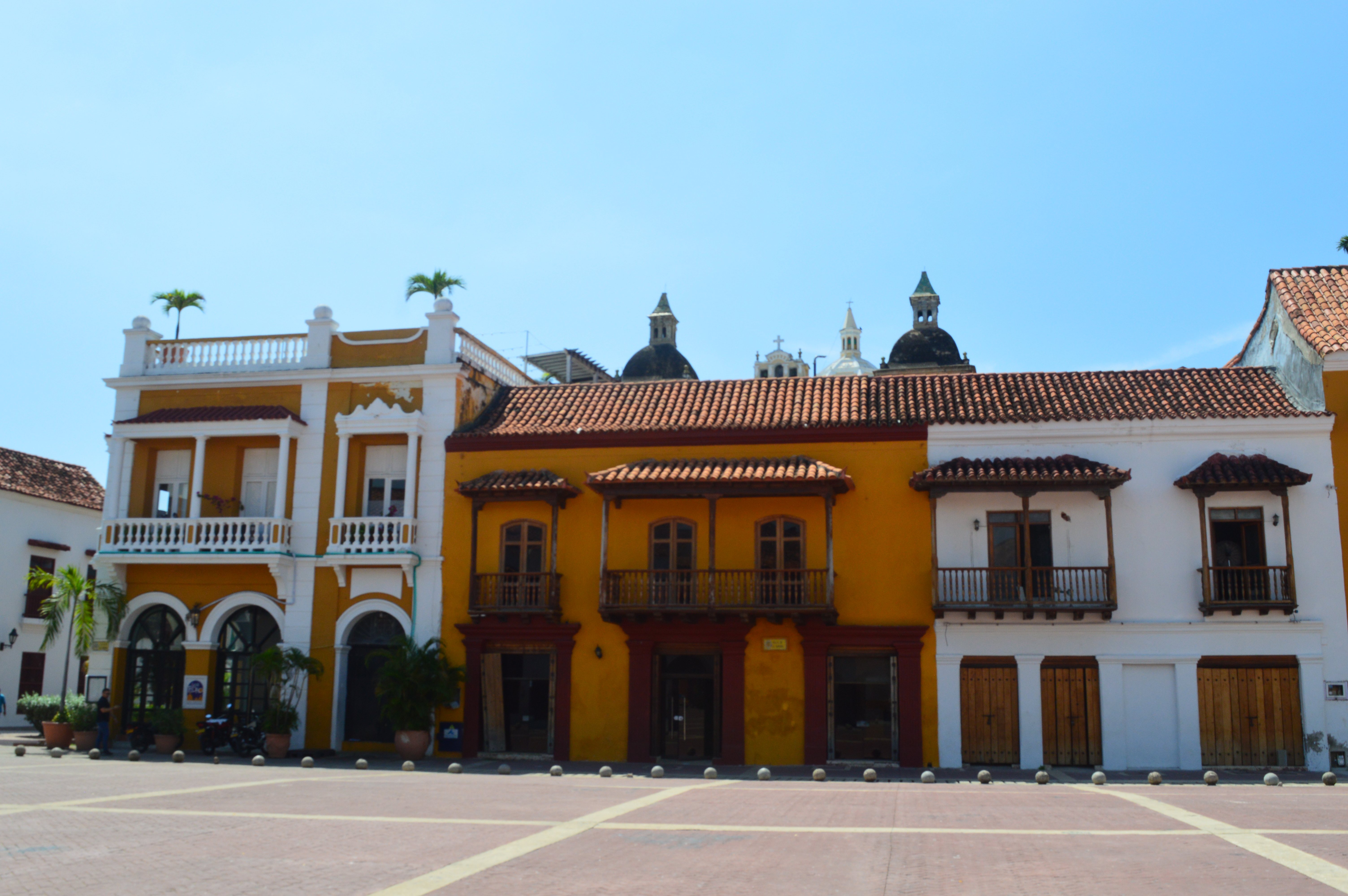
As we walked south down Carrera 7, we saw vendors frying empanadas and stalls selling mangoes, melons and bananas. This street leads to the Plaza de los Coches, in which stands the Monumento Torre del Reloj – a stone gateway with a spiral clocktower. The square was buzzing with tourists. A long arcade ran under a row of colourful buildings, with vendors hoping to tempt tourists with jewellery and crafts. We followed the street as it wound to the right and came to the quieter Plaza de la Aduana.

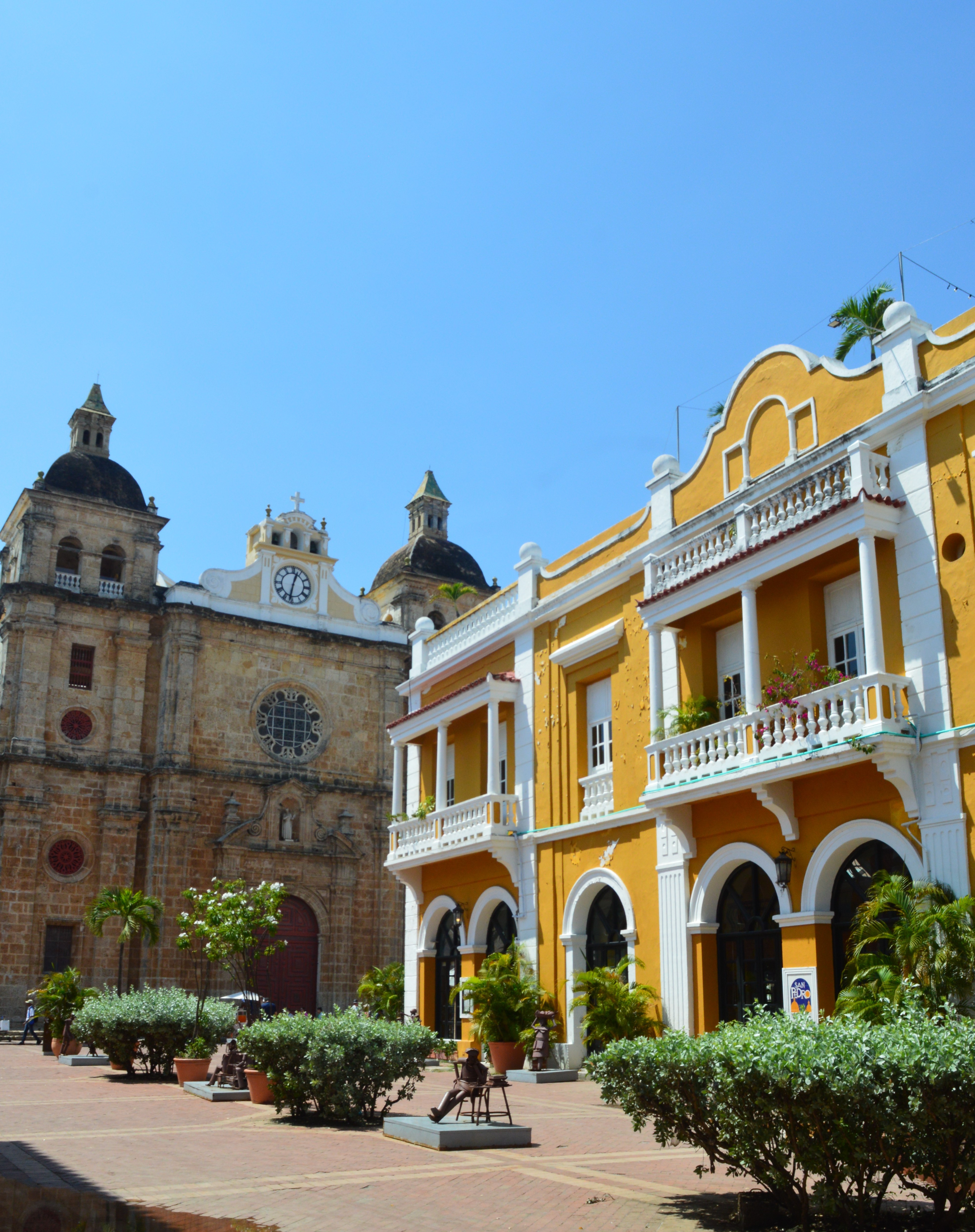
Continuing along Calle 32, the Santuario de San Pedro Claver caught our attention with its double steeple and old stone architecture. The church blended nicely with the bright yellow of the fancy Hotel Casa San Pedro.

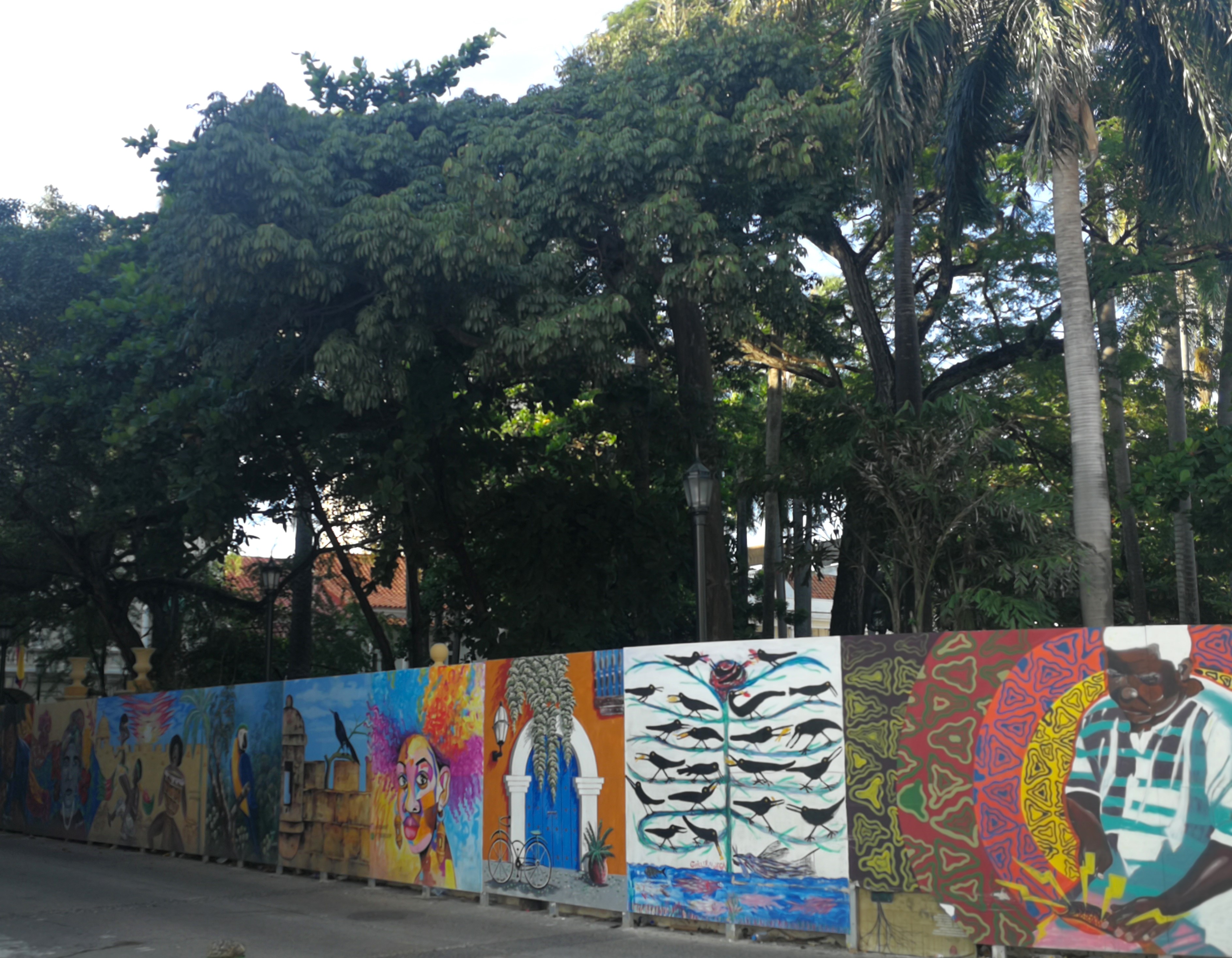
We turned right up the Calle del Landrimal. The street thronged with people as we approached the Plaza de Bolívar. Buskers played in front of park walls painted with beautiful murals and street vendors walked around looking for customers. A Caribbean lady who looked to be in her late 70s smiled gently at the tourists, gesturing with weathered hands at her cart of paper fans. She was quieter than most of the vendors around her, but her presence stood out the strongest to me.

Some of the blogs I’d read about Cartagena had talked of feeling harassed by street vendors and vulnerable to mugging. We prepared for this through the standard travel practice of only carrying the money we needed and wearing money belts under our clothes, and used common sense in not having phones or cameras on show. Some might argue that having a strong man with me helped, but I can truthfully say that as a relatively good-looking woman with naturally very blonde hair, and having experienced a fair amount of street harassment (mostly while living in London), I did not feel unsafe nor harassed in Cartagena. (In fact, this was the case during my entire experience in Colombia.) Street vendors would approach with enthusiastic greetings trying to sell their items, but we found that a polite “Non, gracias” and a gently raised hand to wave them off was enough to prevent them persisting. I would describe the vendors as relentless in their attempts to earn a living, but respectful.

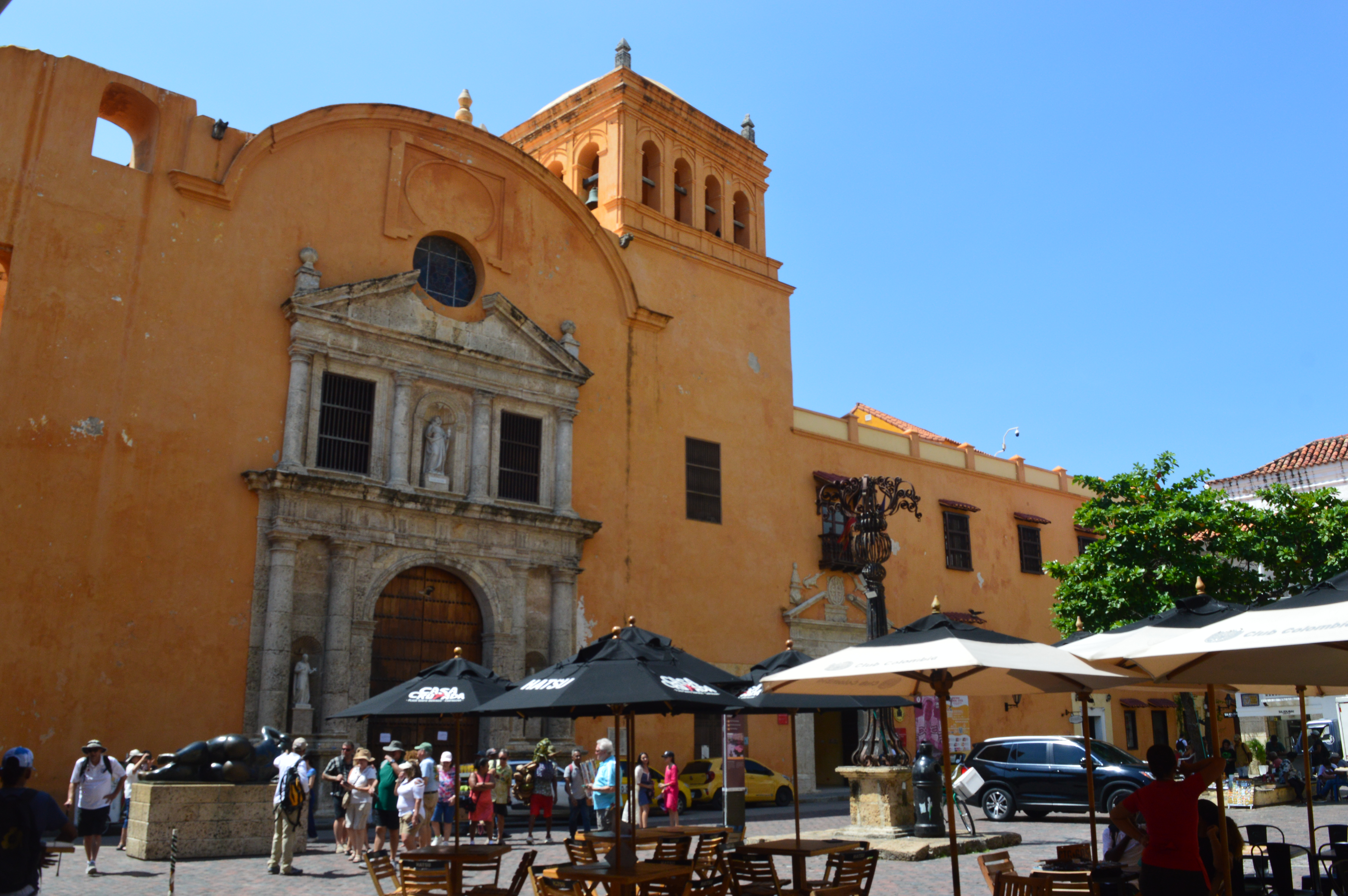
We turned left down the Calle de la Inquisición and then right up Carerra 3. The street led us to the Plaza de Santo Domingo in which we saw a monastery that dates back to the 17th Century.

Continuing along this street, we eventually came to the city wall. I climbed up and took in the ocean view. I knew it would be a great place to watch the sunset, but I wasn’t sure we’d be able to last that long; we had been sipping from a water bottle but the heat and humidity was giving us a light headache.

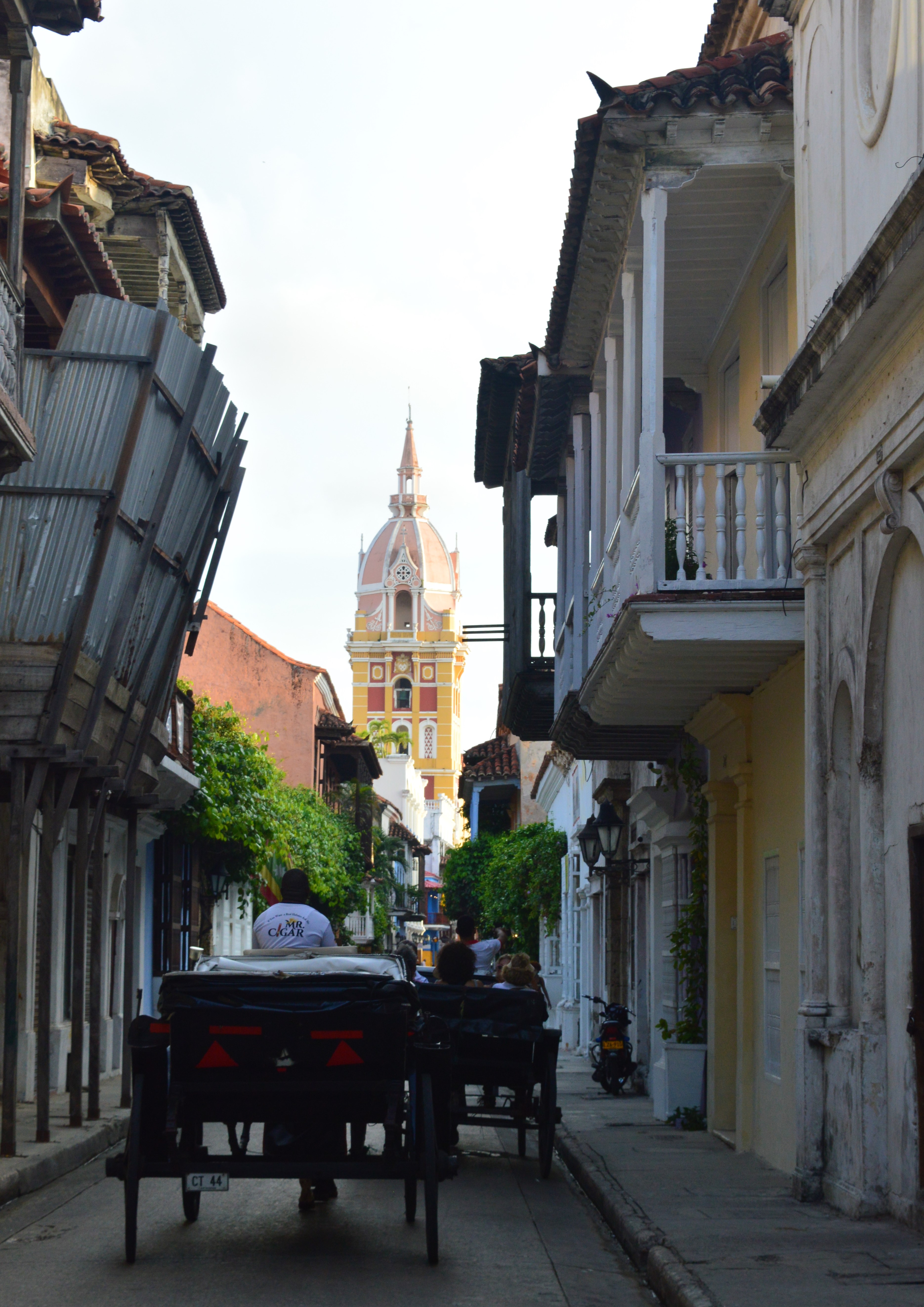
We joined the Calle de Don Sancho, grateful for the slight shade it offered. The stunning Catedral de Santa Catalina de Alejandría rose up ahead. Hearing hooves clip-clopping behind us, we stepped aside to let a carriage pass, led by a lean horse. Caribbean women wearing brightly patterned dresses sat relaxing in a patch of shade. They can be seen around the walled city selling fruit which they carry on baskets on their heads.

After passing the cathedral, we lost our sense of direction. We never bother buying data plans for our phone when overseas, and the Google Maps on my phone was not in sync. After wandering around for 10 minutes with no luck and a decreasing amount of patience, we approached a group of male police officers. I greeted one of them in Spanish. He responded with a smile and pointed us in the right direction to our hotel. We walked up the steps of Casa del Curato drenched in sweat.

After a cold shower and quick nap, we headed out for dinner. Horses trotted briskly through the streets, leading carriages. Located just up from our hotel, La Cevichería was a seafood restaurant I’d read good things about. We took a seat outside, wanting to be away from the noise of indoors. It’s generally advised not to drink tap water in Cartagena, so I prepared to order two bottles. Looking at the menu, I noticed that a bottle of mineral water cost 1000 pesos more than a pint of beer.

As we waited for our food, a street entertainer dressed as Michael Jackson arrived and set up a small stage on the sidewalk in front of us. Hubby and I glanced at each other, wondering if we should have sat inside afterall. The opening to ‘Thriller’ started loudly, startling us in our seats. As the entertainer broke into dance, we looked down at our food, not wanting to get his attention as he hip-thrusted and shamoned away. Our waiter watched from the doorway and grinned at us, evidently expecting that we would enjoy the loud music and random shrieks of “hee-hee!” I wished he had given us a warning.

After finishing his performance, the impersonator approached the diners outside the restaurant and asked for money. I grimaced as he came to our table. My husband quietly shook his head and apologized. I felt awful because this man was just trying to earn a living, but we had not wanted nor asked for what was ultimately a distraction to our dinner.

Upon viewing our bill, my eyes widened with surprise. At 160,000 pesos, it was more than I expected. A tip had automatically been added, and it didn’t seem justified for a disrupted dinner of a dish that was too salty and seafood that tasted like it had just been heated up out of the freezer. Having anticipated paying 120,000 pesos maximum, I had to dash back to our hotel to get more cash from the safe. We left the restaurant disappointed, feeling like we had been ripped off.

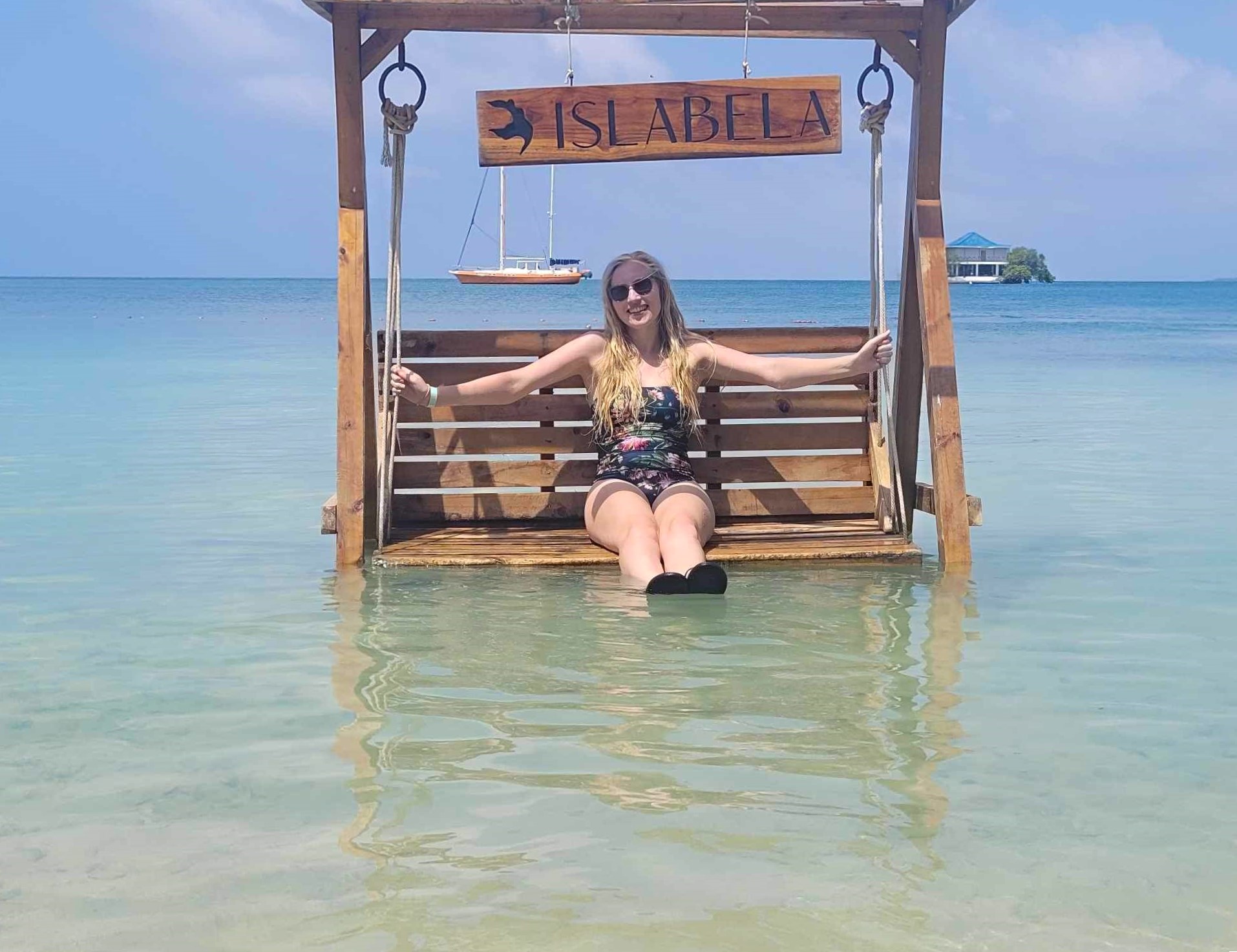
After a great sleep, we got up early. Somehow understanding my jumbled Spanish, the ladies in the hotel kitchen kindly gave us a banana and refilled our water bottle, before we strolled down Carrera 7 to Muelle de la Bodeguita. Keen for a day of swimming in the ocean, we had booked a day tour to one of the Rosario Islands. An archipelago about 36 kilometres southwest of Cartagena, the Islas del Rosario consist of 27 small islands. For a fair price of $200, our tour included the return boat transportation to Islabela Eco Hotel on Isla Marina, plus a welcome cocktail, beach bed (no worrying about others taking yours!), and lunch.

After boarding the boat, we were given lifejackets and the captain gave a briefing in Spanish. As we slowly passed through the harbour, hubby observed with interest a navy ship that carried the Finnish flag. The boat began to pick up speed as we entered wide ocean. Soaring through the sky were slender dark birds with long wings that formed an interesting shape. Looking like pterodactyls from the dinosaur age, they were quite fascinating to watch.

During the one-hour journey, I watched the water hoping to catch sight of some dolphins. Flying fish sparkled in the air as they dove up from the surface. Eventually we came to a small bay with turquoise-blue water. Friendly staff greeted us as we walked towards a collection of rustic umbrellas standing over beach beds in front of a small sandy beach. We dove in the ocean as fast as we could, and it was delightful. For lunch we had fried red snapper and coconut rice with salad, accompanied by a large jug of delicious iced tea. Tour participants had the option to pay extra to go snorkelling with a guide, but we were conscious of funds and felt content with doing our own thing.

The day was so relaxing and a welcome change of pace to balance out the hustle and bustle of Cartagena’s walled city. We spent a lot of time in the ocean, wanting to make the most of the opportunity to experience the warm Caribbean Sea. I observed an American couple avoid the water, instead taking work calls on their beach bed as a waiter from the resort brought them a burger and fries. It seemed like such a waste.

At 3 p.m., a bell signalled that it was time for us to return to the boat. The sun was starting to lower in the sky as we made our way back to Cartagena. Hearing the word “propina” in his final comments, I gave the boat captain a small tip and we headed back to our hotel.

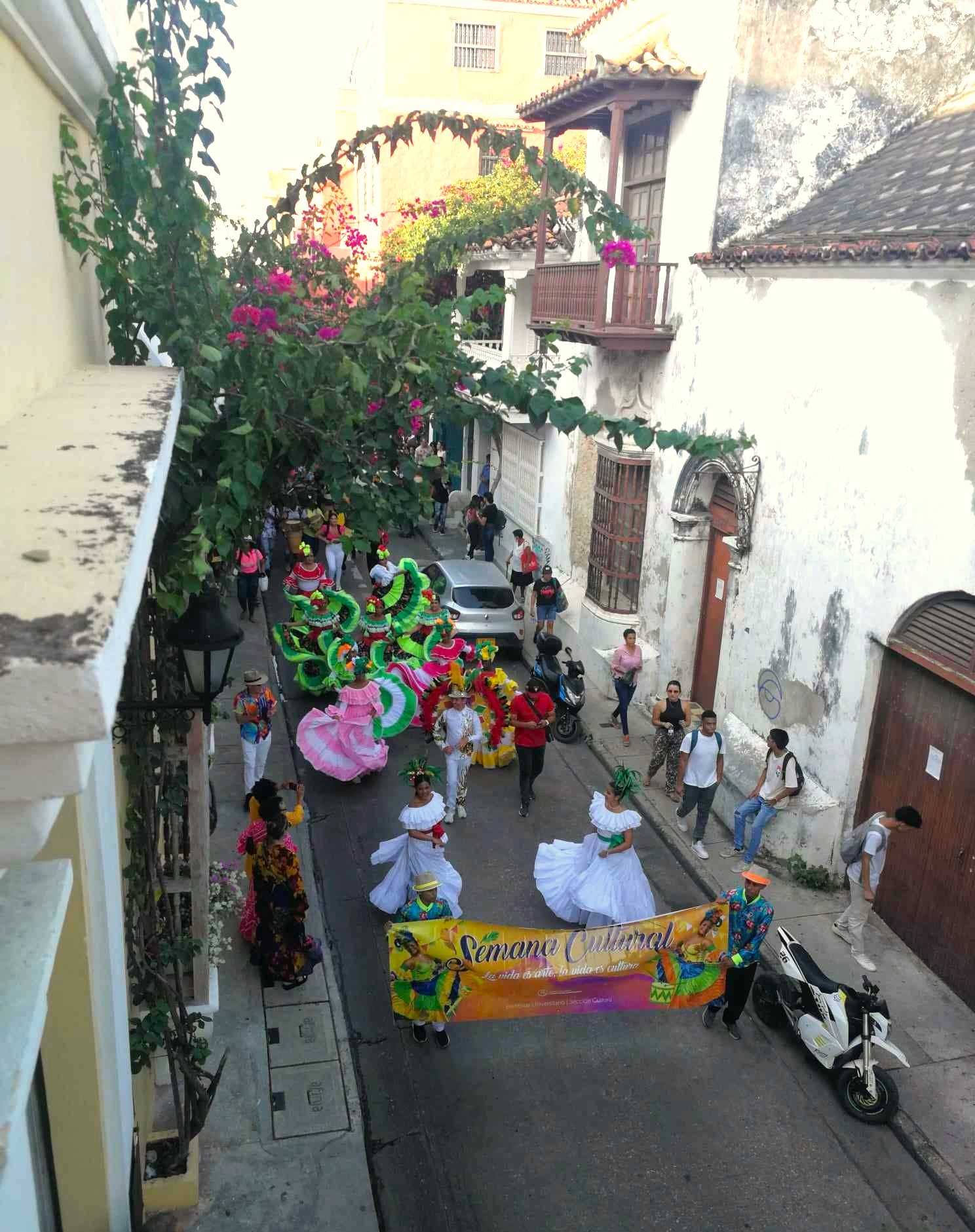
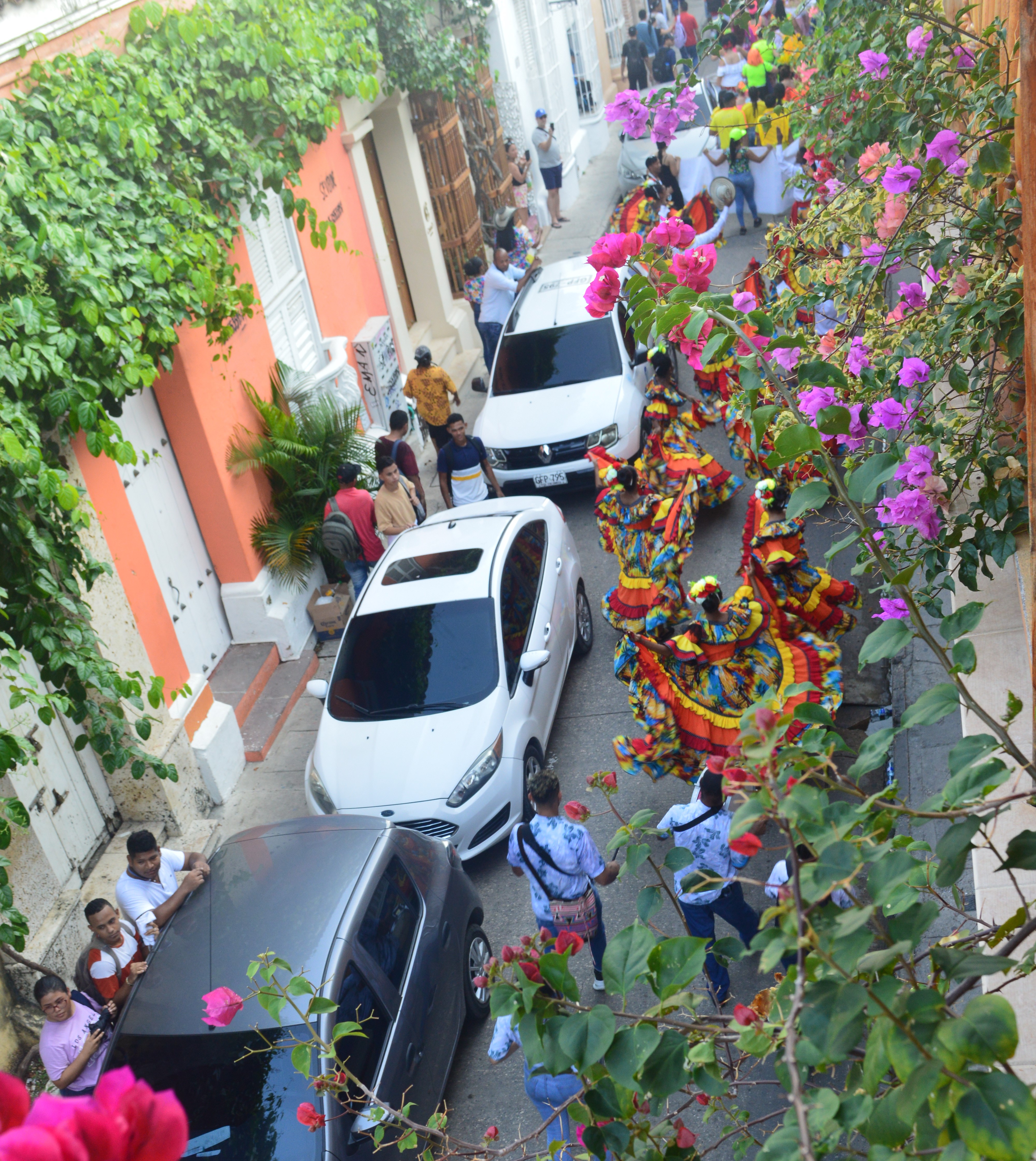
A stage had been set up in the Plaza de los Coches and a crowd was starting to form. As we walked up Carrera 7, we heard singing and drums beating. On approach to our hotel, a colourful procession came down the street, dancing and smiling as onlookers cheered and clapped. Our doorman was standing on the steps of the hotel, watching. I asked him what was happening. It was difficult to hear him above the noise, but I heard the word “carnaval.” I hurried upstairs to the balcony of our room and watched, entranced, as women wearing dresses with bold colours and vivid patterns danced in tandem, twirling in circles and swishing their skirts.

I had one of the best views in the house and I wasn’t even sure what it was for. But a quick bit of research told me that students from local colleges were participating in a cultural week – early festivities ahead of the official celebrations that take place each November to commemorate Cartagena’s declaration of independence from Spain. I felt so lucky to witness this special event, filled with vibrant colours and joyful faces. It was probably the highlight of my time in Cartagena!

The next day, we left Cartagena and travelled south-east to the small town of Santa Cruz de Mompox, before returning to Cartagena two days later. As we re-entered the city on a Sunday afternoon, I watched through my window as a lady around my age with crooked posture collected glass bottles and tin cans from a garbage bin and put them in a bag. Her son sat nearby, looking no older than five years old. He picked up an empty plastic Starbucks cup from the pavement and played with it in his hands, as if it were a toy. I looked away with a pulling in my chest, picturing children in Canada with their pretty dolls and shiny lego.

Our hotel for the third night of our stay in Cartagena was Hotel 3 Banderas, one block east from Casa del Curato. It stood on a pretty street of pastel-coloured houses and hanging blooms.

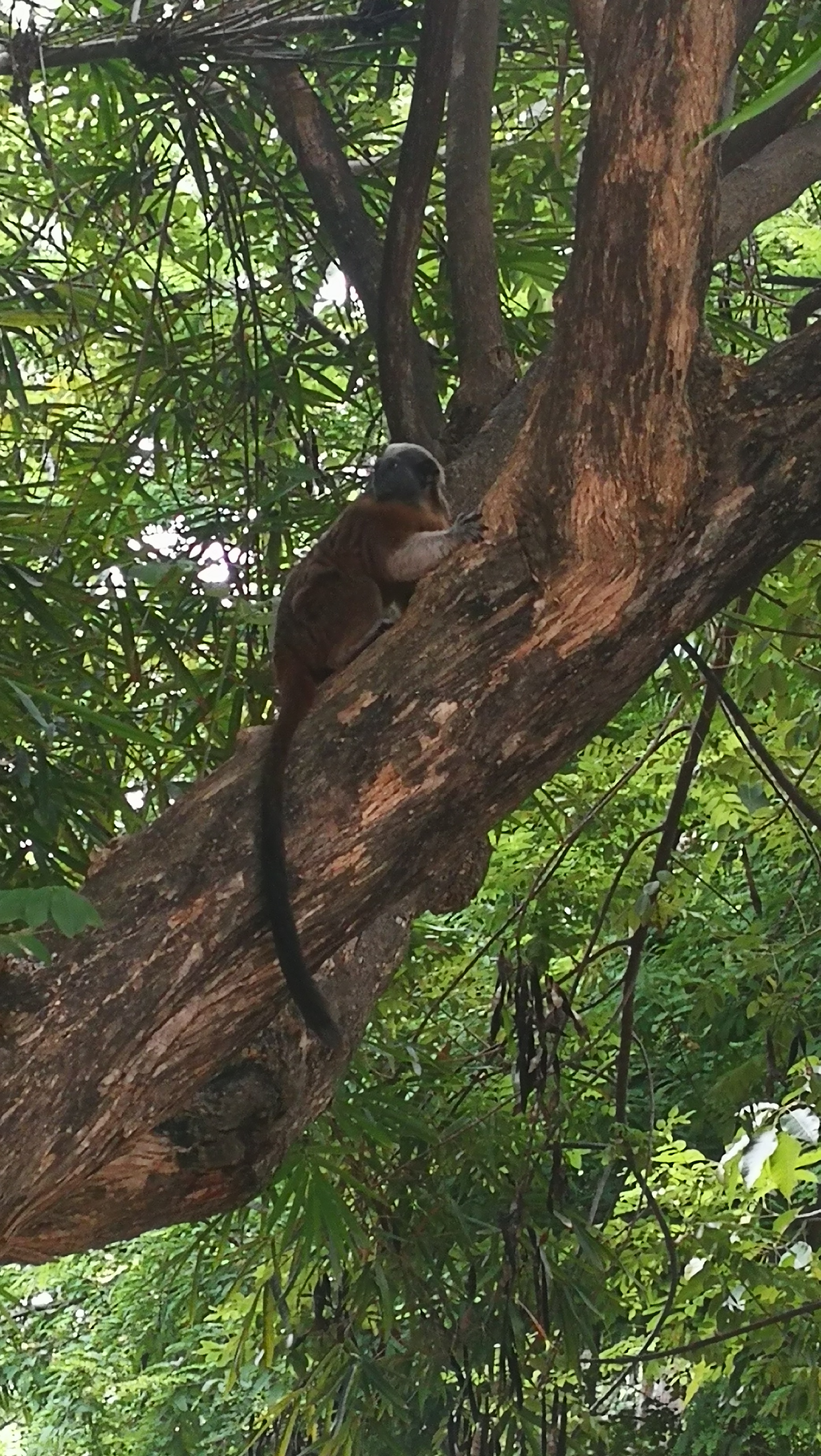
Wanting to avoid any overpriced restaurants, we went for tacos at Los Tacos del Gordo – a small, casual eatery on Carrera 7. We then wandered down to the Parque Centenario where we were fortunate to see several marmosets in the trees, scampering along branches playfully. Someone told us there were a couple of sloths in the park as well, but they are notoriously difficult to see without binoculars.

After spending several minutes admiring the monkeys, we walked out the opposite end of the park and down Calle 31. We were now in the neighbourhood of Getsemani, described on a few blogs I’d read as the somewhat grungier, more “hipster” part of the city. I went in with an open mind but did agree it had a slightly rougher feel to it, similar to looking at London, England, and comparing Peckham with Covent Garden.

A portion of Calle 31 is known as Calle de Las Sombrillas because of the canopy of umbrellas that hang above the street. There are a few of these streets in the neighbourhood, and as you can imagine, they are very popular with Instagram lovers.

Rappers made rhymes as we walked up streets showcasing colourful artwork. After taking a look at the Plaza de la Trinidad, we headed back down through the Parque Centenario (the monkeys were too cute to not see again!). The Torre del Reloj was still surrounded by tourists as we made our way back to our hotel.

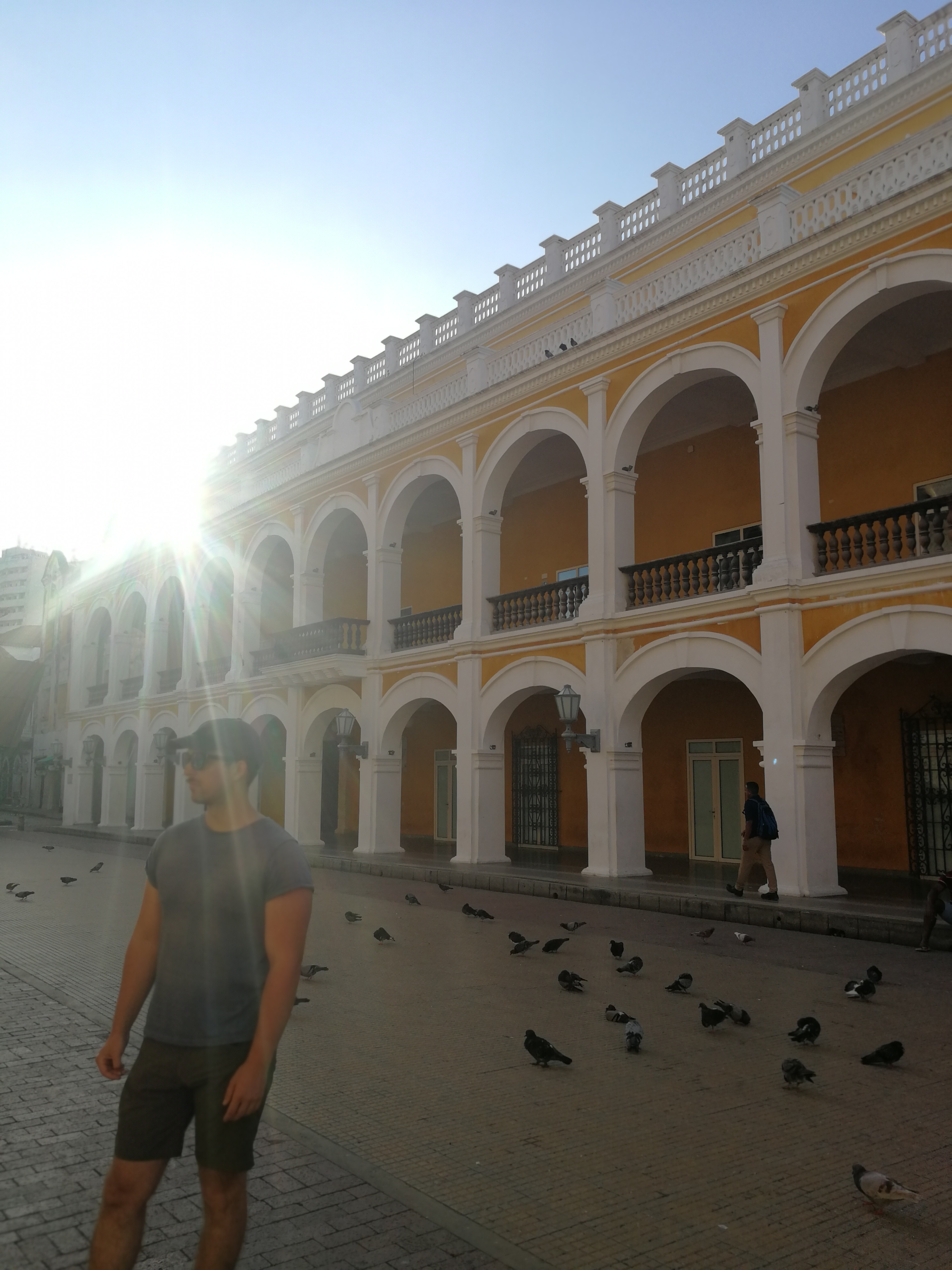
We woke early on our final morning in Cartagena, prepared for an upcoming flight to Panama City. A decision to take a final stroll of the hotspots turned out to be an excellent choice, because at 7 a.m., the city was empty. No tourists, no vendors. We revisited some of the places we had passed by previously, this time able to take a longer look. With no disruptions and a more tolerable temperature, we could greater appreciate the beauty of the architecure and art work inside this walled city.

Grateful for an unexpected 30 minutes of peaceful exploring, we returned to our hotel to pack up our things before heading to the airport. I left Cartagena glad that I got to see it for my own eyes, but reminded that there is always more to a city than what the photos show.

Cartagena was a vibrant city painted with various colours. The walled city was abundant with rich, happy tones – sights that most tourists would see and remember. But it was also speckled with muddy spots – small details that some tourists wouldn’t notice, but that caught my eye and were hard to forget. And on the outskirts of this tourist haven was a greyer canvas that illustrated scenes of struggle and misfortune.

Price-wise, Cartagena was a city that seemed to take advantage of its popularity with tourists. This left me conflicted – in some ways frustrated; in others, mindful that the residents here don’t have much. The prevalence of street vendors caused a complex array of emotions – sometimes sympathy, sometimes annoyance, sometimes sadness. But the strongest emotion was probably admiration, for their tenacity to keep doing what they could to provide for themselves and their families.

A few bloggers I’d read had said Cartagena was not their favourite place to visit in Colombia, and after my own experience, I can say I feel the same. I do not regret visiting it at all; it’s a vibrant city with a Caribbean culture that permeates through the streets, and overall I enjoyed witnessing the different customs and ways of life. The architecture within the walled city is beautiful and certainly worth seeing, and a trip (ideally an extended one) to the lovely Rosario Islands is a must if in the area. However, in any country, the most touristic cities generally do not give the most authentic representation of a country’s culture. To get a better glimpse of the “real” Colombia, it would be wise to combine a visit to Cartagena with time in smaller, quieter towns and communities.

Unknown's avatar

A Local’s Guide to Spending 3 Days Around Oak Bay, Vancouver Island

If you’re spending time in Victoria on Vancouver Island and are looking for places to visit outside of the downtown hub, this guide is for you. For those that enjoy recreation and nature and don’t have a car, there are several interesting neighbourhoods to explore on foot outide of the city centre.

Located on the traditional Indigenous lands of the Songhees Nations, the localities of Gonzales, Oak Bay, and Uplands can all be considered affluent neighbourhoods. With leafy streets, pretty parks, ocean views, and sandy beaches, they are pleasant areas in which to unwind and enjoy island living.

Read on for ideas on how to spend 3 days in these picturesque neighbourhoods.

Day 1:

After enjoying a sleep-in, head to Good Earth Coffeehouse on Oak Bay Ave for a quick breakfast. It’s here that a friend introduced me to vanilla rooibos lattes. I’m not a huge tea drinker but these are delicious if you’re looking for something without caffeine.

After breakfast, walk down Foul Bay Road, admiring the grand houses and saying hello to the deer that can often be found snacking on someone’s lawn. At Crescent Road, cross the crosswalk and turn left. Shortly on the right, there’ll be a small parking area. Some stairs lead down to Gonzales Bay, a sandy beach that makes a good spot for an ocean dip and ball games. If you were to wake up and see this beach for the first time, you’d be forgiven for thinking you were in California. The sight of snow-capped mountains in the distance across the ocean will remind you that you’re further north! I recommend visiting Gonzales Bay on a weekday as it’s a very popular beach during summer weekends.

Gonzales Bay

After you’ve had your fill of beach time, head back to Crescent Road and continue right. The road becomes King George Terrace as you walk up a hill that winds to the right. After a couple hundred metres, you’ll come to a rest area with parking spaces. If you feel like it, follow the path down to Trafalgar Park for a breezy view of the ocean.

From here, continue along King George Terrace as it winds downhill. Once the road flattens and it’s safe to do so, you’ll want to cross to the other side. Just next to the start of Sunny Lane is a narrow footpath that leads up to Walbran Park. The path involves a set of stairs and is quite a workout (not accessible for wheelchairs, sorry!) At the top, cross the road and follow a path to the viewing platform. The panoramic vista that includes views of the San Juan Islands of the US will be worth the thigh burn from the stairs!

Views from Walbran Park

If you feel like returning here during your trip, Walbran Park is an excellent spot to watch a sunset!

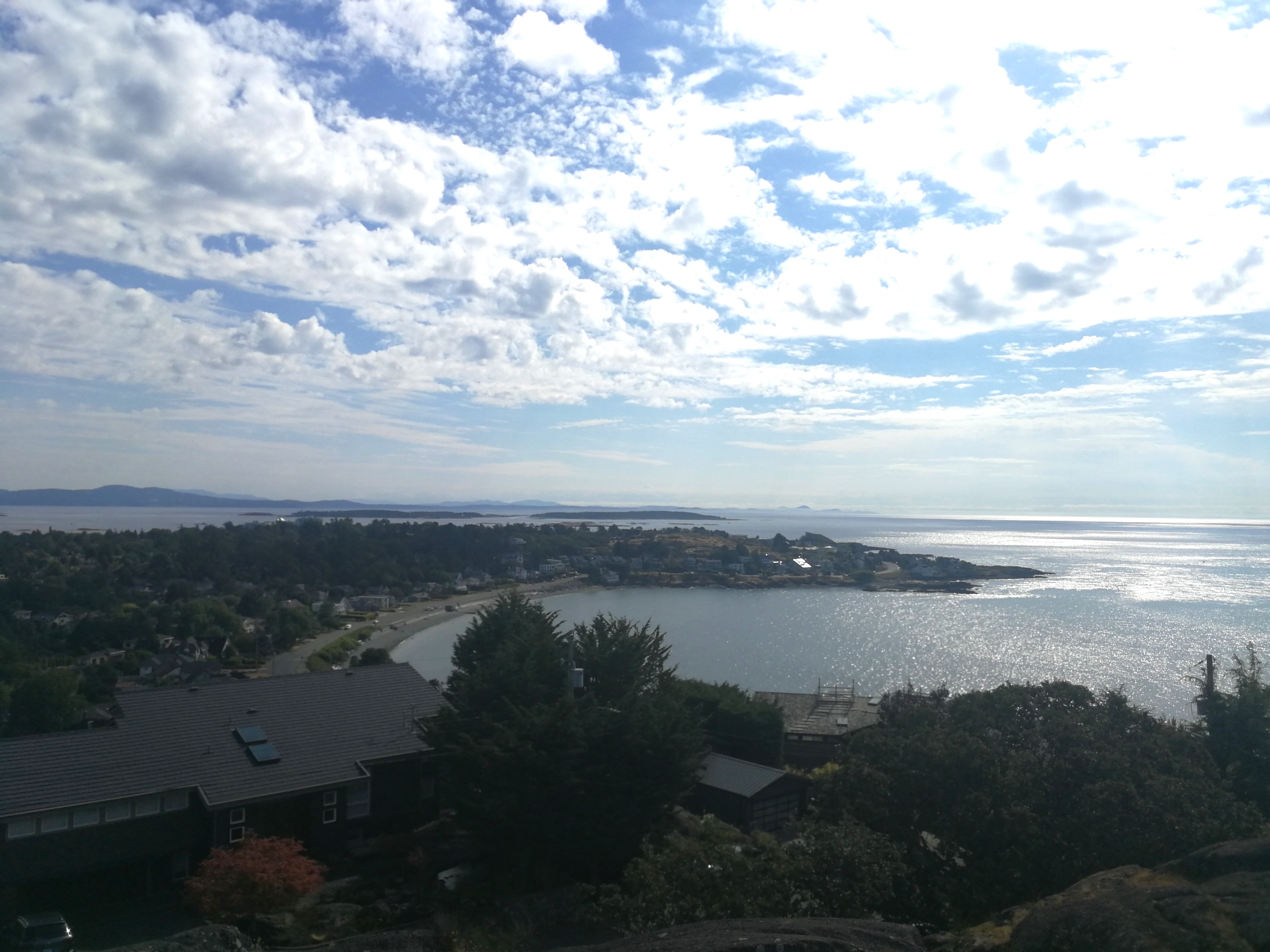
From this park, you can continue onto another nice viewpoint by walking left along Denison Road. After a few hundred metres, you’ll come to the entrance of Gonzales Hill Regional Park. Home to a striking white observatory, there are great views of glittering ocean, the leafy neighbourhoods of Fairfield and James Bay, the Westshore communities, and distant mountains of Sooke.

Views from Gonzales Hill

After all that walking, it’s time for a break and some cake! Exit Gonzales Hill via the path down Fairfield Place and, once on Fairfield Road, cross and walk down towards Foul Bay Road. On the right you’ll see an entrance to the Abhkazi Gardens, open everyday 11am-5pm with entry by donation. While they don’t have the same size and splendour as the world-renowned Butchart Gardens, these gardens are a lovely, tranquil place to wander through, without large crowds and the constant click of cameras. You might even see the small turtles by the pond!

The Teahouse within the gardens offers a few different menu options for high tea, provided in a cozy and non-pretentious setting. I had the afternoon tea last year and it was delicious! The final tea sitting is at 4pm. (Note that there is a dress code.)

Day 2:

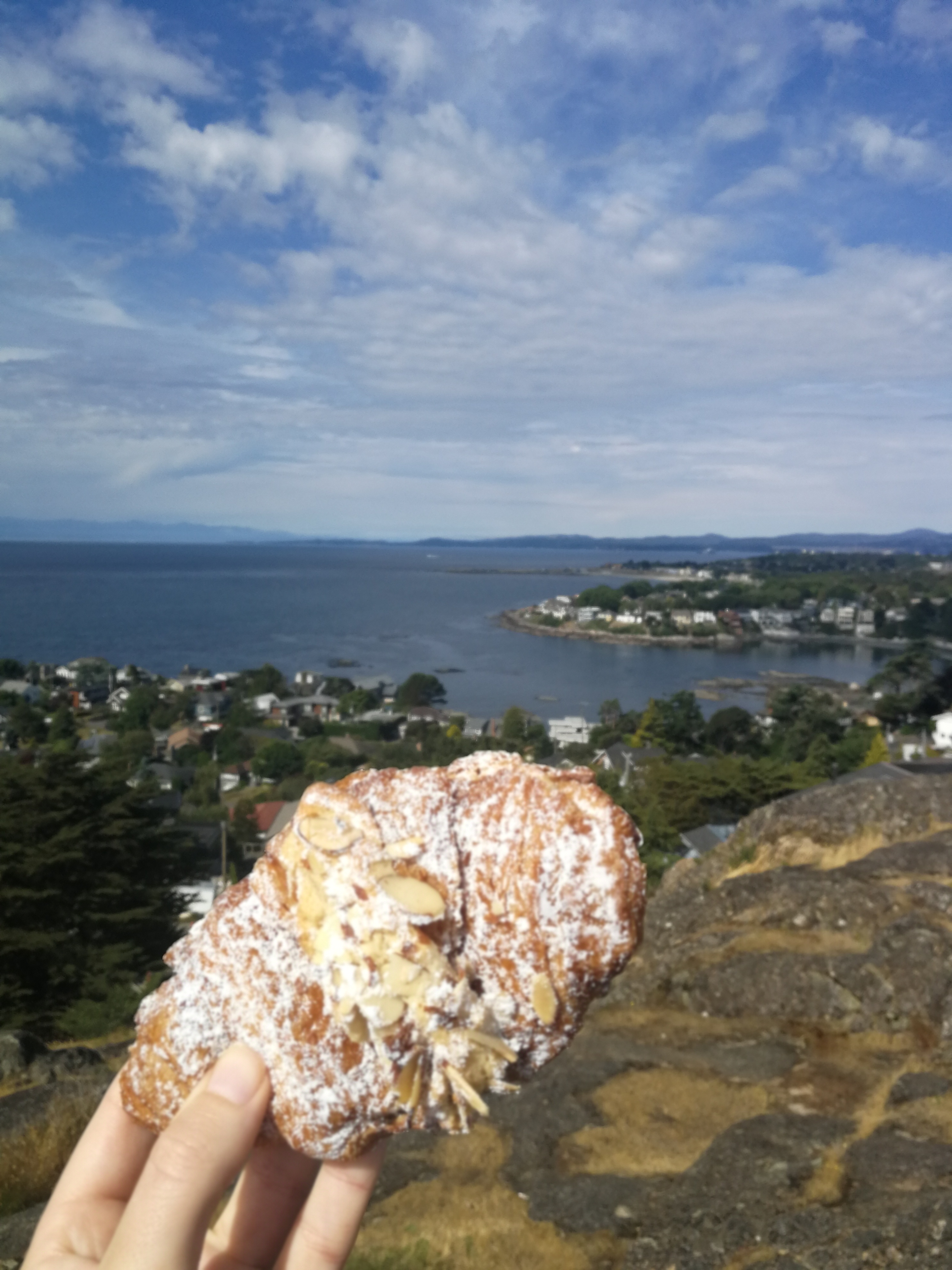
Start your day by stopping at Demitasse Cafe & Garden Centre on McNeill Ave. As well as selling plants, this sweet little cafe has yummy savoury and sweet pastries, including gluten-free options. The double-baked almond croissant is one of my favourites. Fun fact: if you read my book, this cafe is featured a few times in part 3!

From the cafe, walk south down Hampshire Road, turn left on Lafayette St, and then turn right down Monterey Ave. The road will lead you to Beach Drive with McNeill Bay in front of you. This wide pebble beach is popular with dog walkers, but not so popular for swimming due to the prevalance of seaweed and fairly choppy waves.

Walk along the esplanade before turning left up Transit Road. After a hundred metres or so, there’ll be a sign on the right indicating the Centennial Trail. Follow the narrow path that’s cloaked by trees and you’ll come to Anderson Hill Park. Looking over NcNeill Bay, it’s a good place to sit and eat your almond croissant!

Breakfast with a view!

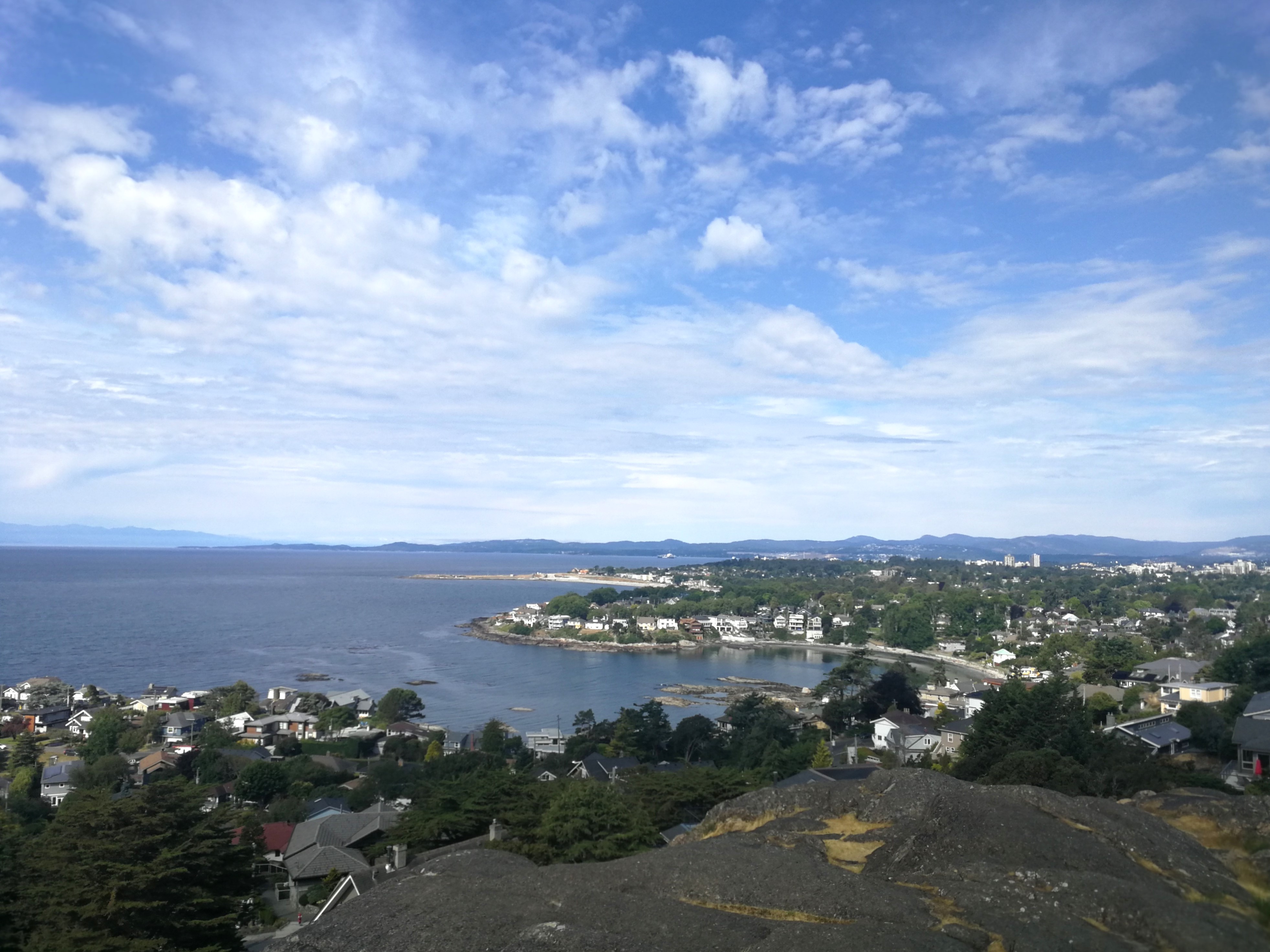
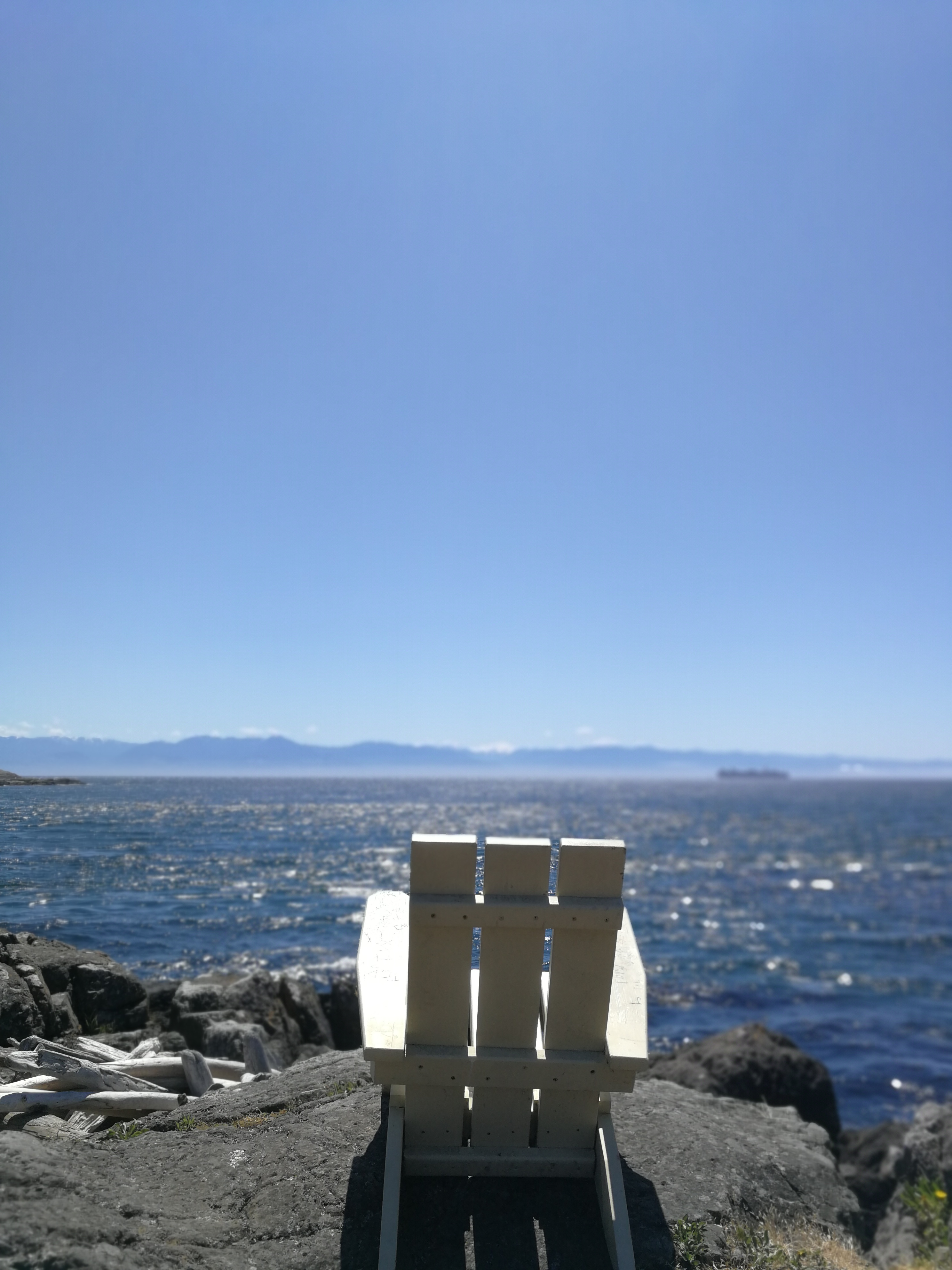
Go back the way you came down Transit Road until you return to Beach Drive. Cyclists will often pass by (some panting more than others!) as the road winds uphill to the right. At a rest area, you’ll see a small pebble beach below and some rocky bluffs with a few wooden chairs on top. This area is called Kitty Islet. Follow the path down and take a seat to enjoy a couple chapters of a book or watch the boats go by.

Views from Kitty Islet

Once you’re ready to move again, continue along Beach Drive. Soon you’ll be surrounded by the neatly manicured lawns of Victoria Golf Club. Enjoy the ocean and mountain views as you walk – just keep an eye out for flying golf balls!

Beyond the golf course, you’ll eventually pass Oak Bay Beach Hotel, popular for it Boathouse Spa. A few years ago, some coworkers kindly gave me a gift card which I used to book a massage. At the time, guests received complimentary access to the sauna and mineral pools after their treatment. Now you have to pay an additional $30 to access them. If you have the cash to splash, I recommend booking yourself an appointment for a true self-care treat. Alternatively, you could stop for some lunch in the Hotel’s Faro restaurant, which specializes in Neopolitan-style pizzas.

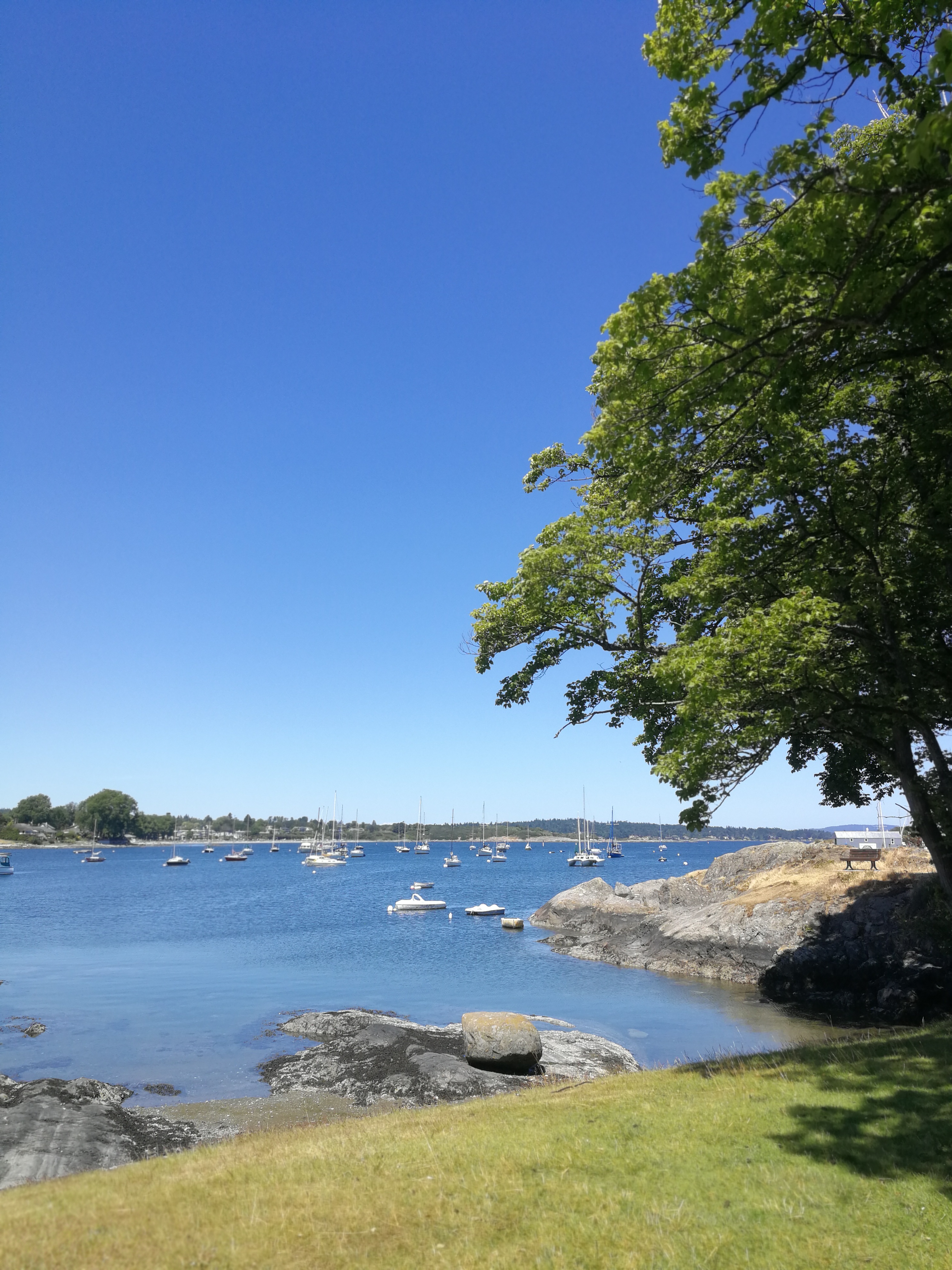
Continuing along Beach Drive, the interestingly named Turkey Head Walkway is by Oak Bay Marina. Seals can often be seen swimming by the shoreline. Around here, you can book a fishing charter or rent a kayak or canoe to explore the calm surrounding waters. A little further along is Queen’s Park – a pretty, grassy park good for picnics, reading, or just enjoying the view of boats bobbing up and down.

Queen’s Park

When you continue along Beach Drive, you’ll pass a shallow bay and then see Haynes Park on your right. Turn left up the crosswalk away from the park and follow the path that goes up some steps and joins Oak Bay Ave. This bustling main street has many businesses to keep you entertained – a chocolate shop, florist, garden centre, art shop, bike shop, and fashion boutique to name a few. You’ll often see retired locals sitting with their dogs outside a coffee shop, chatting away. Popular dinner options include the Penny Farthing Pub, Vis-a-Vis, Bon Sushi, Deadbeetz Burgers, and Tapas on Oak.

On the second Wednesday during the summer months, the Avenue comes alive with Oak Bay Night Market. Live musicians play as local vendors sell crafts, jewellery, art, jams, honey, cheese, and more. A barbecue sizzles and food trucks sells various dishes, from Greek wraps to poutine to curries.

Day 3:

Grab a beverage and breakfast item to-go from Pure Vanilla Bakery on Cadboro Bay Road, or alternatively, sit down for a meal at The Village restaurant on Estevan Ave. I haven’t eaten at The Village myself, but everyone I know that’s eaten here has said good things.

Continue down Estevan Ave and the sight of sparkling water will come into view. This is Willows Beach, one of Victoria’s most popular places for sunbathing, picnics, paddleboarding, and an ocean dip. Runners will often jog along the esplanade and on an evening, seals might pop their heads up out of the water curiously. On a clear day, Washington’s Olympic Mountains rise up formidably in the distant west. The beach area also has a playground and public washrooms. Dogs are not permitted on Willows Beach between May 1st and September 30th. If you visit outside of this season, you can enjoy the sight of dogs galloping gleefully along the sand, making furry friends.

After catching some rays and having a splash, wander east along the espalanade and walk up the stairs. Following the path to the right takes you to Cattle Point. Where does this name come from, I hear you ask. Well, during the late 19th Century and early 20th Century, this area was the destination for unloading cows from steamships, and the cows would swim a short distance to shore (a funny image to picture, I know!) No cows are unloaded today and instead there is a boat launch. The east side of Cattle Point looks out towards Cadboro Bay, the next neighbourhood along. On a clear day, you’ll get a striking view of Mt. Baker in Washington State.

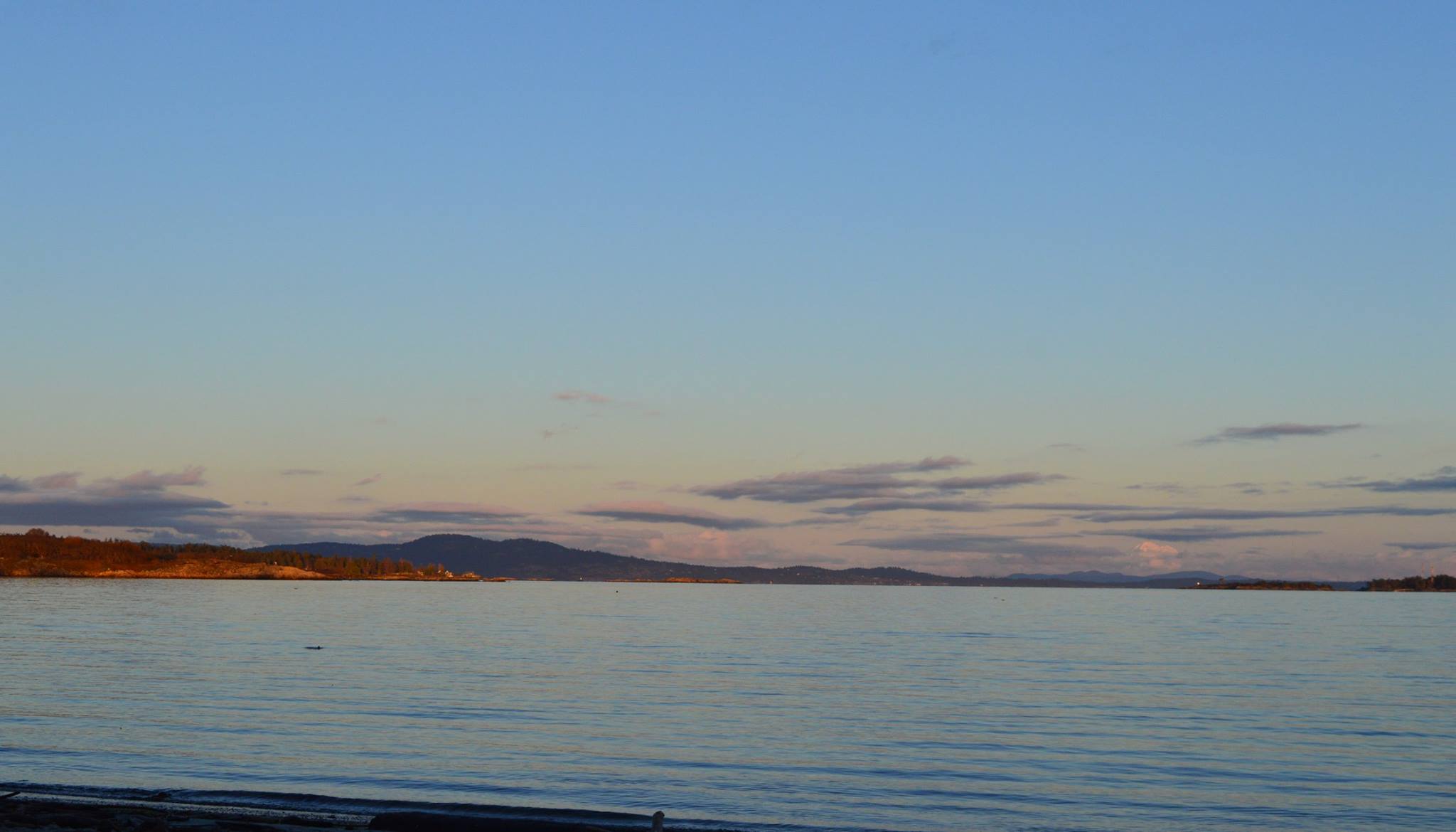
Willows Beach and Cattle Point are pretty places to visit during the evening, with the sky turning a soft lilac as the sun goes down. They are regularly featured in my book!

Evening view from Willows Beach

Cattle Point is part of Uplands Park. If you follow the loop round until you rejoin Beach Drive, across the road you’ll find an entrance to the main section of the park. It’s a peaceful oasis with various flat trails through Garry Oak meadow. Whenever I come here, I think it would be a great location for an engagement shoot or wedding photos.

For lunch, walk back along Beach Drive with its million-dollar houses and turn right back up Estevan Ave. Willows Galley is a family-run fish and chip shop open 12pm-6pm except Mondays and Tuesdays. As someone who comes from the country of fish and chips, I can confidently say I approve! The menu also includes burgers, poutine, and ice cream. Just up the road past Musgrave St is Lokier Garden, a quiet setting in which to enjoy your meal.

Within Estevan Village there is a florist, jewellers, barber shop, women’s gym, and clothing consignment store. You’re bound to see customers outside the popular Ruth and Dean bakery and cake shop, and near here is Bungalow gift shop which sells a variety of items including home decor, stuffed toys, soaps, and cards.

When it comes to dinner plans, Nohra Thai Kitchen on Estevan Ave has excellent reviews, as does the nearby Taiwanese restaurant AsUsual Cafe. Another option is the fancy farm-to-table restaurant Sedona, on Cadboro Bay Rod. Otherwise, The Old Farm Market on this road has a good selection of local products if you’d like to make your own dinner.

*

If you’re planning a trip to Victoria, I hope you’ll give yourself a few days to explore some of the neighbourhoods outside of the downtown core. I’ve lived in or around Oak Bay for most of the years I’ve lived in Canada, and the places I’ve mentioned in this post never lose their charm. If you like going for walks and finding scenic views, you’ll love exploring these areas!

Unknown's avatar

How to Spend a Rainy Day in Victoria, BC

You’ve arrived in Victoria for a couple of days and it’s scheduled to rain on your first full day. With its many forests, lakes, and mountain views across the Pacific Ocean, Vancouver Island looks beautiful in the rain. But if you don’t have a car with you, what can you do?

Luckily, there are many options to keep you entertained in the downtown core of British Columbia’s capital city.

The first decision of the day is breakfast. Victoria has many great breakfast and brunch options, including Jam Cafe and Blue Fox Cafe. The problem is, because these restaurants are so popular, you often have to wait in line. If the lineup continues once you have your table, you might feel somewhat rushed to eat quickly so others can get inside (or maybe this is just me?). These restaurants are also quite small and can feel a little crammed.

For a relaxing sit-down experience in a light and spacious environment, consider Fathom Restaurant inside the Hotel Grand Pacific on Belleville St. At the time of writing, the menu includes avocado toast, coconut chia pudding, tiramisu pancakes, chorizo and bacon hash, salmon and shrimp tartine, and more exciting options. If you’re less of a sit-down breakfast person, the Hotel is also home to the cozy Courtyard Cafe which sells various warm beverages, smoothies, sandwiches and baked goods (all made in house) in a friendly, quiet atmosphere.

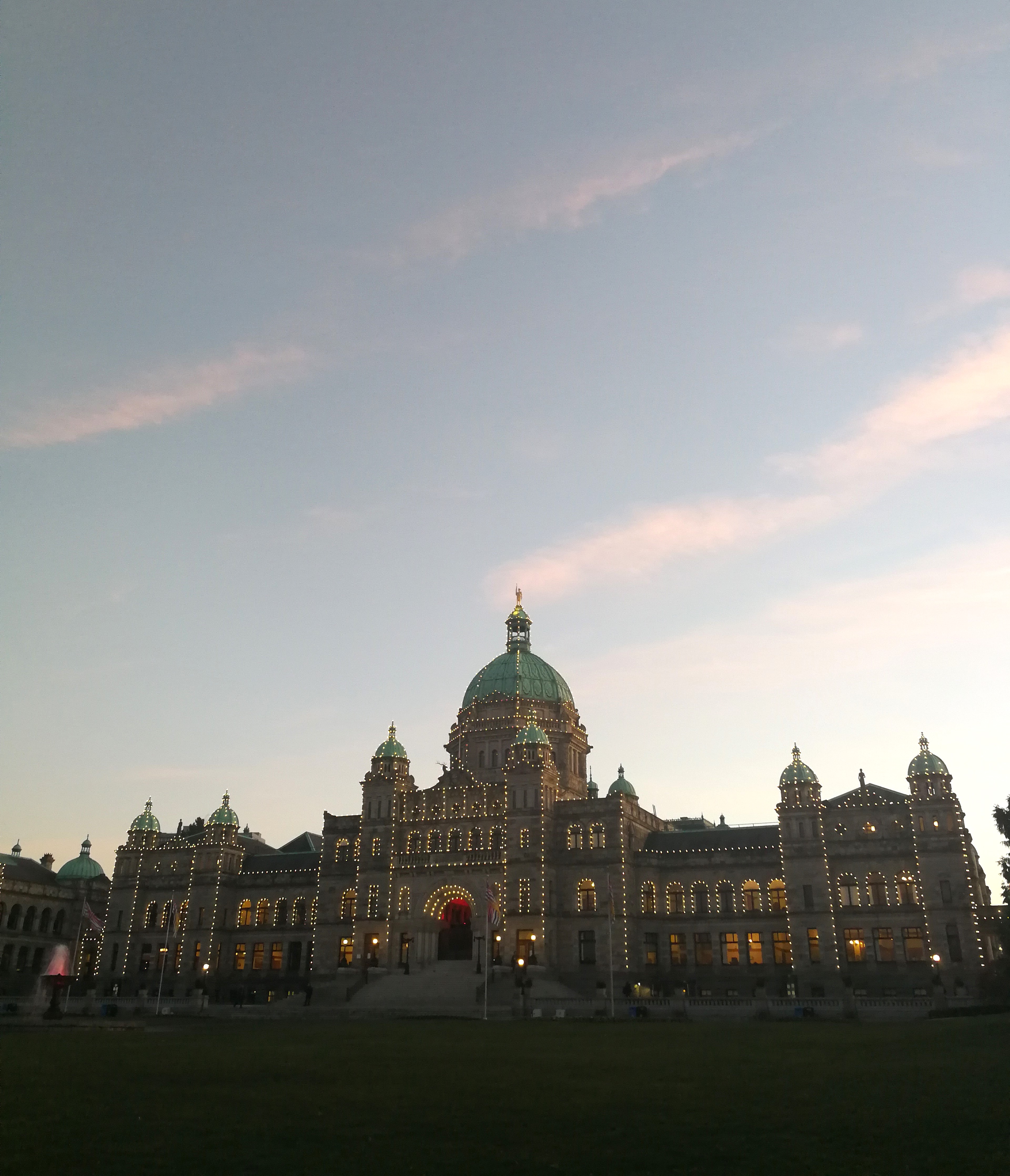
If you’re visiting Victoria during a weekday, consider taking a tour of the BC Legislature located next to Hotel Grand Pacific. You can go self-guided or join a guided tour. Times are posted on the legislature’s website. Be aware that visitors are required to go through security screening before entering the building. Unknown to many, the parliament building also has a small dining room with some tasty food for great prices.

The BC Legislature on a clear evening.

Also located on Belleville St is the Royal BC Museum. A lovely space, it hosts various exhibits and its large IMAX theatre features interesting documentaries that showcase Indigenous culture and the beautiful wildlife and landscapes of British Columbia.

From the museum, you can walk through the gardens of the famous Fairmont Empress Hotel and up Douglas St before turning right up Fort St. On this block there are a load of great local shops to peruse. You could spend hours browsing the book shelves at Russell Books, and plant lovers will like Brown’s the Florist. Just opposite, The Papery sells beautiful cards, journals, calendars, and craft decorations. If you’re looking to buy household and cosmetic goods that contain less plastic and are made more sustainably, The Good Planet Company sells various items including candles, bed linens, dish cloths, soaps, food containers, and more! Even if you’re not buying, it’s worth visiting this shop just to feel inspired by the various consumer options that are better for the planet. Just up the street, you can build your vinyl collection at Ditch Records & CDs, and across from here, Oscar & Libby’s is a great place to buy gifts for someone that likes puzzles and games.

By now, you might be ready for some lunch. In this block of Fort St, you’re in a prime area to try food from various cultures. Fans of Vietnamese cuisine can try Pho Boi, Burger Crush has a small menu that’s done well, and La Taqueria offers a more authentic Mexican menu (and strong margharitas!). A short stroll down either side of Blanshard St also opens up more options, including the Italian Deli that makes delicious paninis and sells imported goods, and a couple of ramen and Korean restaurants. For a sweet treat, the award-winning Crust Bakery on Fort St is known for its delicious pastries (blueberry custard is a must-try!) while the nearby Dutch Bakery offers special chocolates and cakes. (If you like marzipan, almonds and whipped cream, you’ll love the Dollar Roll!)

From here, you can head to Yates St by crossing through St. Andrew’s Square on View St. If you have any room left in your stomach while inside this small mall, you’ll probably be tempted by the smells from Empire Donuts, as well as the freshly made soup from Soupa Cafe.

Yates St is home to the Interactivity Board Game Cafe. Bring your friend(s), choose a game, and play away. You can also order food from the menu, which includes a long list of milkshake flavours. If boardgames aren’t your thing and you’re more of a pool person, you could spend a couple of hours at Peacock Billiards on Blanshard at View.

If you’d rather not do anything and just want to switch off for an hour or so, Sapphire Day Spa is on View St, while The Spa Magnolia on Courtney St is considered a luxury spa accomodation.

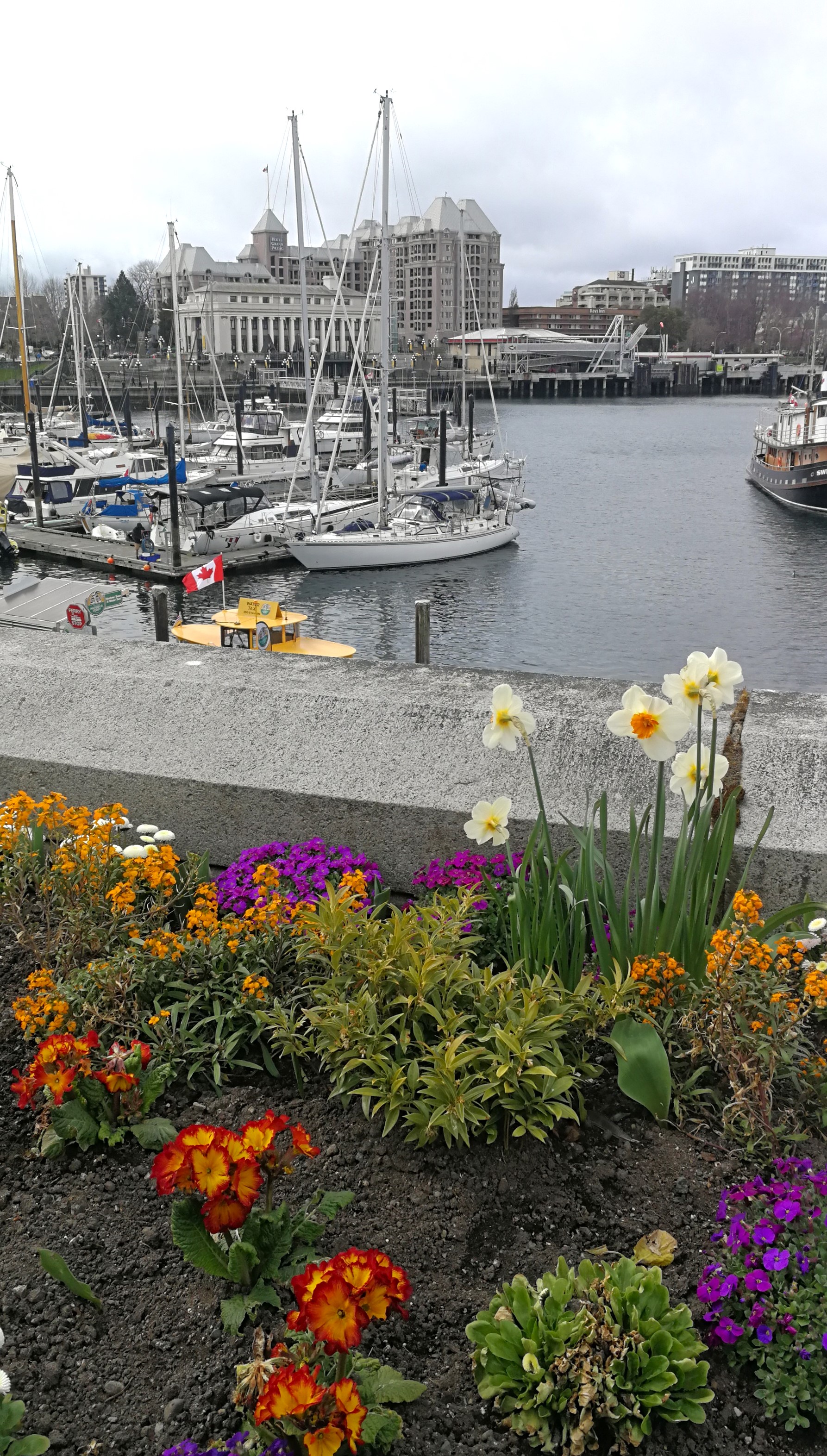
Victoria’s Inner Harbour

If you want to give your feet a rest and get out on the water, consider booking a tour with Victoria Harbour Ferry. This 45-minute tour in a sweet little water taxi shares information about the homeland of the Esquimalt and Songhees First Nations, the development of Victoria as a city, and its naval history. You might see some sea otters and seals in the harbour. Even orca whales sometimes make a brief appearance! Visit the Victoria Harbour Ferry website for more information.

Locals love Victoria for its thrift stores, and there are many to choose from. Value Village on Store St is probably the biggest, but if you’d rather have your money go towards a non-profit, choose Women In Need on Pandora Avenue or the Salvation Army on Johnson St. You can find some great bargains!

When it comes to dinner, there are so many good choices in the downtown core that aren’t part of a chain. If you’re vegetarian or vegan, there’s Rebar near Bastion Square, or Green Cuisine in the Market Square off Johnson St. Tapas lovers will love Tapa Bar in Trounce Alley or Perro Negro on Yates St. For true farm-to-table cuisine, 10 Acres Bistro is a good choice. If you like the pub scene, Bard & Banker or the Irish Times on Government St might appeal to you. Fans of Italian can try the beloved Pagliacci’s on Broad St, Fiamo on Yates St, or the fancy Il Terazzo on Johnson St. If you like seafood, consider Finn’s or Nautical Nellies on Wharf St, or Ferris’ Oyster Bar on Yates St. For something more casual, Tacofino on Pandora Avenue is one of Victoria’s most popular eateries, making big burritos with a blend of Mexican and North American style.

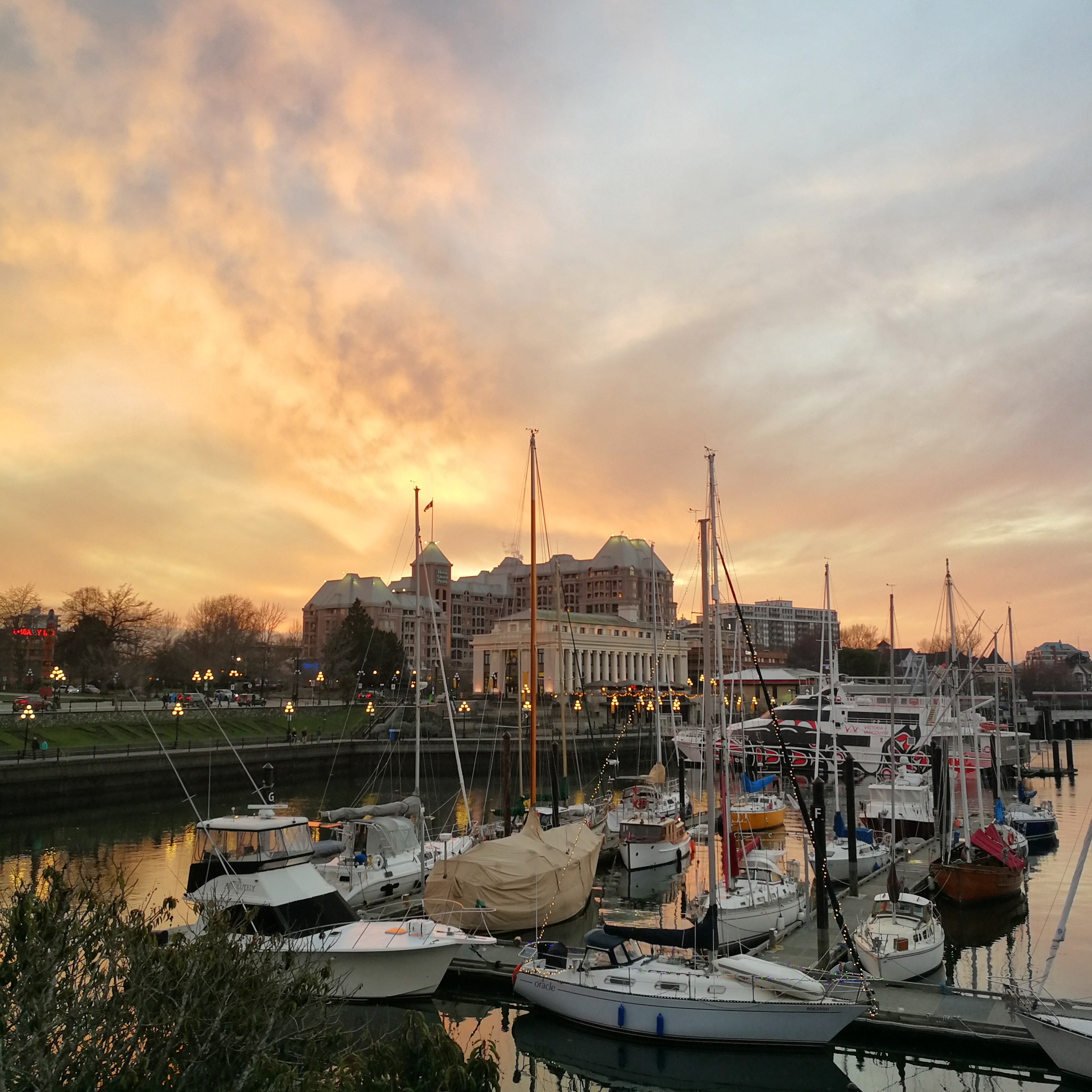
The weather in Victoria can often change throughout the day. There‘s always a possibility you could get a lovely sunset in the evening!

If rain is forecast during your visit to Victoria, don’t despair. With a vibrant community of locally owned businesses and organizations, there are many great things to see, do and eat in this west coast city! Whether you like art, history, shopping, games, or being pampered, you’re sure to find something to keep you happy on a rainy day.

*
The author wishes to acknowledge the traditional territory of the Lekwungen speaking peoples, on whose lands the establishments mentioned in this article are based.

Unknown's avatar

Santiago de Compostela – A City of Culture & Connection

September 2022 brought me and my fiancé to Lugo, Spain, for my friend’s wedding. We decided to make a trip out of this occasion by first exploring some of the other highlights of the north-western region called Galicia. I knew of the Camino de Santiago hike, a historic pilgrimage route that ends at the Cathedral of Santiago de Compostela, where Saint James the Great is said to be buried. While we wouldn’t have time to complete the trek, I jumped at the chance to visit the revered old town that is recognized as a UNESCO World Heritage site.

Our flight landed at Santiago’s small airport late on a Tuesday evening. A cab driver drove us to the heart of the city in 15 minutes, at a fixed rate of 21 Euros. I was impressed by how well he knew the location – many taxi drivers these days end up asking their customer for directions!

We had booked three nights at Hotel Oxford Suites on Calle de San Francisco. Its close location to the Cathedral and photos of the traditional stone walls in its rooms had caught my interest. The website had said check-in was open until 11pm. It was almost midnight when we arrived. I had emailed earlier in the day to ask if there were special instructions for arriving late, but received no response. We approached the front door only to find it was locked. A sign translated to English said to WhatsApp call the number provided to gain access. We had our Canadian phones with us and no data. Uh oh.

Fortunately, the street was still quite busy with locals returning from the bars (or more likely, making their way to them!). I spotted a man who seemed similar to our age and asked him in my best Spanish if he spoke English. Thankfully he did, and he kindly called the number for us and told us the code to the hotel, our room number, and room code. The kindness of strangers strikes again!

When I went down to reception the next morning to pay, it became clear that English is less spoken in this autonomous region of Spain, but I liked this. It made the experience feel more authentic and was an incentive to practise the language. Galician is a language of its own here, and I would later be told by a native that many people from other parts of Spain can’t understand it. Probably the easiest thing for foreigners to remember is that in this region, “thank you” is pronounced “grath-ias” and not “gras-ias.”

Hotel Oxford Suites was more like a hostel, with a café bar downstairs that sold coffee for 2 Euros. My fiancé had pledged to have less coffee during this trip but he couldn’t resist the cheap prices! The room was comfortable but it was a little loud (inside and outside the hotel) so I would probably book a different place to stay if returning again. (Hotel Costa Vella looked lovely but was fully booked on our dates!)

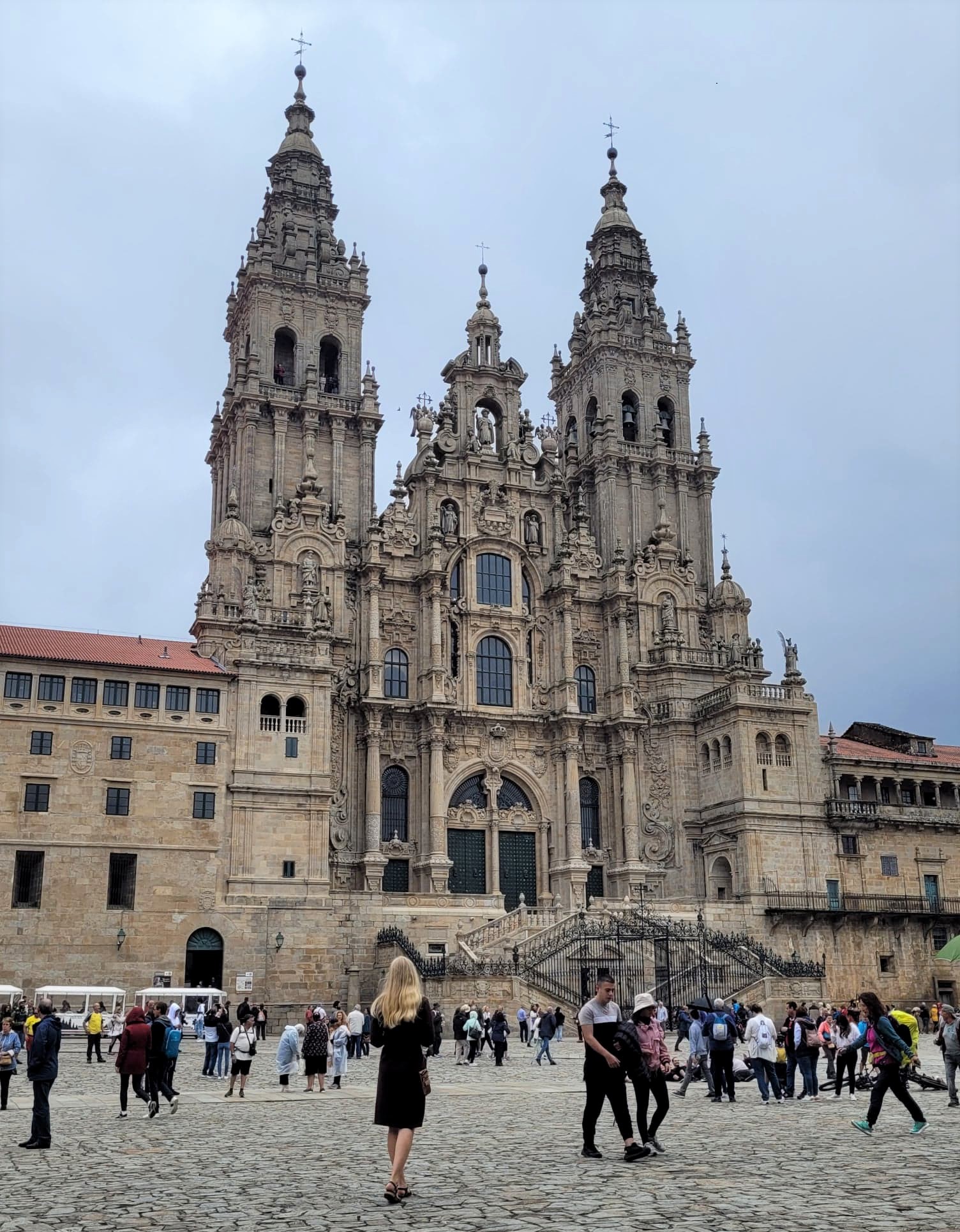
The forecast had said there would be showers for the duration of our stay. Cloudy skies looked down on us as we walked towards the Cathedral, from where an instrument that sounded like a mix of the clarinet and bagpipes played throughout the day. Throngs of people filled the main square (Praza do Obradoiro), many of them hikers that had just finished the long trek. Cheering in celebration, they lay on the ground with their legs in the air in what seemed like both a demonstration of their fatigue and a sign of their respect to the symbolic building that stood before them. I’m not religious myself, but you don’t have to be to appreciate the beauty and significance of the Cathedral of Santiago de Compostela.

We walked down the cobbled streets of Rúa do Franco, passing restaurant windows with small octopus on display (a Galician tradition I didn’t feel compelled to try!) Other windows showed lobsters in tanks, awaiting their fate. On the more commercial street of Rúa da Caldeirería, we came across a small, unpretentious bakery called Pastelaría Tentación that sold empanadas, sandwiches, and pastries. The lady listened patiently as I tried to pronounce our choices. We would end up coming here again the next day.

We next made our way to Rúa das Ameas and passed through the Mercado de Abastos where various vendor stalls sold fruit, cheese, meats, and seafood. We bought some fresh peaches for 2 Euros and wandered back to the square, where even more hikers were celebrating the completion of their hike.

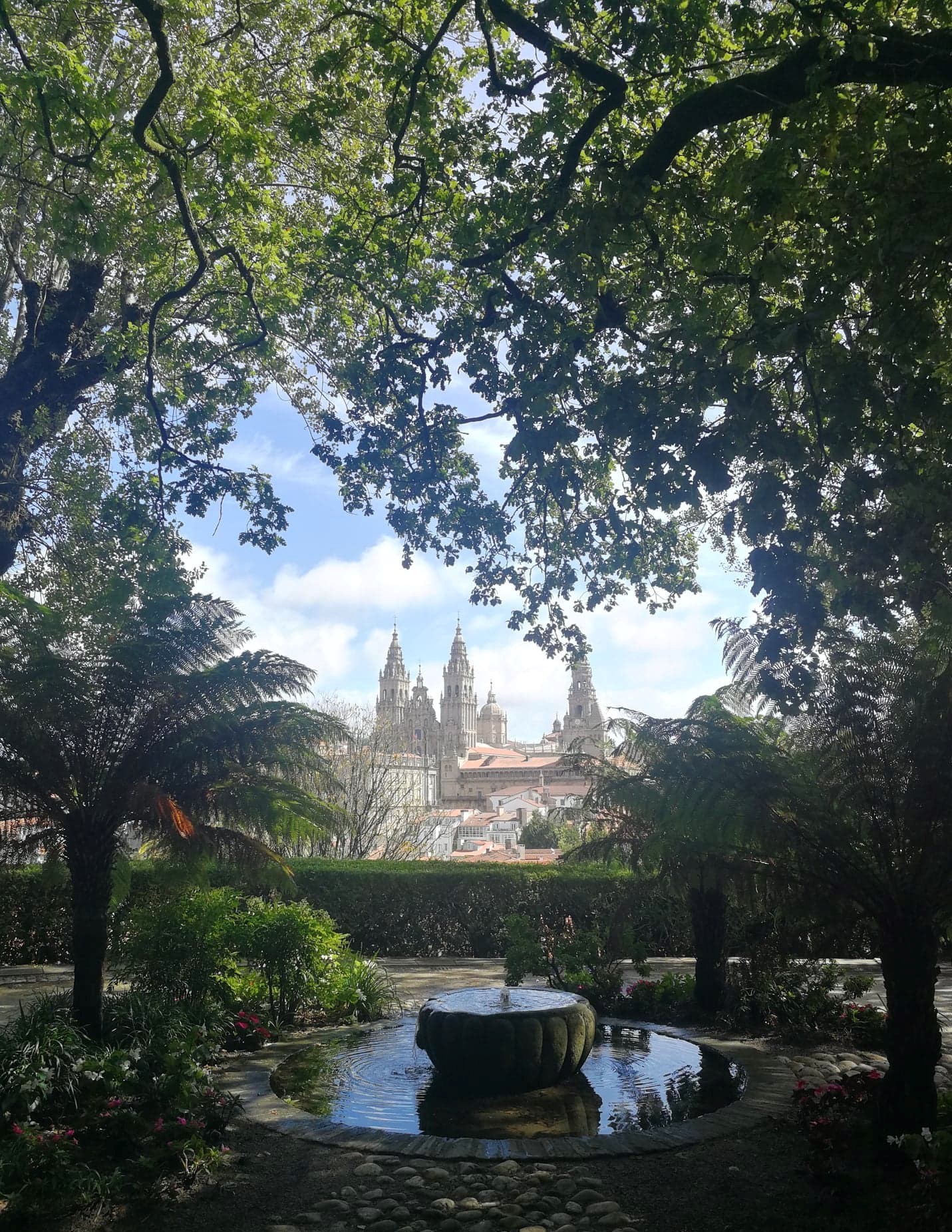
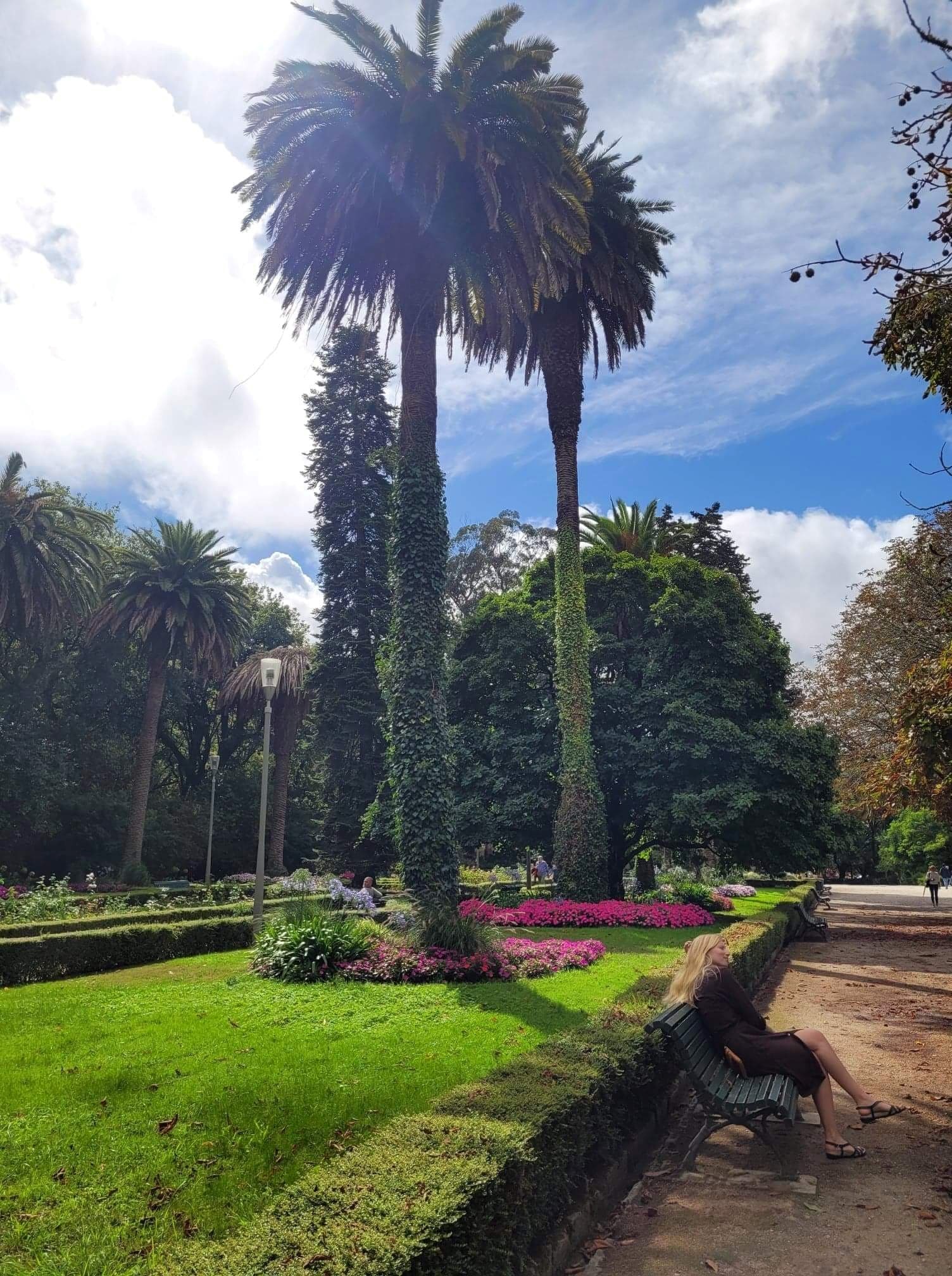
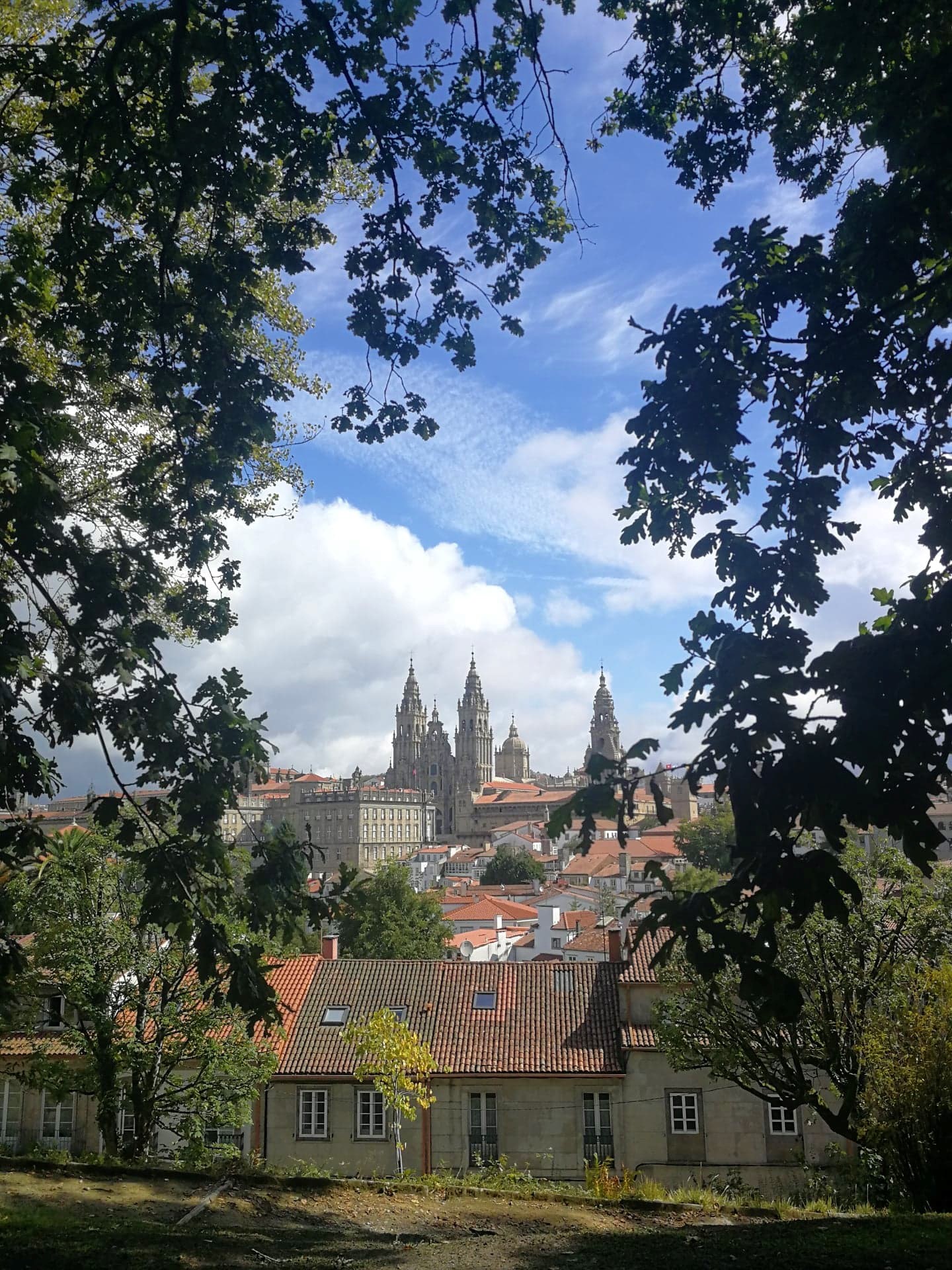
By now, the sun had broken through the clouds. We walked down Rúa das Hortas before taking a left up Rúa do Pombal and entering Parque da Alameda. And what a lovely park this was! People jogged along the tree-lined promenade while others sat reading or chatting on benches beside pretty flowerbeds. A calming sound of trickling water came from a fountain, in front of which there was a beautiful vista of orange roofs, church spires, and the Cathedral towers.

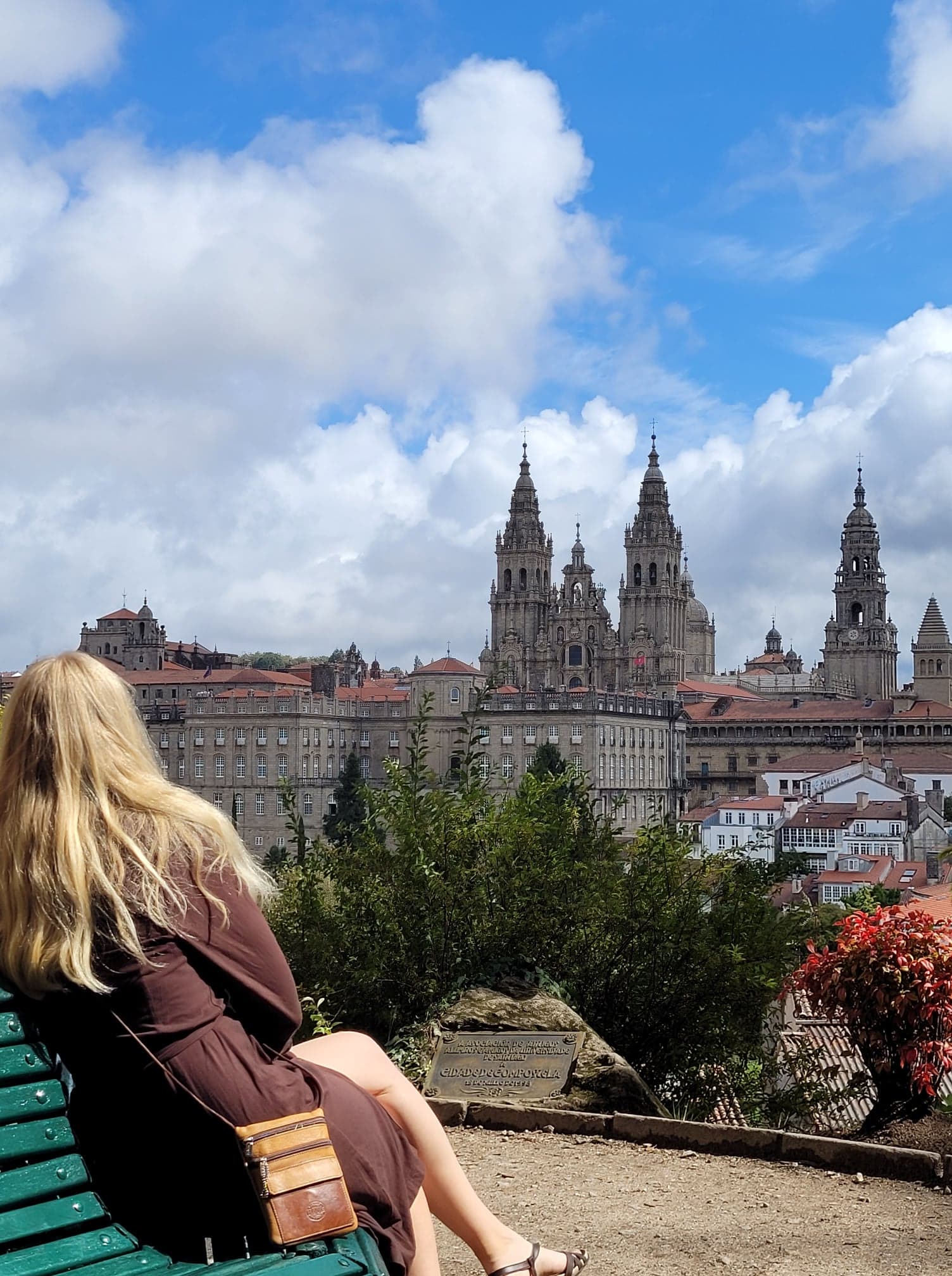
As we stood having a cuddle in front of this view, a same-sex couple came behind us and showed us a photo they’d taken of the town, with us included in the image. We offered to take their photo in return. We were amazed (but glad!) that there weren’t many other tourists in the park. It definitely provided what I would imagine are some of the best views in Santiago de Compostela. Looking outwards from the city, we saw rolling green hills in the distance.

As we made our way back to our hotel for a siesta, the sun decided to do the same. We felt even more lucky that we went to Paque da Alameda when we did!

My friend had recommended a tapas bar called El Papatorio for dinner. Evening meals are eaten later in Spain, with many restaurants not opening until 8 p.m. We sat in the Praza do Obradoiro trying to guess what all the different flags on surrounding buildings symbolized before making our way down Rúa do Franco again. A group of women who looked to be in their early twenties were walking up the street, smiling and cheering as they neared the end of the Camino hike. Upon hearing them, a group of elderly ladies that were sat on a restaurant terrace proceeded to applaud them.

There was a line-up outside El Papatorio, and of course, the view in front of me of the opposite restaurant included the window of lobsters in the tank. As we waited, one of the kitchen staff proceeded to pluck a lobster from the water. The lobster’s comrades proceeded to rush towards the other side of the tank, frantically climbing over each other in an attempt to hide themselves. It was actually quite uncomfortable to witness this behaviour and realize how aware they were of what was happening to their friend…and what would eventually happen to them!

As I pulled my eyes away with a newfound sympathy for lobsters, the couple next to us made a joke about the scene. They were an Australian couple in their 60s and had just finished the Camino hike. We ended up sitting next to them in the restaurant. They said they did the hike every year, but this was their first one since the pandemic began, now that they were finally allowed to leave Australia. This year was the busiest hike they’d ever experienced, with thousands more participants than usual. The couple’s kids were of similar age to us, and they shared empathy about the challenges our generation faces with rising inflation and house prices. The man advised us to plan financially for the future “so that in 30 years you can come back to lovely places like this.”

It was 50 Euros for two drinks and a large and delicious selection of tapas. As we paid our bill, I was reminded how nice it is not to have a tipping culture in Europe. The waiter brought back our exact change; there was no question of “Would you like change?” as I’ve noticed happen in some restaurants in Canada. His approach actually made me more inclined to leave a tip.

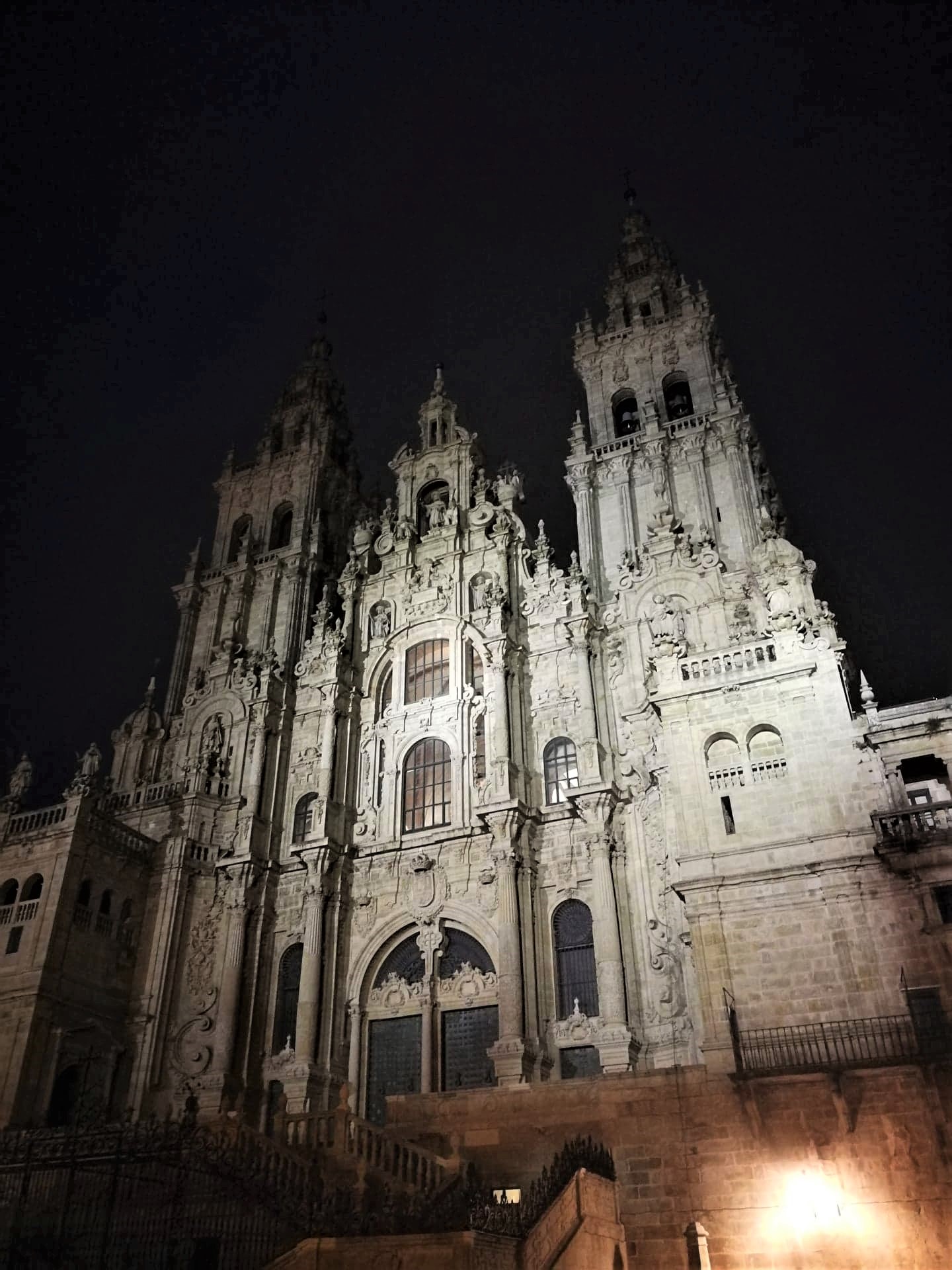
We walked back to our hotel with full bellies and warm hearts. The Cathedral stood luminous under a dark sky, like a lighthouse to the hikers seeking its welcome.

The next day, we took a day trip by train to the coastal town of Pontevedra, known for its charming medieval squares and many bridges. The journey took around 30 minutes and it was only 20 Euros for both return tickets. Views from the window showed lush green land. Galicia truly seems to be like the British Columbia of Spain!

On return to our hotel in Santiago de Compostela that evening, we would learn that the Queen had passed away. I suppose I felt a little more indifferent to this news than some Brits, but what’s for sure is that we will always think of Santiago de Compostela whenever we remember hearing this historic news!

We had dinner on the leafy terrace of a laid-back restaurant inside Casa Felisa hostel on Rúa da Porta da Pena. It was 40 Euros for two drinks and two meals that included sea bass and beef. The downside for people that aren’t used to eating dinner so late is that it’s hard to fall asleep when it feels like your stomach is still full to the brim…

On the Friday, we were leaving for Lugo in the afternoon. We spent the morning sitting in the square with our luggage, relaxing under the sun. For breakfast we chose to dine at Café Carrilana on Rúa de San Paio de Antealtares. A more modern and youthful café, it served yummy eggs bennies and fresh orange juice that was actually freshly juiced and not from a carton. A large group of people comprising of individuals from all around the world were sat at a table nearby. It seemed that they had met during the hike and, having formed strong bonds, were having a final meal together before everyone went their separate ways. After a German man said his goodbyes to everyone, an Irish woman quietly left the table to walk out of sight with him and say a more personal goodbye. Maybe they will see each other again, maybe not.

There was something truly joyful and uplifting about our time in Santiago de Compostela. We encountered so many friendly people – locals and fellow tourists. With all the hostile events going on around the world, we all need some amiable connections to remind us of the goodness in others. If you’re interested in visiting Spain and experiencing authentic culture, choose Santiago!

Unknown's avatar

Canals & Cobblestones | Exploring Copenhagen on Foot

In early October 2019, I spent a few days in Denmark visiting one of my closest friends who currently lives there. She was offered a job that started just before my arrival date (yay for her!), so I would be entertaining myself for two of the four days. This was a great opportunity for me to have some solo travel time I’d been craving, and I spent it walking around Copenhagen.

After touching down in Copenhagen in the mid-morning, its airport quickly stood out as the best of the many I’d been through in the weeks prior. The washrooms were clean, there was lots of signage that actually led you to the correct place, plenty of bins, and there were free maps! I love a free map. The back of it even had a photo of a bikini-clad lady wrapped around a pole, advertising a gentleman’s club in the city centre. How did they know that’s what I was looking for?!

Buying a one-way ticket for 36Kr, I hopped on the metro to Christianshavn, wondering how quickly I’d regret only bringing one sweater with me. I’d been in Greece the week before, where the temperature had been a good 15 degrees warmer with zero chances of rain. At a nearby Fakta supermarket, I got off to a strong start by giving the wrong change (why must the smallest amounts be the bigger coins?!) to the cashier who, upon realizing the bright blonde girl in front of her wasn’t Danish, looked very confused. It was bound to happen at some point, so I mayaswell have got it over with early on.

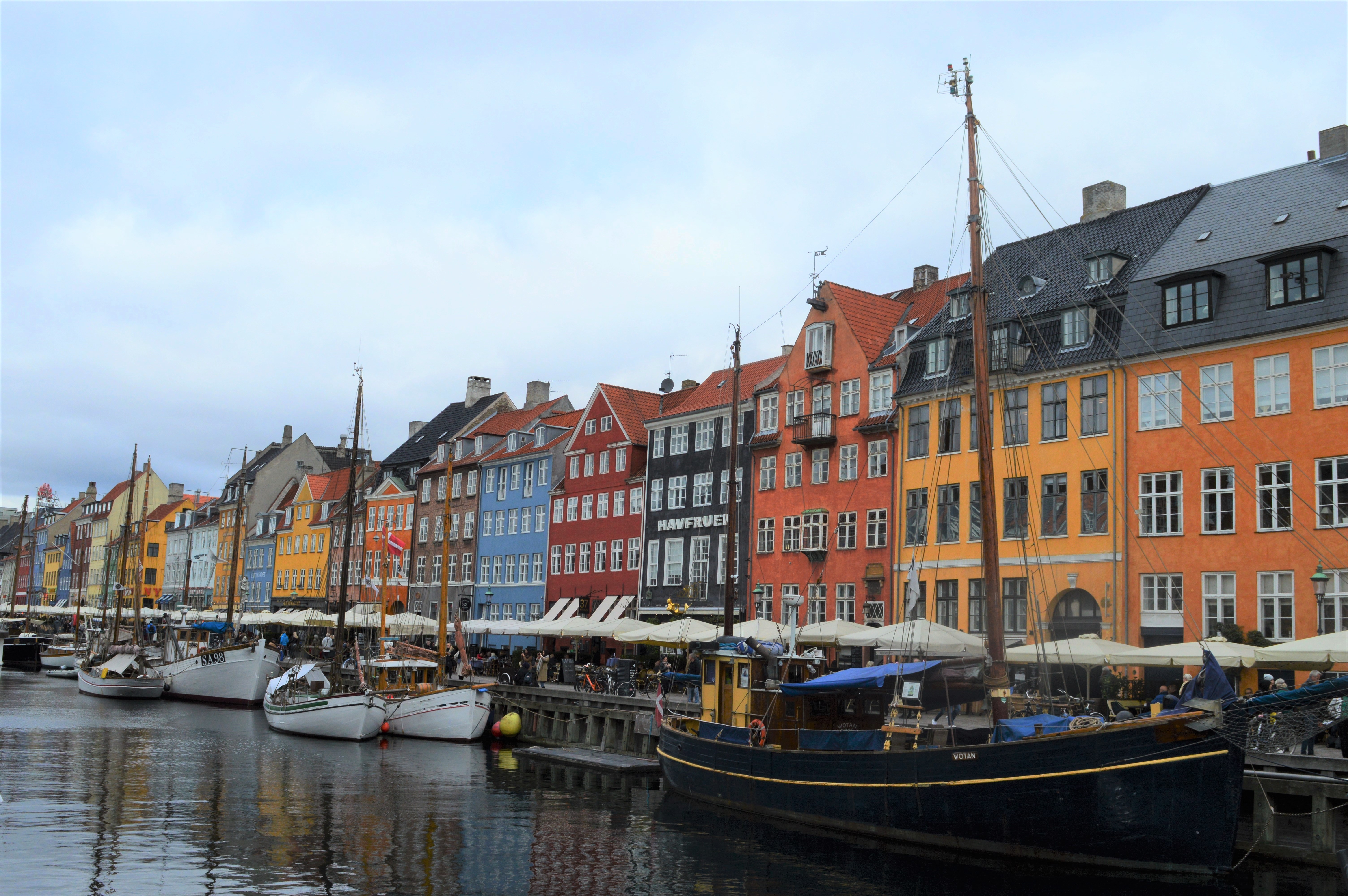
Overgarden Oven Vandet ran along a quiet canal lined with trees and overlooked by tall colourful buildings. I quickly got accustomed to the sound of my suitcase rumbling along the cobblestones. Locals and tourists passed by on their bikes, all helmet-less. The city is very bike-friendly, as you would hope all would be to help reduce global carbon emissions. I crossed the Inderhavnsbroen (pedestrian bridge) and caught a glimpse of colour in the distance. Following its direction, I soon realized I was approaching Copenhagen’s most photographed spot: Nyhavn (New Harbour). A swarm of buzzing photographers were gathered on the bridge with their cameras to capture the colourful buildings and the old boats that sat before them. Grey skies weren’t clouding their excitement. I annoyed a sufficient number of the hive by squeezing past with my suitcase in tow to take a quick peak, before escaping to a quieter viewing spot down the side of the canal.

I then continued down Havnegade, pausing on a bench to eat one of my cheap supermarket snacks. Passers-by would occasionally look my way, sometimes with a curious expression and sometimes indifferent, and I remembered how strangely nice it is to be alone surrounded by strangers. It’s the best way to realize that you don’t actually care how you look to other people.

By the early afternoon, I was starting to lose feeling in my fingers from dragging my suitcase, so I went to find the Royal Danish Library on Castle Island, where I’d agreed to meet my friend later on. Behind it is the Danish Jewish Museum, and behind that is the Bibliotekshave (library garden), a lovely little oasis with a pond, statues, and benches for sitting with a book. In today’s case it was too cold for that, so I went into the library and found a spot to read on the second floor. It’s a lovely library and I was fondly reminded of my days as a university student when I basically called the library my home.

Higher education is free in Denmark, which probably explains why so many of the people studying looked older than me. All of the females also looked very cool, and not because they were trying to wear the latest trends; they just looked genuinely and effortlessly cool in their fashion sense. With their stony faces, you’d think they were walking the runway rather than trying to find the Philosophy section.

That brings me to my next observation. The Danish (or at least, those in Copenhagen) don’t exactly strike you as the friendliest bunch of people. You can’t help but feel that if you were to collapse to the ground from a heart attack, they’d cycle past you with a look of disdain that suggested you were inconveniencing them. When I met up with my friend (who, incidentally, I hadn’t seen in 3 years!!), I brought up my observation and she confirmed that it’s an accepted cultural trait. She even recalled how someone had once told her he could tell she wasn’t Danish because she smiled too much…

The next morning, after an evening of learning about hygge, I got the train from Lyngby to Nørreport. Seating consisted of fabric-covered benches rather than individual seats, however this communal arrangement failed to encourage any conversation between the passengers. Opening the inter-carriage doors required you to wave at them in front of your face, which often resulted in one looking daft if it wasn’t done properly.

Today I was suitcase-less, meaning I’d be able to move quicker, not have to deal with the incessant sound of wheels struggling over cobbles, and avoid losing one hand to numbness from the cold. I also now had a woolly hat lent to me by my friend. It was going to be a good day. 

Approaching the station, my bladder suddenly decided to put in a request. Thankfully there was a free public washroom located outside Nørreport station, one of those circular ones like the one outside Russell Square in London (if it still exists). These had always seemed a little sketchy to me, but upon opening I was pleasantly surprised. It was clean, there were multiple cubicles with doors that worked, and the sink actually had soap, water and hand towels. This might just be an underestimated contributing factor to why Denmark is often considered one of the happiest nations in the world..!

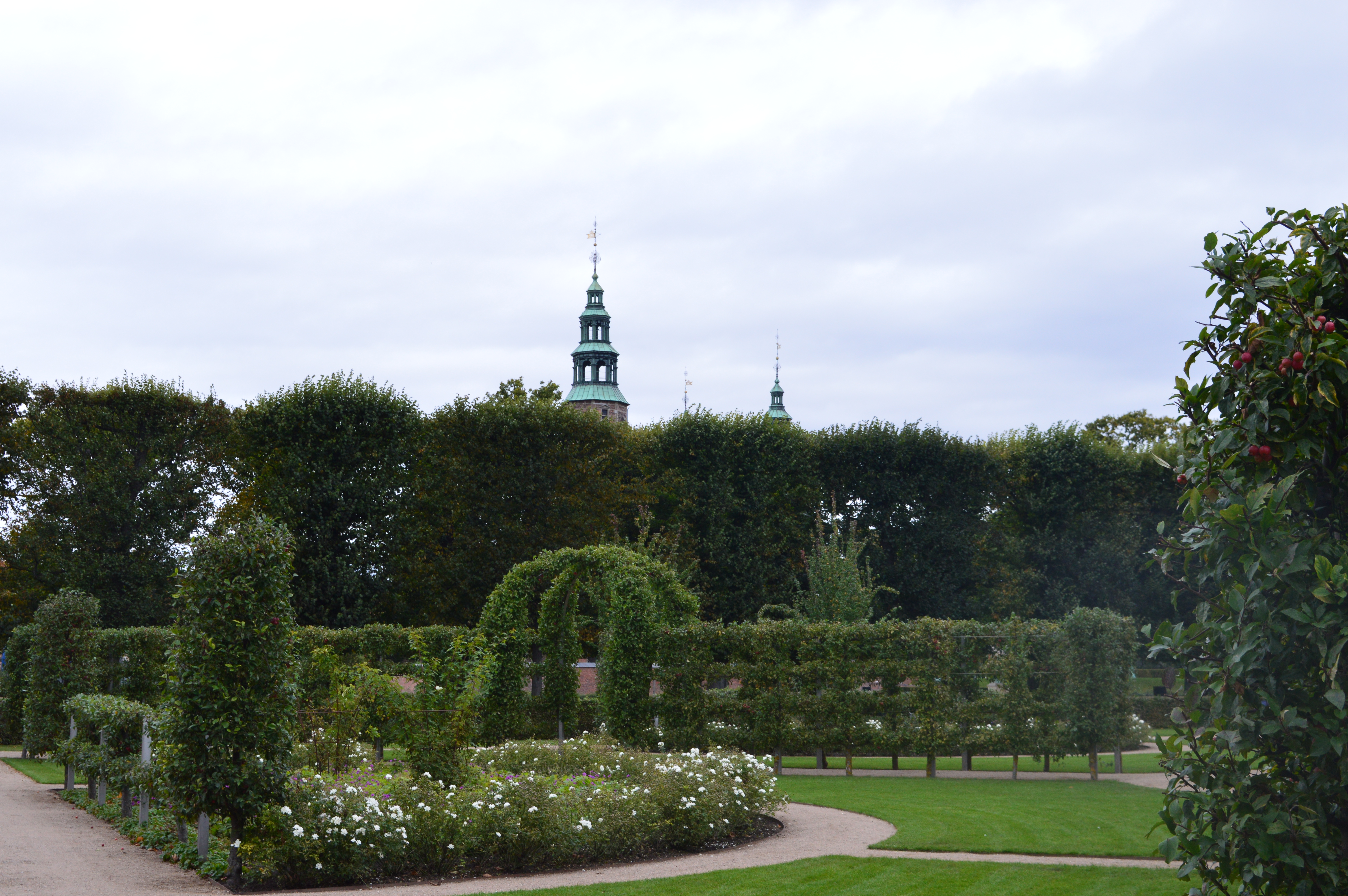
After browsing a Netto supermarket for the cheapest carbs that would keep me going through the day, I headed to the Royal Garden, located off Gothersgade. With its open space and pretty horticultural arrangements, this seems like a great place to walk a dog and pen the next popular Scandinavian crime series.

Further up the road was the Botanical Garden, another aesthetically pleasing place where I could admire the autumn colours starting to show on the trees. From here I walked down the street path past Peblinge Sø (lake), which was popular with runners. Continuing my tour of Copenhagen’s parks led me to Ørstedsparken, where I witnessed an Eastern European couple taking pictures of every single monument around. A fluffy labradoodle-cross caught my attention, galloping around gleefully with a stick in his mouth. He ran up to me and I petted him for a few seconds, only to look up and see his owner several yards away watching with a mightily pissed off expression. At least the dogs are friendly here.

As I ambled down Vester Voldgade, which surrounds the more commercial district, I suddenly realized how clean the streets were, and that there was a distinct lack of homelessness in the city. Denmark is known for having one of the highest tax rates in the world, but if that money is going towards ensuring people don’t have to sleep on the streets, you have to applaud it.

I decided to walk around Castle Island again. Today, royal horses were being trained in the arena of Christiansborg Palace.

After retreating into the Royal Danish Library again for 30 minutes of warmth and washroom access, I returned across Knippelsbro to Christianshavn, so that I could admire the neighbourhood’s cobbled streets again without a suitcase. To go up the Church of our Saviour only cost 35Kr. The chance to see 360 degree views of the city and get rid of loose change? Excellent!

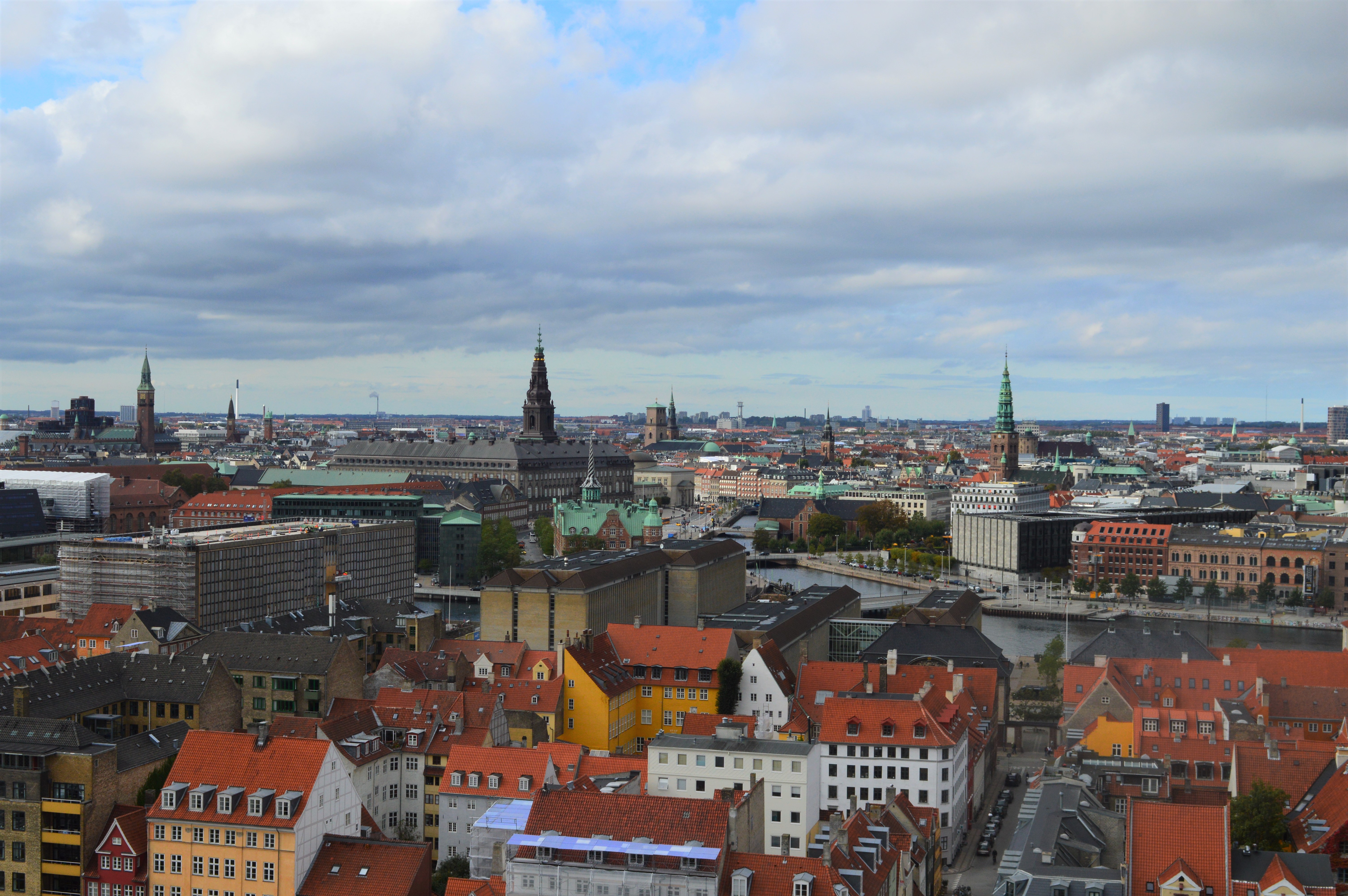
It takes around five minutes to reach the top of the Church, depending on one’s level of fitness and how many times you have to wait for people to descend the stairs or, in my case, finish taking a million photos of the same bell. Thankfully the sun had just started to peep out from behind the clouds as a gesture of goodwill. There were some lovely views looking over the harbour and the sea of orange-roofed buildings surrounding it, with Church and tower steeples poking up here and there. I appreciated the lack of skyscrapers.

One thing I really liked about being in Copenhagen was simply hearing bits and pieces of different languages. I was starting to notice however that the majority of conversations I was hearing were in German. At the top of the Church, I saw members of a family taking it in turns to take (or as the Germans would say: “make”) photos of each other. Feeling generous, I asked them in German if they’d like a photo together, but the father waved me off with his hand and a curt “Nein”, before thanking me as an afterthought. Hey buddy, I didn’t vote for Brexit, okay.

I next headed towards Christiania, the Freetown of Copenhagen. As soon as I entered the area, I got weird vibes. The people seemed sketchy and on edge and, frankly, some of them looked like they had just murdered someone. Weed is sold here, and I couldn’t help but find it amusing to see blaring hand-painted signs of “No photos”, along with a man whose specific job seemed to be shouting at people for getting their cameras out. Living in Canada, where recreational use of marijuana became legal in 2018, it’s easy to forget the secrecy that surrounds its selling in other countries. I didn’t stay there long. Taking photos of bronzed leaves against a backdrop of red and yellow houses seemed much more appealing.

Now that the sun was out, I decided to briefly stop by Nyhavn again, and happened to arrive just as the bridge was up. From here I walked down Larsens Plads before taking a left to see Amalienborg Palace, where Denmark’s Queen resides. If you listen carefully, you might hear her still laughing about Donald Trump daring to propose buying Greenland off her.

Further down Frederiksgade is the Marble Church with its distinctive dome. Yet more Eastern Europeans busied themselves taking 5000 pictures of every statue in the courtyard. The ones that displayed male genitalia always seemed to attract the most interest. It was here that an American man asked me to take a picture of him, and then promptly ran off after. “What an interesting place,” I thought.

When continuing down Larsen Plads, you eventually come to Kastellet, which is a preserved fortress. Upon my arrival it started to rain, but I continued to walk through the entrance. Surrounded by an inner and outer moat, the fortress is used by the military but is also a public park popular with runners, especially those wanting a change from flat terrain.

As I walked on down one of the gravel paths surrounding the Kastellet, a lady stopped me to ask for directions. Blatantly assuming I was Danish, she said she was looking for the Little Mermaid statue. Since I had an idea of where it was, I was able to point her in the right direction, and the illusion was maintained. Maybe I look more effortlessly cool than I thought..?

I made my way to Østerport train station to meet my friend, and that concluded my two days of solo time exploring Copenhagen. If you are just looking to walk around and get a comprehensive idea of the city, two days is really all you need. Those planning a longer trip will be able to enjoy many different museums and restaurants.

While Copenhagen was a little too cold (in more ways than one) to win my heart, it is a very walkable and photogenic city with some gorgeous architecture, and overall it’s a great choice for anyone craving some time away for solo exploration.

Unknown's avatar

24 Hours in London for the Big City-Hater

I lived in London for five years, first as a student at King’s College London and then after university when I got my first “grown-up” job as a staffing coordinator at a renowned cricket ground. As a 19-year-old who had grown up in a remote valley in North Yorkshire, moving to London truly was a life-changing experience. It opened my eyes to more cultures and experiences, brought me some fantastic opportunities, and introduced me to some great friends. However, it was never a place I was going to live in forever. A country girl at heart,  the city lifestyle and culture didn’t appeal to me. By the end of my five years in London, I couldn’t wait to be out of its smoggy urban maze. Some friends suggested I hadn’t given it enough of a chance, and they were probably right, but I wouldn’t be dwelling on it once I had moved to the west coast of Canada.

When I planned some time in London during my visit home in June 2018, I vowed to go in with a more optimistic attitude. Being in London as a tourist rather than a local would allow me to see the city with new eyes and perhaps appreciate it some more. As I was staying with my best friend in Hertfordshire for a few days, we organized just one full day dedicated to London, involving some of my favourite places and minimal exposure to the crowded hot spots. The below guide is for anyone who also has a disinclination for tourist-bombarded concrete jungles, but wants to get a taste of London.

My day started with a bus from Kings Cross to Hackney. My adopted home of Victoria on Vancouver Island hasn’t yet adapted to the whole cashless card-tap thing, but I personally find this backwardness quite endearing.

“Ooh, a new restaurant!” I would note along the way, or, “What happened to that shop?” We had brunch at a place called Café Miami, where a good-looking-but-he-knew-it hipster provided the least amount of welcoming customer service as possible. Nevertheless, supporting independent businesses is something I always liked to do in a city where international food chains can be found on every street corner of the central tourist traps.

After stuffing our faces with fish tacos and pancakes, we waddled down to London Fields where football (soccer) supporters were watching a World Cup match on a pub’s outdoor screen and sunbathers lounged on the sun-bleached grass. The park also has a lido (public outdoor swimming pool, for my non-British friends), but as its one of few places in London to offer clean water, prepare for it to be packed with people on hot summer days. This park leads on to Broadway Market which, in addition to its stalls selling flowers, fruit and veggies and multicultural dishes, has a lot of nice albeit pricey independent cafes and restaurants. Street markets, of which there are many spread around London, were one of my favourite things about living in this city.

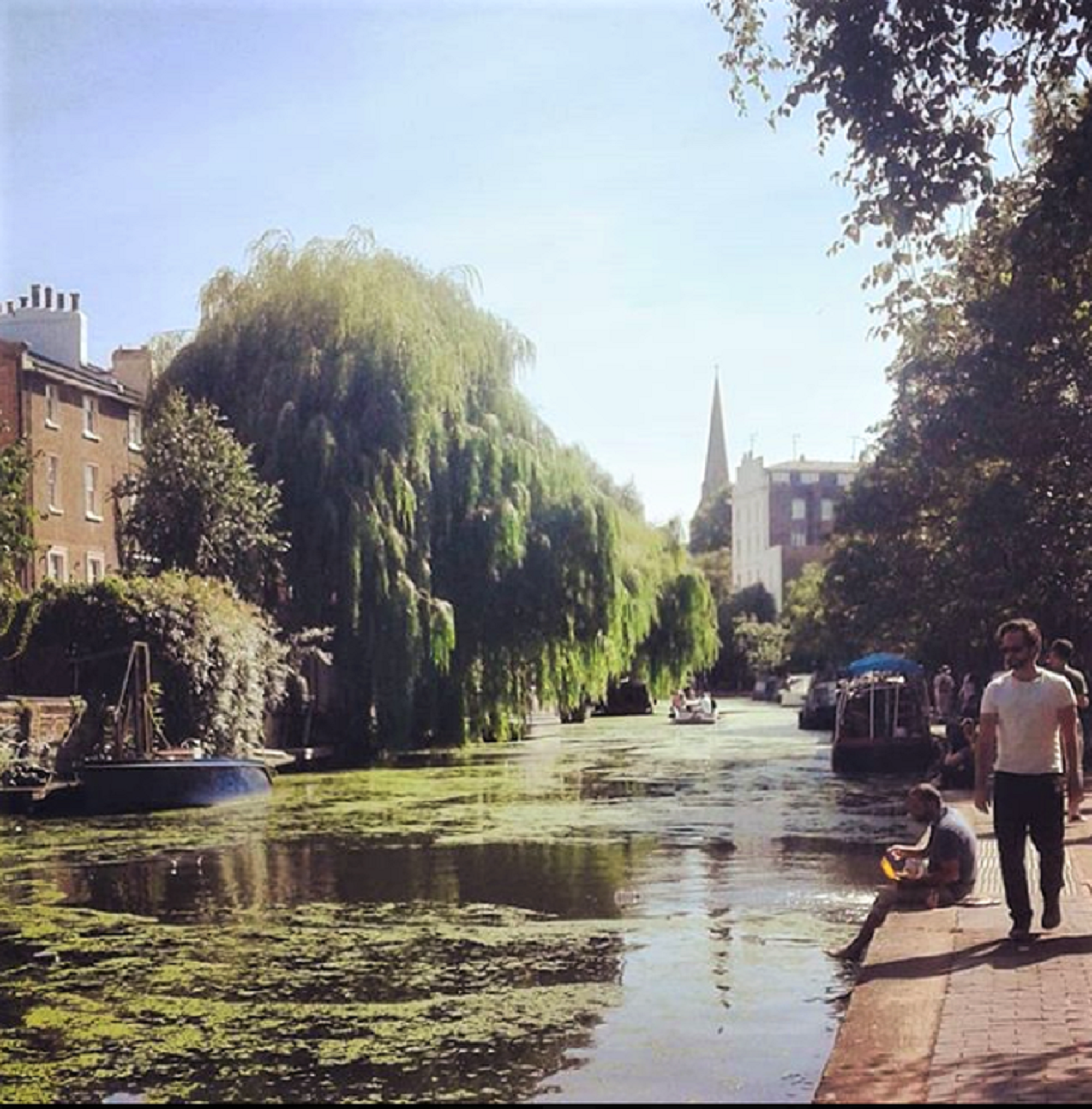
We then joined Regent’s Canal. Ahh, the memories. I would often run, cycle or walk along this canal, enjoying how it wound through the city, exposing me to the various neighbourhoods that make up this cosmopolitan city. In some spots you get beggars or drunks, in others you get talented buskers and charming boats selling plants and books. During our walk, I was even treated to the classic experience of having my ankles snapped at by a territorial male swan. It’s like they knew I was coming back.

Camden

Arriving in Angel, you have to temporarily exit the canal. Walking through this borough on a sunny summer’s day, I’ll admit that I had the thought of, “I wish I had spent more time in this part of town.” Sunshine can make anything look nice, but Angel definitely seems to have a certain charm to it that doesn’t involve being shrouded in selfie-snapping tourists.

Moving further along, King’s Cross has seen a lot of development in recent years, with new little walkways and green patches put in behind the station. You can’t deny that there are some very talented urban developers in this city.

Regent’s Canal runs through Camden, which is a tourist haven I can make a slight exception for, because it’s got a great vintage market, great music scene and, most importantly, a Lidl supermarket. It’s a place where on two separate occasions (once as a student, once as a graduate) I went on second dates that would eventually lead to disastrous short-term romances and consequent over-analysis on my part. But I can’t really blame Camden for that. Plus, the dates were so romantic in nature (think Cuban bars, tapas, margaritas, and live soul music) that I honestly still smile when I think about them, even though both guys turned out to be jerks.

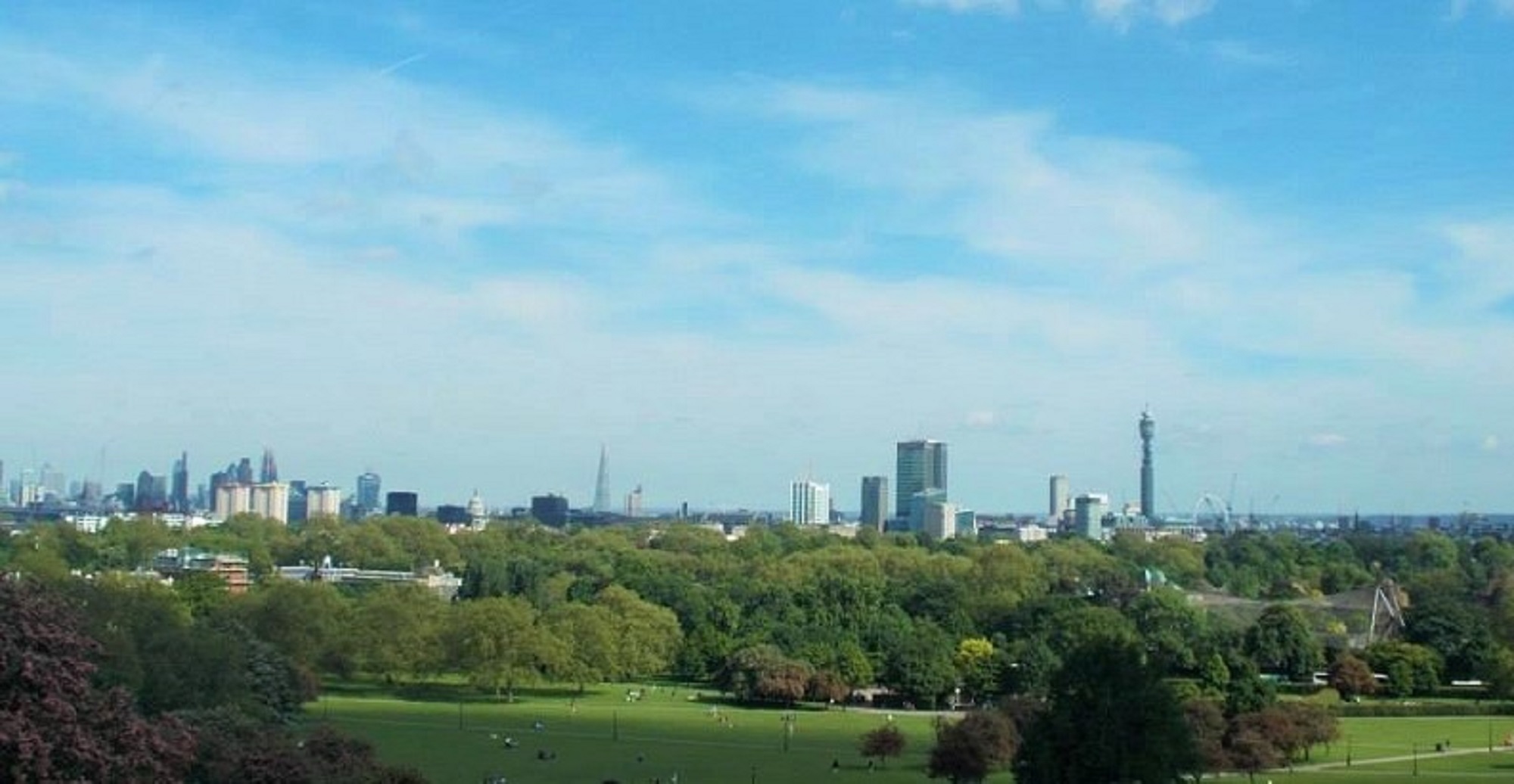
The stretch of canal between Camden and Little Venice is a pretty spot along which my university running club would often run on Wednesday afternoons. One of the exits takes you to either the zoo (nope) or Primrose Hill which, forming part of Regent’s Park, is always a place I recommend people go to if visiting London. It offers awesome views of the city that showcase its famous old landmarks and newest architectural creations. It’s a place where you are close enough to the city to feel in it but far enough away to not feel its pollution in your lungs. It’s also a place where you can spot cute dogs and the occasional celebrity, though good luck being able to chat to any of them (the dog being my priority here).

I lived next to Regent’s Park for two years as a student (in an expensive box of a room in a courtyard where dear little boys would kick balls into our kitchen window) and it was always the place where I’d go for a run, have birthday picnics, or watch local cricket games after work. My friend and I met some work friends here for a picnic (I’ve missed Marks and Spencer’s confectionary tubs) and when they asked about my Canadian life, it certainly seemed worlds apart from my life in London.

Primrose Hill

Primrose Hill in 2013 (before more skyscrapers were built)

If you’re going to be in London for just 24 hours, you should probably treat yourself to a night out. My friend and I used to subscribe to Time Out Offers through which we would get deals on theatre tickets, outdoor cinema screenings, and restaurants. One of the last places we got a discount for was a casual restaurant called Bird, on Chalk Farm Road. As the name might suggest, it specializes in chicken. And it’s really really good.

My favourite bar in London is also located in Camden. Joe’s is a 60s northern soul and rock’n’roll bar. Simple in design, its standout feature is its juke-box, which gets everybody up twisting and jiving and not caring what they look like. I confess, I didn’t actually go during this visit, but that was only because my friend and I had to catch a train back to Hitchin. Joe’s is the place where I fell for my Beautiful Heartbreaker during my first year of uni, and the place where I fell over attempting my (drunk) version of a Lindy hop on my 22nd birthday after graduating. It’s a place that plays genuinely great music unlike the generic horrors in the charts today, and a place where strangers actually talk to each other.

*

The next evening, I caught the train into central London again to catch up with some uni friends who are all nailing corporate careers, whether recruiting, writing for newspapers, or working their way up in big law/financial firms. I can be happy for them but also happy knowing that I wouldn’t be happy doing the same thing myself.

We met at the Knights Templar on Chancery Lane. (It should be mentioned that this place happens to have the grandest, largest, most beautiful public washrooms ever known to a pub-goer). Boarding the tube and quickly remembering the route I needed, I thought, “Maybe I could live in London after all.” I’d had a nice day out previously and the city seemed so familiar. Then I emerged out of Holborn station to a hostile swarm of miserable commuters on the rush home, elbowing past others and looking like they wanted to shoot themselves. Hmm, maybe not.

As much as it isn’t for me, the truth is, London is so big and diverse that you can find a neighbourhood and activities that fit your personality and interests. You just might have to spend half your monthly earnings living there, or face a minimum hour-long commute to get there (unless you are the child of a Russian oligarch or Arab oil tycoon, in which case Chelsea probably already has a bachelor pad in your name). London has an abundance of green spaces, amazing sports stadiums, a vast array of festivals and events, more bars and restaurants than you will ever be able to squeeze into your lifetime, some really cool converted buildings offering some really cool shows, and it carries a lot of history (much of which, admittedly, is hard to be proud of) and nice architecture.

Looking back, there are definitely things I wish I had done more of when I lived in London, like going to the theatre, trying different bars and restaurants, and exploring more boroughs. But I know it wouldn’t have been enough to keep me there. I just tell myself that I can have these experiences as a tourist whenever I visit again. London is simply too crowded, hectic, grey, dirty, and impersonal for me to want to live there permanently. So I’m happy to just enjoy it for 24 hours and then never see it again for the remaining 364 days of the year.

Unknown's avatar

Locked Out & Snowed In | A Winter Welcome from Kelowna

As the plane began its descent, billowing clouds dispersed to reveal the sight of snow-dusted, tree-studded mountains flanking a shimmering lake. A rush of frosty air hit me as I descended the plane’s steps and walked into the airport. With no checked bags to wait for, I headed straight to the line of yellow cabs outside. Yes, cabs. No longer am I the super frugal 20-year-old student always looking for the cheapest mode of transport. There was no direct bus route from the airport, and I didn’t fancy waiting outside in this weather.

The cab driver asked what my plans were, and clearly thought I was a weird person when I told him I didn’t really have any, because he proceeded to stop talking to me.

This was my first trip to the Okanagan Valley in six years, having previously spent a week doing a Workaway exchange in a tiny town called Cawston. In bitterly cold late December, it was hard to remember how hot it can get in this region during summer. I had almost come to Kelowna in the late summer of 2017, but since it was mostly on fire, opted for the slightly less smoky Rockies instead. It was actually at the Kelowna Greyhound bus depot where my backpack went missing. But hey, that was six years ago, no grudges.

The 15k drive into downtown Kelowna saw us pass large department stores, car dealers and warehouses. I paid my $40 fare and walked up the steps to my airbnb motel apartment  – an excellent choice for a solo traveller looking for simplicity and convenience. (If you’re new to airbnb, you can get $45 in travel credit by following this link.) I dumped my things and headed out to wander through City Park, located close by. Traffic roared over the bridge that leads to West Kelowna. The beach, scattered with bathers in the scorching summer months, was now swathed in snow and there were super pretty views of the mountains across the placid lake. I walked along the lakeside passing squealing children on an ice rink, a small marina, Canada geese gathered on a hill to escape the icy waters, and a Cactus Club Cafe pumping out music while its guests celebrated Boxing Day. Near Waterfront Park, two boys with hockey sticks zoomed up and down a frozen pond against the backdrop of a residential care home.

Tip number 1 when travelling to a new place it to research the nearest supermarket before arrival. Bernard Avenue had a nice array of bars, cafes, bookstores and boutiques, as well as a Safeway. By now my face had probably frozen into an awkward expression and through my jeans my legs stung with cold. Thankfully there was a Starbucks inside the Safeway, as if the store manager had anticipated the visit of naive English girls to Kelowna in the winter. Normally I’d prefer to support local independent coffee shops, but right now I was desperate for a sugary liquid to warm my insides.

Setting off back to my apartment unashamed to concede defeat to the -15 temperature, I pulled out my keys and inserted them into the lock, excited for warmth. But the door wouldn’t open. I blew on my fingers and tried again, but to no avail. At first I laughed about it, until a further five minutes of failure inspired me to ask for help.

A door two rooms down opened at my knock and out peeked a dozy looking topless guy, followed by a strong wift of weed.

“Oh, hi! I’m sorry, I was trying to -” The door shut before I had a chance to ask him for help, although that was probably for the best…

Looking around me, there seemed no other option but to ask one of the (slightly better off-looking) neighbours across the road. An elderly lady wearing bright red lipstick opened the door.

“I’m so sorry to bother you,” I began in my strongest English accent, “but I’m staying across the road and can’t seem to unlock my door.” *Rolls my eyes self-deprecatingly*

The lady “Ooohed” sympathetically and ushered me inside before calling down her husband. He followed me back to my door, asking with a Quebec accent where I was from, which inevitably led to the “long way from home” spiel I’ve heard many times the past year.

“I’m pretty sure the top one is unlocked, it’s just the bottom one that’s really stiff,” I explained.

The man took the keys from me and opened the door on the first try.

Tip number 2 (or maybe that should be 3 after “learn how to unlock a door properly”) is to make the most of good weather for hiking, even if it’s been your plan to complete a certain activity another day. I awoke the next morning to see snow falling and wind blowing the tree branches. Appropriately layered, I walked up Ellis St towards Knox Mountain…only to realize I couldn’t actually see it too well. I had a head lamp and suitable footwear, but decided a solo hike wouldn’t be a smart move if I couldn’t see the trail. I should have gone the afternoon I arrived, when skies were clearer and I’d still had a few hours of light left. Lesson learned.

Instead, I headed back south and walked down Abbott St past cozy houses and small lakeside parks towards Mission Creek Greenway, where I commenced a 6k walk on a snowy path alongside the frozen creek. It was a nice walk during which I encountered dog walkers, runners who were somehow finding traction, and elderly couples.  A pleasant oasis from the town, the greenway would make a lovely running route in the dryer months. About 3k into the walk, the views on both sides of the creek changed from residential properties to open spaces with hay barns and horses. Upon reaching Mission Creek Greenway Regional Park, I now had to find my way back to downtown. Returning the same way seemed a little pointless, but my only other choice was to walk along the fairly busy Springfield Rd. Most of this 6k walk was spent inhaling car fumes and focusing intently on the ground, because I did not want to slip on my backside in front of swarms of traffic.

I made it back downtown with my legs exhausted from around 15k of snow-walking. As I collapsed on a bench in City Park, I was greeted by a cheery elderly couple. They jovially remarked, “Now you just need a Starbucks cup!” Indeed, that seems to be the Kelowna attitude towards winter weather: get yourself a hot drink, and get on with it. Thankfully, it only took two minutes for me to unlock my door this time.

On my third day there was a snowfall warning in effect. It looked like I wouldn’t get any of my mountain hikes in afterall. I guess I should have been a little more realistic. Still, missing a hike wouldn’t detract from the trip. Instead, I spent the day browsing art galleries, museums and cafes. Luckily for me, admission to Kelowna’s art gallery is free on Thursdays. While I’m not talented at creating them myself, paintings are something that I have recently realized I really appreciate. Based on Water St, the gallery had some lovely oil and acrylic canvases, as well as a rather dark but interesting exhibition exploring existential themes.

Outside the gallery, cars drove along the snowy roads as if there was nothing slippery on them. I spent the remainder of the afternoon reading in Pulp Fiction Coffee House on Pandosy St. Featuring a vintage bookstore and antiques section, this retro cafe played music by the likes of Johnny Cash, Jackie Wilson and Del Shannon. I resisted buying a cinnamon bun until I left. All for the good cause of supporting local, obviously…

I didn’t hike Knox Mountain and see views of Okanagan Lake from the summit; I didn’t see the trestles at Myra Canyon or witness the waterfalls at Crawford; I didn’t climb the extinct volcano of Mt. Boucherie, but I still got something out of the trip. I fulfilled my need to get off Vancouver Island for a few days and spend time alone exploring a new place at my own pace. In the age of Instagram (which I foolishly joined recently), there is so much pressure to do the BIG things and get the BEST shot. This takes the attention off simply enjoying the experience of being somewhere different. Aimless wandering is an underrated activity. Sometimes you just need to get away to clear your head.

That evening should have been my final night in Kelowna, but mother nature had other plans. I arrived at the airport the next morning to discover a huge queue at security and a crowded lounge due to flight delays caused by snowy conditions. Then the cancellations began, followed by the complaints. (Canadians aren’t as polite as you think, folks.)

I spent that evening sleeping on a row of seats in the airport (not my first time), with the only food options being a stodgy sandwich from Tim Hortons, a stodgy sandwich from Subway, or a stodgy meal from White Spot.

Sleeping in an airport against your will can make you do crazy things. For me, it was spending $200+ to book a room at a nearby hotel for the next evening. But the comfy bed and warm bath was worth it (I mean, not reeeally worth that much money, but anyway…).

I left Kelowna two days later than planned, arriving back in Victoria late on New Year’s Eve and going to bed before midnight. It’s fair to say my trip had some unexpected developments. But hey, these moments are what make our travels so memorable!

Unknown's avatar

Books & Bridges | Budapest for the Quiet Solo Traveller

There seem to be two types of solo traveller. There are the ones who, as extroverts or simply because they don’t enjoy being alone, enjoy putting themselves in social situations and meeting new people. They will join free walking tours and bar crawls and essentially go to any place or do any activity that allows them to interact with others. Then there are the solo travellers who, perhaps being slightly more introverted, are happy to explore alone and avoid the big social scene, looking for picturesque serenity more than pubs and parties.

I definitely fall into the latter group. If I’m travelling solo, particularly if it’s just for a short break, I don’t tend to look for social contact and companionship. Brief encounters with a random character are enough to satisfy my social sanity whilst ensuring my personal itinerary isn’t interrupted. The truth is, I like having time alone and having the chance to fulfil my own plans at my own pace. However, if I do happen to meet someone who becomes a great travel companion, I will cherish this new friendship and do my best to preserve it.

Budapest is a top choice for a boozy holiday with a friend or romantic getaway with a partner, but it’s also a great place to wander around solo. Below is an account of my time in Hungary’s capital city.

*

A few bad experiences of sharing hostel dorms with snorers has made me more inclined to choose Airbnb for accommodation. This is definitely a wise option for Budapest because of the exchange rate. I spent £19 a night staying in a spacious room with a double bed, hosted by a lovely lady called Maria. Her cool apartment is decorated with various travel souvenirs and is conveniently located next to Nyugati station. She’s also very helpful when it comes to recommending things for you to do and see that cater to your particular tastes. If you sign up to Airbnb using my code, you’ll get a discount!

It was in Budapest where my love for vintage shops was reignited. Falk Miksa utca is home to many antique stores varying in value and appearance – some are elegant stores featuring opulent collectables, others have more of a flea-market feel.

DSC_0050

I love nosing through vinyl collections for Motown records, and the one above has many to browse (although Motown music isn’t so popular in countries of the former Soviet bloc). Inside, the store was packed with CDs from Britney to Deep Purple, Jennifer Rush to Santana. Opposite this was an antique shop called Kacabajka, where an old lady sat contentedly on a wooden chair chatting with the male owner. Some people would call the items in the shop junk, but I loved looking at the typewriters, delicate crockery and other interesting knickknacks. It was here where the question “Beszél angolul?” caught my attention (it means “do you speak English?”) and I looked up to see a Middle Eastern couple asking me what metal I thought an ornament was. After helping them, I hoped the shop owner wouldn’t proceed to start chatting away to me in Hungarian…

To others it was obvious I wasn’t Hungarian. As I browsed some fancier antiques in a store down the road, a man on a stool said: “This man [the owner] would like to know where you are from.” The questioner wore a top hat and waistcoat and rested the point of a long black umbrella on the floor. When I said I lived in London, he told me he had visited Portobello Market a few months ago and had some good finds. He spoke with a well-to-do accent and I suddenly felt like I was in the scene of a 1920s F. Scott Fitzgerald novel.

I was keen to browse some second-hand book shops, but discovered that sadly those recommended in my (slightly dated) guide book had shut down. However my Airbnb host recommended I try Massolit on  Nagy Diófa utca. This is a quiet little street (I walked past it about three times) which makes the cosy cafe and book store even more appealing. University students and academics appear to be the main customers, with a range of genres being offered from romantic fiction to political economy. I spent a good 30 minutes deciding on which book I would buy, only to end up buying two – ‘Roughing It’ by Mark Twain and Pascal Mercier’s ‘Night Train to Lisbon’ –  for between 1000 and 1500 Forints each (£2 – 4). In some cafes you feel very aware of being alone, but here you can sit with a hot drink, some cake and a book and feel completely comfortable. Once again I was transported to a New York setting, this time when I was aged 15 on a trip to visit my sister, sitting in a cafe in Greenwich Village and seeing a girl in a black hat, blue vintage dress and boots eating soup alone whilst reading a book, thinking to myself that she was really brave and cool.

DSC_0089

Budapest is a beautiful and safe place to walk around at night. Visit in early spring and the river banks are not bustling with people, as they seem to be all year round in London. If you’re into photography, you’ll love capturing the glittering bridges and various Churches, palaces and parliamentary buildings that beam brightly at the Danube below. I happily spent a couple of hours each evening taking photos from both sides.

DSC_0106 DSC_0127 DSC_0129 DSC_0199 DSC_0208 DSC_0215 DSC_0216 DSC_0225 DSC_0235

Another thing I love when travelling alone is to have picnics. You can choose where you eat and there’s no waiting involved. Thankfully there was an Aldi near where I stayed so I could stock up the night before, paying around 775Fts for some baps, cereal bars, fruit and chocolate. Naturally I also had to include Hungarian cakes in my itinerary. A good takeaway bakery is Lipóti on Kiraly utca, which makes a delicious chocolate and blackberry brownie cake as well as classics such as poppy seed cake.

For picnic locations, head to the Buda side of the city where you’ll discover more historical architecture and see its greener side. I made my way there over Margaret Bridge, taking a detour to visit Margaret Island. In summer this large park holds performances in its Open Air theatre and there’s also an outdoor swimming pool. You won’t see the park at it’s prettiest in the spring, but I did love how there was a separate 5 km track set up for runners!

DSC_0132

Castle Hill in Buda is a UNESCO World Heritage Site home to regal museums and the Royal Palace. You enter a quaint quarter where you’ll find many tourists but all within a tranquil haven of cobbled streets, splendid statues and quiet restaurants. The picturesque views of Pest continue for over a kilometre. It’s the perfect location for a wedding parade!

DSC_0147 DSC_0144 DSC_0152 DSC_0154

If you want to get even bigger and better views of the city with fewer tourists on your tail, head further south and stride up Gellert Hill. There are various paths that zigzag to the top, with little signage to direct. The logic seems to be that the quicker paths will hurt the most! It was just below the famous Liberty Monument that I noticed a man stood with a briefcase with a fidgety manner looking around at fellow tourists. As I passed him he asked me to take a photo of him so I naturally obliged. He was Dutch and explained with shifty eye contact and an odd smile that he was on a stag do and had been told to have a crazy picture taken, otherwise he’d be paying for all the drinks that evening. I shrugged and nodded along. “The crazy picture involves me wearing no trousers,” he said with nervous excitement. I politely declined and walked away while he looked on helplessly. Seeing random men expose themselves in woodland areas was definitely not on my itinerary today!

Panoramic views of the Danube and Buda’s rolling suburbs await you at the top of Gellert Hill. It seemed like the appropriate place for my picnic. Unfortunately I also seemed like an appropriate person for people to ask for photos from. One of the requests came from a Scottish man around my age. A brief conversation revealed that he was having a week off from teaching English in Prague. He asked what my plans were for the rest of the day, and I sensed he was interested in hanging out some more. However when I mentioned my plan to browse more markets and second-hand shops his mouth straightened with indifference. He was planning to go to an open table-tennis meet in a bar.  The two types of solo traveller had clashed. Maybe it would have been a fun event but I had no intention of changing my plans; I was enjoying my independence too much! Shortly after we said our goodbyes and followed our preferred routes down the hill and into the remainder of our individual trips.

DSC_0166

Take a right after crossing the Elisabeth Bridge and join Vaci utca – one of the longest shopping streets in Pest. Near the end you’ll find more craft shops. If you carry on south you’ll reach the Central Market Hall near Liberty Bridge. Inside this huge building is where locals will buy their meat and fruit, as well as spices, spirits and pastries. Upstairs tourists can find various gifts and souvenirs including paintings and shot glasses. There are also plenty of food stalls around if you fancy saving your Pick salami for later…

DSC_0180 DSC_0183 DSC_0182

For your third day in Budapest, City Park is a pleasant place to come and read a book in the spring sunshine. It was here that I enjoyed seeing a mother leave her toddler to crawl on the ground and examine a stone plaque. I wish more parents would be less pedantic about safety and allow their children to explore their inquisitive nature!

DSC_0277

Heroes’ Square

DSC_0295DSC_0307

If the weather isn’t so nice, and even if it is, definitely devote a couple of hours to the House of Terror which is on Andrássy utca in the direction of the park. Interested as I am in history, I’ve never been a huge fan of visiting museums. I find them quite draining and if the weather is decent, I’d rather stay outdoors being active. However this former headquarters of the Nazi and successive Soviet regime is definitely one of the most interesting and enlightening museums I’ve been to. In each room visitors could pick up a sheet which summarised the country’s history relevant to the context or theme of that particular room. Excellent footage was shown, whether it was interviews with former camp labourers during the Nazi occupation or propaganda films created by the Soviets. Harrowing as some of the films and photos were, the museum didn’t try excessively to influence visitor’s emotional reactions; it simply gave the facts and left them to decide how they felt. Even better, I only had to pay 1000 Fts for entry because I had ID to prove I was under 26. This discount scheme is a brilliant way to encourage youths to learn about the history of their or another nation. For just £2.50 I became so much more knowledgeable about a period in Hungary’s fascinating history.

Because I ended up being gripped for almost three hours in the Terror House, I could only grab a milkshake from Kino Cafe before heading for the airport. This 80s-style art house cafe situated off Kiraly utca makes fruit shakes for 570Fts that actually taste like real fruit, with no added sugar. I wish I’d had more time to spend inside (…and try their cheesecakes).

Whilst the city didn’t have so many events nor so much pretty greenery at this time of year, March was still a great month to visit the very walkable Budapest. I’d highly recommend it to someone embarking on their first solo trip, especially if they are a quieter traveller. Even if wandering alone, there are still plenty of opportunities for momentary but memorable social encounters that won’t require you to sacrifice individual plans. Flowers were beginning to bloom but their arrival hadn’t yet attracted swarms of tourists – ideal for someone who likes to avoid the crowds and adventure alone!

DSC_0317

If you have additional suggestions for quiet solo travellers visiting Budapest, please comment below.

Unknown's avatar

Views of the Afternoon in Szeged, Hungary

Most people who visit Hungary are bound for the bars and bridges of Budapest. I however began my trip from Liszt Ferenc airport not towards the capital city, but south towards Szeged where I would be reunited with a girl I met on a bus from Porto to Lisbon in July 2015. I left behind the Brits on their stag-dos and girly weekends for the quieter side of Hungary, encountering views of a modest country life that exists away from busy beaming tourism, and views that exist behind closed doors and closed borders.

I decided to purchase First Class tickets for my journey from Ferihegy to Szeged, simply because they translated into £14 and I’ve never experienced a train journey in this class before. I boarded a quiet carriage occupied by only a few people, businessmen and smartly dressed ladies. The two men sitting near my seat reservation looked up at me in surprise, as in unused to seeing people of my age and casual dress in this carriage. I quickly realised that First Class in Hungary offers the equivalent to standard class in England i.e. no complimentary drinks and meals. Dang. Nevertheless, I enjoyed the peace and quiet of my two hour journey to Szeged as country life began to unfold outside the window after we pulled out of the rusty train station where a white cat wandered warily along a wall covered in graffiti.

It looked like winter had been harsh on the land. In the distance a tractor stood abandoned in a bland field, waiting for summer to awake it from its slumber. An old man ambled among his dreary crops as around him crows pecked around like looters looking for the last valuables from a battleground. A pile of logs and mouldy hay bales lay forgotten near a muddy marsh. Dilapidated shacks were dotted randomly in areas of wasteland covered in blankets of felled trees. In their small pastures, families shovelled manure from a wheel barrow onto the hungry ground. Thick-fleeced sheep huddled together whilst a shaggy coated horse sniffed for signs of grass and chickens scratched at the sandy earth. A scarecrow stood lonely in a deserted orchard that was too bare for even the most desperate of crows. But as the train approached Szeged, the views seemed to get brighter. Three deer cantered elegantly through a field where the grass was greener. The Hungarian flag blew gently in the breeze as it hung off a canary-yellow house with a pool in the back garden. A local white bus cruised along a road in the distance until the traffic increased on a large road heading into the city. Szeged is known as the “city of sunshine” and sure enough, the sun came out from behind its cover as my train pulled in.

My friend and her boyfriend met me at the station and we walked on towards Dóm Square. For a small entrance fee, visitors can walk up to the top of the twin-spired Votive Church for 360-degree views of the city. It was pleasing to see a lack of skyscrapers for a change.  Home to a very distinguished university, Szeged is a nice area for students. The trees on the other side of the river Tisza lacked colour at this time of year, but it is easy to imagine pretty postcard views in the summer. In warmer seasons, crowds will lap up the sun by sitting on the banks of the river, and there is an Open Air festival held every summer.

Dömötör Tower, Szeged, Hungary

DSC_0009

Following the great flood of 1879, the Emperor promised to make Szeged “more beautiful than it used to be.” Within this there was a pledge to build a Church as a thank you to God if he would help the city recover from its immense damage. Inside, it was possibly the most beautiful Church I’ve ever seen. Even someone who is not religious, like myself, couldn’t help but be silenced in awe and respect by its grandeur. The intricate detail of the interior decor was incredible, with regal furnishings catching my eyes and rich colours catching the afternoon light that shone through the glass painted windows.

DSC_0004
We moved on to drink mulled wine and eat cake in a cafe called A Cappella. Ordered desserts were delivered upstairs via an elevator. I sampled Hungary’s “cake of 2015” which contained peach pálinka (brandy) syrup, and dobos cake which is layered with buttercream and topped with hard caramel. We talked about our lives in England and Hungary. My friend’s boyfriend is training to become a doctor and remarked how he’d hoped to study in England because of its reputation for having good medical schools. His high view of the British medical scene seemed ironic when taking into account the strained resources of the NHS and the current strikes by junior doctors.

I then asked my companions about Hungarian views of the refugee crisis in the Middle East. They were aware of their country’s reputation for taking a hard-line stance on immigration, although they were not aware of the infamous video which surfaced in 2015 showing a Hungarian journalist pushing and kicking arriving migrants. I asked why they thought their government had decided to close the border. I was told that the government had chosen this approach itself, but it followed consultation with some members of the public through a survey. Questions they were asked included what they thought the cause of the refugee crisis was, and what they thought the results of taking in migrants would be. It quickly emerged that a fear of terrorism was the key cause of public reluctance to accept them, along with an assumption that those from Arab nations would not assimilate into Hungarian and European culture.

To me this was an interesting view. Hungary was briefly involved in the coalition force that invaded Iraq in 2003. Around 360 Hungarian troops were also sent to fight in Operation Enduring Freedom in Afghanistan. However, Hungary is not a country one would associate with attracting terrorists. Its involvement in foreign military conflicts is minimal compared to the likes of Britain, France and the United States, i.e. countries who are key targets of terrorist activity.

“I have heard that there are areas of London controlled by Muslim communities,” the boyfriend said. It wasn’t his fault for having this exaggerated view; clearly the right-wing journalists in Hungarian media have been fabricating reports and creating scapegoats. I tried to explain that there is a large presence of Muslims in London, and indeed extremism is probably being secretly bred in some of these areas, but a distinction must be made between moderate followers of the Koran who are proud British citizens, and jihadists who aim to destroy western society from within it.

Later we went to a cool bar and restaurant called Maláta for burgers and home-brewed beer. A silent black-and-white film played on a big screen next to a book shelf and umbrellas hung off the ceiling. At one point I was distracted by the arrival of four boys asking the waiter in English for a table. They had British accents and I assumed they were exchange students doing a semester abroad at the University of Szeged. They were of either Bangladeshi or Pakistani heritage, possibly Muslims themselves. I thought back to the Muslim boys of their age fleeing Iraq and Syria, perhaps jumping onto jam-packed boats at that very moment to begin a treacherous journey across the ocean. Is the evident fear of migrant-led terrorism present in Hungary based on the migrant’s religion or their citizenship? Would these young male migrants be viewed differently if they hadn’t come from the Middle East and instead had British accents and birth certificates? Or were the British boys enjoying a meal in the bar also being viewed with concern because of their potential association with Islam? The vast majority of Muslim men are fleeing areas controlled by Islamic State due to fear that they will be forced to fight for a group they do not support, and not because they want to spread its violent ideology westwards.

Lying in bed that night and going over the events of my first afternoon in Hungary, I recalled the splendour of the Votive Church. The power of religion is both fascinating and frightening. Some people believe so strongly in the existence and goodness of an unseen higher power that they will invest all their time, effort and money in building a magnificent Church with their two hands to demonstrate their respect and create a place of community for their fellow worshippers. But some of these people cannot respect the peaceful presence of another faith and recognise the clearly visible desperation of its civilian followers fleeing war, oppression and persecution. They refuse to open their arms to at least sympathise with these vulnerable people if they are unable to help them practically. They are so open to the existence of a God, yet so closed to the reality of  human events.

This afternoon in Szeged had revealed many views, some pretty, some unpleasant. I should clarify that, as the Archbishop of Canterbury recently argued, being reluctant to take in thousands of refugees doesn’t make a nation and its citizens racist. By increasing the population, mass immigration poses a problem for a country’s resources in terms of finance, infrastructure, jobs and welfare. But some of the expressed rationale behind such decisions can reveal the presence of unjust, bigoted views within society. They are views that seem to contradict the instruction in the Bible given to Christians to “love thy neighbour as thyself”.

Around the time I was in Hungary, Croatia, Macedonia, Serbia and Slovenia closed their borders to migrants, and deals have now been agreed for Turkey to accommodate arrivals form Greece in return for economic support. I hope that those innocent refugees turned away from Europe can understand that there are many people on this continent who pity their situation, and do not view them with fear and suspicion.

*

If you would like to use this article as a reference while visiting Szeged, you can download it on the GPsMyCity app here.