Unknown's avatar

Souvenirs and Sentimentality

One day as I  went to leave my flat for a class during my second year of univesity, I went to spritz myself with some body spray, but nothing came out of the can. I shook it and pressed down harder on the releaser, but there was no sound of jolting liquid from inside; instead all I heard was a pathetic gasp of empty air. I unwillingly put the can back down, feeling a brief sense of glum. I had other deodorants and perfumes that I could use, but for some reason I still left feeling incomplete, as if I’d lost something.

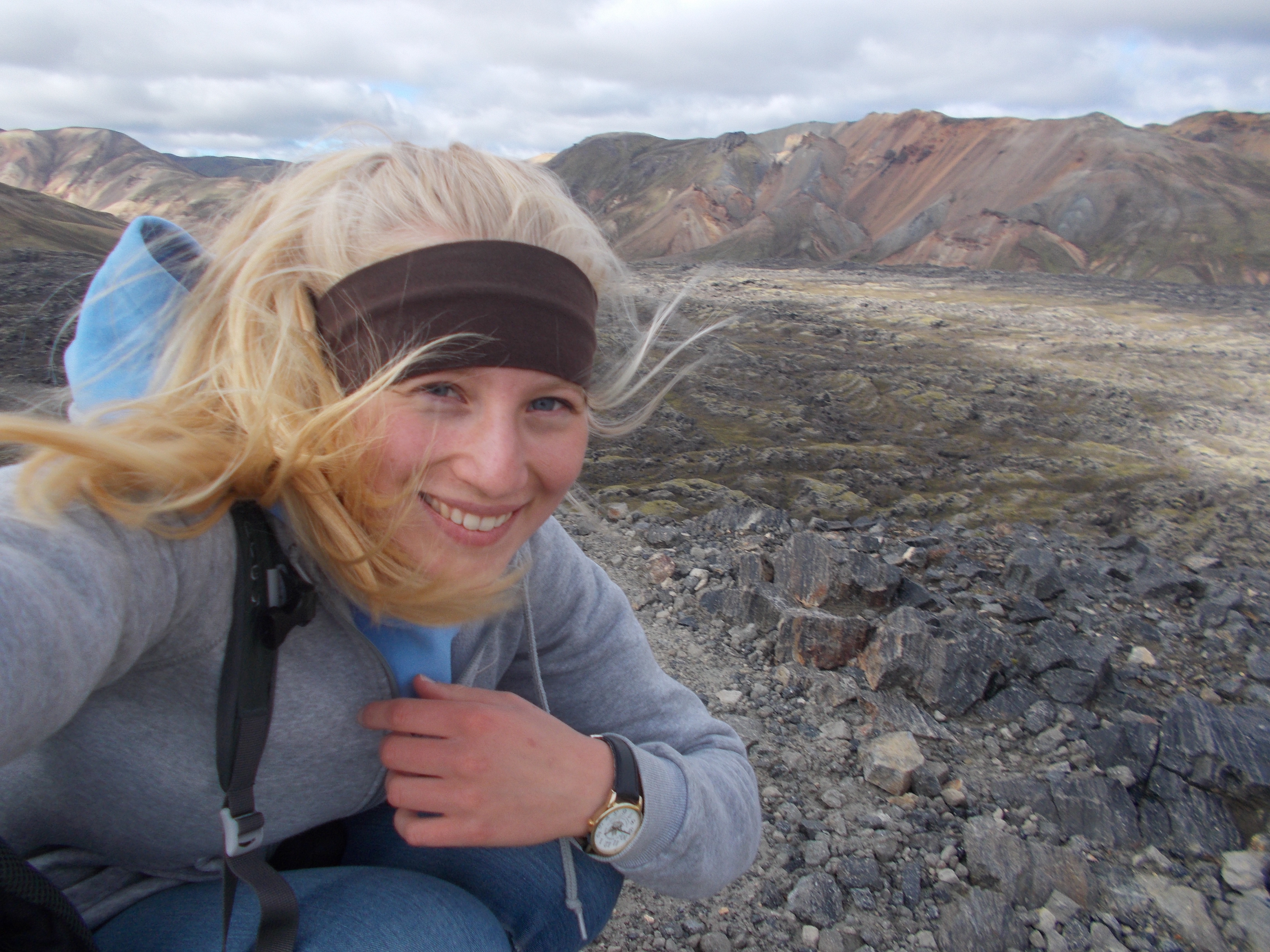
Then a week later, my watch stopped working. At face value it’s not a particularly special watch of huge monetary worth – a black leather strap wearing away on the inside, its face with its lightly scratched surface surrounded by a golden rim smudged with fingerprints. Most people wouldn’t look twice at it, probably thinking it was a piece of junk. I didn’t even wear it in or outside the flat and hardly even used it to check the time, using items of technology such as my phone or laptop instead. And yet just having it around provided a sense of comfort, so that when I no longer heard its faint clicking and instead saw its hand twitching weakly, I felt a pang inside.

Why was it that I was so moved by these items losing their function? They seemed so insignificant. Financially they were of minute value. But their sentimental worth was huge.

I found the watch when I was in Australia, having met up with my sister for a road trip up the East Coast. We spent a night in a hostel in Byron Bay, where it was attached to the base of the bed above me. For some reason it really caught my interest, and I lay in bed just looking at it. I knew that it had probably been left there unintentionally, and that I should probably give it into reception in case someone returned for it. But another part of me wondered if it had been left there on purpose, as a ‘gift’ from one traveller to another. In the end, I took it with me. At first I felt quite bad for proclaiming it as my own – had I not technically just stolen something? But I later came to believe that I really had been meant to take it.

A few months later I was in Canada, on my first proper solo backpacking trip, with the watch strapped securely to my left wrist. On my first full day I went to see Niagara Falls. As a girl used to the countryside over the city, my arrival in Toronto had been pretty overwhelming and I was still not quite at ease with the whole ‘going-it-alone’ process. On the bus back, we passed a sprawling lawn decorated with a flowerbed cultivated into the words ‘School of Horticulture’. The words rang a bell but I wasn’t sure why. I absent-mindedly looked at ‘my’ watch to check the time, only to fully comprehend what the tiny writing on its face said: ‘Niagara Parks Commission –  School of Horticulture’.

Excitement shot up inside me. It was a bit like the feeling you get when you finally crack the answer to a difficult question – it’s often at a time when you aren’t really thinking about it and instead the answer suddenly comes to you just like that, causing a feeling of accomplishment and disbelief. Despite the seemingly obvious word ‘Niagara’ (and image of a maple leaf), never before had I associated the watch with Canada. The overly-imaginative girl inside me began to believe it was a sign; the watch had indeed been left for me and I’d been destined to come here all along, to continue the journey that its previous owner had begun, and perhaps other owners before him/her. I didn’t want to accept the high possibility that it had just been pure coincidence. Before arriving I’d had doubts about my reasoning and ability to travel alone, but now my trip seemed to have a greater purpose, and any doubts were washed away, all thanks to a boring old watch.

The story behind the body spray isn’t as memorable. I bought it in a ‘Canada Drugs’ store a few weeks into the trip, simply because (I was increasingly conscious of my lack of showering and) it was cheap, to the extent in fact that it was almost tacky (‘Mystical – Our Version of Fantasy Britney Spears’) But it had a nice smell – like candyfloss. Whenever its fragrance filled the air after returning home, the fumes would transform my mind back to little moments from the trip where the aroma had been present: moments of joy and excitement; friendship and romance; sadness and frustration. It seems pretty fascinating, when you think about it, how powerful this sense can be for stimulating certain emotions.

From that trip onwards, the watch went on to become for me that special ‘thing’ that many people have and always treasure. It’s normally a cuddly toy that one can snuggle with for comfort or childhood nostalgia, a special stone that acts as someone’s lucky charm, a poem written by a loved one, or a piece of jewellery passed down through a family generation. But for me, it was a plain old watch – an item that only I as the owner could understand the personal significance of. The watch is often a feature in my travel photos, yet few will probably pay much attention to it, viewing it as having only a practical purpose. But it’s the personal experiences surrounding such random objects that make them so special and worth holding onto. They are a gateway to a meadow of memories.
151

It’s fair to say I can get a bit OCD about collecting souvenirs though. And by ‘souvenirs’ I don’t mean t-shirts or mugs bought from a shop at the airport, baring the country’s flag. When I returned home from Canada and reluctantly began unpacking, jumbled together in a plastic bag at the bottom of my bag was a bunch of travel tickets and scrunched-up receipts from certain Canadian shops; dog-eared tour brochures and ripped maps; scraps of paper on which I’d written notes of bus times or the name of a musician I’d heard; pebbles and flattened grass stalks; wrappers and labels from confectionary and drinks specific to that country. I knew it looked slightly OTT, and yet when I discovered later that one of the chocolate wrappers had been put in my bin (mother!) I rushed over in horror to remove it and place it delicately in a box that would later become devoted to travel souvenirs, as if returning an abandoned baby to its cot. Some might say this is the behaviour of a person with worryingly excellent stalking potential, but fresh from the trip I was just so desperate to cling onto every memory.  Each random item took me back to experiences that I wanted to remember, either because they made me feel proud, happy, amused or curious.

Now I’m a little more relaxed when it comes to my souvenir-hoarding, by that meaning I’ve removed the presence of food-related memoirs (mainly because it just makes you crave something you can’t access in your own country). But I stand by the other assortments, curious as to whether, looking through them again in 40 years, they would spark a recollection of some personal event or emotion. I think on the whole, the weirder one’s collection of souvenirs, the more interesting stories they have to tell. It’s fair enough for someone to return home with a load of expensive items from Duty Free, or famous gifts from the Tourist Office shop, but it’s unlikely that these items will provide a special memory of a place. Furthermore, everyone can take a photo of one famous amazing site, but photographs alone can’t necessarily remind one of a unique memory related to it.

You might be wondering how I managed to keep a 75ml can of body spray going for two and a half years. I think that sub-consciously  I was conserving it, not wanting to finish it because that would mean the ending of a tie to certain memories. And so when there was nothing left in that can it was briefly a sad moment, because it appeared to reflect the loss of a link. Likewise, seeing the watch sit silent seemed to signal the end of something, as if a chapter had been closed. Canada was the story I’d been forced to stop reading early because an upcoming degree required other commitments,  and I was reluctant to forget the storyline and the characters completely. The spritzes of spray in the months after acted as a reminder; snippets from the plot I’d immersed myself in. Whilst I had fantastic stories to tell from countries elsewhere afterwards, Canada continued to top the list for the book I found hardest to put down. Now that the scent would no longer hover through the air and the watch no longer tick along, it was as if there were no more words to read –  it was time to accept that, two and a half years on, the trip was officially in the past and no longer a new, glossy book on my memory shelf.

Of course, this doesn’t at all mean that the memories are gone forever. But when one places so much sentimental value on an object, it is easy to feel that a connection to an experience has been weakened in some way. Some people might think trying to maintain strong attachments to travel memories through the form of objects is lame. But what’s wrong with trying to retain a nostalgic association, if the experience really meant something to you? I don’t think people should feel embarrassed about holding onto certain mementoes from a trip because they might seem pointless, unfashionable or weird to others. At the end of the day, it was your personal experience and only you can understand the sentimental worth of something.  Hold on to anything that made you feel anything, because then in later years you at least give yourself a chance to reflect and remember.

***

Relevant links: Souvenir Finder
Unknown's avatar

Pine Cones & Brown Bears | The Things We Can See From Running

The end of my degree is fast approaching and I’m starting to think about the things that I will (and won’t) miss from university. While in time I may indeed start to miss 9 a.m. seminars, hoarding through countless books and articles late in the library, and filling in footnotes on essays, it will be my time in the university’s running club that I’ll miss most.

Presiding over a sports club has had a greater emotional impact than I expected. Being a ‘figurehead’ inevitably makes one more passionate about the sport they represent, and subsequently keen to encourage others to share this enthusiasm. There has been nothing more fulfilling than seeing people show up to a first session with a pessimistic outlook, only to see them again a few weeks later, finishing the session with a smile and saying, “I’m really glad I made myself do that extra set.” Nobody probably notices the little beam of delight on my face when I hear such comments, or watch someone who originally couldn’t complete the warm up running with a new fluidity. It’s a sight that inspires me for my own running too. I’ve witnessed people do things that they originally insisted they couldn’t, simultaneously surprising myself with how much I enjoy and can cope with being a ‘leader’ of a large group. The experience has highlighted how reciprocal the psychological effects of running with others can be, regardless of age or ability.

But the great thing about encouraging others to run, and being encouraged by them, is that it doesn’t just have to take place in school or university. It can be done anywhere, including when travelling. I’m not sure I would have adapted so comfortably to my role was it not for my help-exchange experiences. It was during an evening run in Canada when I particularly learned how when it comes down to significant circumstances, anybody can take the lead.

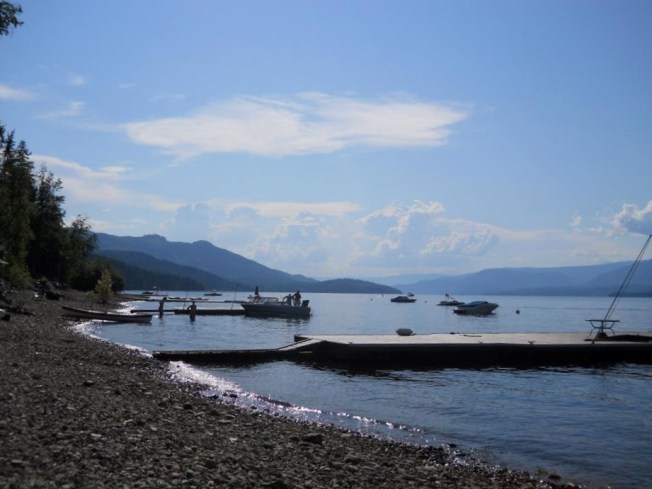
My first homestay experience was in British Columbia, where on one evening I was asked by a mother to take her 12 year old son out for a run. Ice hockey season would be starting soon and he needed to get fit. The family lived on a farm near Shuswap Lake, which we would go swimming in with the dogs and horses. I stretched outside, admiring the melting beams of light oozing from the lowering sun onto the placid surface, until the boy appeared reluctantly. We walked down the sandy drive to the road not saying much, my comment on it being a “lovely evening for a run” provoking only a greater look of dread on the boy’s face. I didn’t know the area well at all, nor the boy’s level of fitness. Watching him swing his arms half-heartedly by his rather tubby torso, head down as he scuffed his trainers over the pine cones on the gravel, I figured we would just go for a gentle jog for a couple of miles. Cars barely touched the road that was sandwiched between dark sheets of fir trees.

Shuswap Lake

The sweet smell of pine fragranced the air as we set off. A delicate humming of midges serenaded my ears, soon interrupted by the sound of the boy panting behind me. Eh oh. Was I going too fast? I didn’t think anyone had mentioned asthma..? I told him to think about his breathing – in through the nose, out through the mouth – wary of sounding patronising…but also of causing my host’s son to collapse. When I glanced behind me to make sure he was still alive, a frown of concentration was etched on his face as he inhaled deeply before blowing out, his eyes fixed straight ahead of him determinedly. “Good! That’s much better,” I said encouragingly. He nodded his thanks, eyes still focused ahead. I considered trying to make conversation, only to decide it wouldn’t help with his rhythm. Occasional calls of “Keep it up!” and “You’re doing really well!” received no verbal response. And so I carried on running in front, letting the sound of pine needles crunching under my trainers entertain me instead and distract from any awkwardness.

A few painfully un-conversational minutes later, the road curved uphill slightly to the right. I had no idea where we were going but carried on regardless, staring at the grey tarmac as if it might contain chalk-written signs telling me something funny to say to lighten the mood. Suddenly the boy piped up with breathless gasps: “Okay… we should probably…start talking now… so that…the bears don’t come.” My head jerked up in alarm. Bears? Nobody had mentioned bears! The faint, innocent smell of lemon in the air suddenly became blotched with an overriding aroma of panic. But being the ‘adult’ here, I told myself I had to remain calm. I swallowed and attempted a casual, “Oh, okay,” hoping I didn’t sound too squeaky, before offhandedly suggesting we turn back. “Yeah,” the boy replied earnestly with a greater fluency of speech that seemed to reflect his new-found authority, “and you should probably run behind me now, because although I may not be too great at this long-distance stuff, I can sure run fast when I have to!”

I bit my lip, trying not to laugh as I obediently slowed to let him overtake. His sudden entrance into protective mode was adorable, providing a brief distraction from the startling issue at hand. “Oh I’m sure we’ll be fine, but yeah, good idea,” I said in a confident tone, before immediately casting a fleeting look over my shoulder at the pine trees to the side. “If you see anything, just follow me,” the boy instructed, as I just avoided stepping on his heels after another cautious glance behind me. I asked him about school and his interests, the words ‘bear bear bear’ running through my mind in time with my quickening footsteps. As he explained the rules of ice hockey to me, I tried to decide which would sound better: ‘I’m really sorry, but your son had a cardiac arrest’, or, ‘I’m really sorry, but your son got mauled by a bear’. Nothing could have prepared me for this.

But gradually through maintaining conversation I became more relaxed and the frequency of anxious peeks over my shoulder decreased. While I would continue to encourage him with desperate utterances of “That’s it, pick up those feet!” and “Doing great!”, he would puff “Almost there,” over his sagging shoulders, which would rise again resolutely every time I urged him on.

The sense of urgency caused the boy’s running to pick up immensely. We arrived back at the bottom of the drive exhausted from our mad dash, the boy bending over double puffing away. ‘He must hate me,’ I thought to myself as I wiped the sweat off my brow. But when he stood up straight, spread across his face was a grin of both relief and pride. “It’s true, you can run fast when you have to!” I remarked teasingly, and I held my hand up for a high five. The boy returned it, sealing what became the beginning of a great ‘brother-sister’ relationship for the remainder of my stay. I felt proud of him, knowing that he probably hadn’t run that fast for such a distance before. And I felt proud of myself too. Having never had a younger brother, just trying to persuade an unfit lad to keep running whilst being responsible for his welfare was a new enough experience, before the small matter of bears came up.

Being in a position of responsibility had made me act more calmly than I probably would have if alone, simply because I felt a duty of care to someone; a sense of duty that would have appeared with any child. And at the same time, the young boy had adopted a protective persona that disguised his real fear, feeling that it was his duty to take charge because of knowing the area best, and because of this belief that, as the male, he should look out for the female guest.  A true little gent. Or at least I thought so until it occurred that he’d organised things so that I would be the first to be eaten…

This memory is what always comes to my mind when people ask how I can enjoy running so much. It can do so much for human relations, mainly because of the various contexts in which it can take place. Everyone knows that marathon runners form great friendships because all share a sense of accomplishment, which they have achieved having helped one another get through the process. But this effect of running doesn’t only come from huge distances or competitive settings. In this instance, the boy and I had become closer through a shared sense of fear, with the act of running helping to bring us together through our mutual support and dependence. Someone comparing the before-and-after scenes at the bottom of the drive couldn’t have failed to notice how paradoxical they were, following just 20 minutes of running. I’ve continued to see such sights whilst training with my university team mates.

It only really hit me recently that there probably wasn’t actually any real danger of being chased by a bear – it was perhaps a rumour that the boy’s young, gullible mind had believed. Or maybe he had even made it up so we could head back early, thinking that the girl with bright blonde hair and a funny accent would probably fall for it. But even if that was what happened, I’m glad for it, because of how much the experience helped me get the most out of running while at university. I’ll truly miss walking out of Regents Park with stories and special moments to look back on from the training session, but if I keep running, I know that there will be so many more of these to come.

Unknown's avatar

10 Reasons to do a Help-Exchange

When planning a trip, I tend to split it into two sections – part of it involves true hostel-loving backpacking, the other a help-exchange. We’re living in a day and age where students and ‘gap yah’ kids will spend huge amounts of money to volunteer in an orphanage in a developing country for two weeks, in an attempt to boost their CV with extra credentials. Personally, I’m not a fan of this organised travel; partly for the reason that I believe it does little to encourage independence and travelling skills; partly because I’m not convinced that continuously passing young children onto different groups to be ‘cooed’ over and have photos taken with is beneficial for their mental well-being and social development. (This article sums it up brilliantly). Students may also be lured into paying extortionate amounts of money for holiday package tours, where they only mingle with fellow tourists and essentially see the country for five minutes.

If you do a help-exchange in contrast, you’ll spend so much less money, yet probably get so much more out of the experience. The system is simple – you register with a website, pay an £18-£20 membership fee that’s valid for two years, and create a profile for yourself. You can then scout the website’s host listing, or hosts can contact you. The idea is that you do four-six hours of work a day for your host in return for free meals and accommodation, so that you’re both doing each other a favour. In your free time you’re free to go off exploring on your own. A help-exchange can be done in any country on any continent, with an incredible range of options on offer – from helping an Eco camp in Africa build a school for six weeks, to looking after huskies in Norway for one week. Below are ten extensive reasons why you should consider doing one yourself!

1. Develop social skills & independence
The process of organising a help-exchange requires the sole effort of the applicant: you yourself have to find an appropriate host decisively but considerately, noting their requirements whilst taking into account your relevant skills and other travel plans. Instead of filling out an application form, you have to contact the host directly either by phone or email, ensuring you come across as friendly, coherent and suitable in a few sentences without referring to your ‘exceptional’ A level results. You have to organise how you get to your host – sometimes you might be asked to turn up at the door – in which case you need to plan travel arrangements. And finally, you have to introduce yourself to your host using communication skills that convey your genuine personality rather than the one you might use to impress someone in a job interview, and conduct yourself aptly for a guest. The process is like a less formal version of applying for a job – there are fewer competitors, no strict deadlines and no daunting interviews. Help-exchanges are also a great way to boost one’s confidence at meeting new people.

 2.  Save money & recuperate
A help-exchange is budget travel at its best. Even staying in hostels that only cost £17 per night starts to add up if you’re on a long trip. The particularly great thing about a help-exchange is how spontaneous it can be – you can contact somebody even when you’re in the country having commenced your travels – ideal if you’ve suddenly found yourself short of funds or there’s been a problem with your current accommodation. Staying in one place for a while also allows the weary traveller to rest their body and mind – it’s nice to have some time off lugging a backpack around everyday, or constantly thinking about public transport timetables and hostel bookings for the day ahead. Saving money on the practicalities of food and accommodation also means your pennies can be put towards more exciting activities in your free time. Plus, being given free meals in return for your help makes a nice change from a cheap ‘on-the-road’ diet of cheese-sandwiches, bananas and biscuits…

3. Develop new practical skills
The wide range of jobs that hosts advertise for help with means that you can guarantee learning a new skill, ranging from knitting to carpentry. Sometimes I’ve not contacted a host whose description sounded perfect in so many ways, just because I had no experience of the specific work they needed help with. But one occasion where I didn’t let this feeling of inadequacy put me off was with a family on Vancouver Island. They owned a vineyard, and as much my mum might have tried to encourage me over the years, I had no experience of pruning. As I was shown what to do on my first day thoughts of: ‘Oh crap, I’m totally going to ruin this guy’s vines, he’s going to be annoyed with me!’ filled my head. Then I remembered that it wasn’t a test, and I wouldn’t be judged for asking questions, but was actually more likely to be respected for trying to ensure I did a decent job.

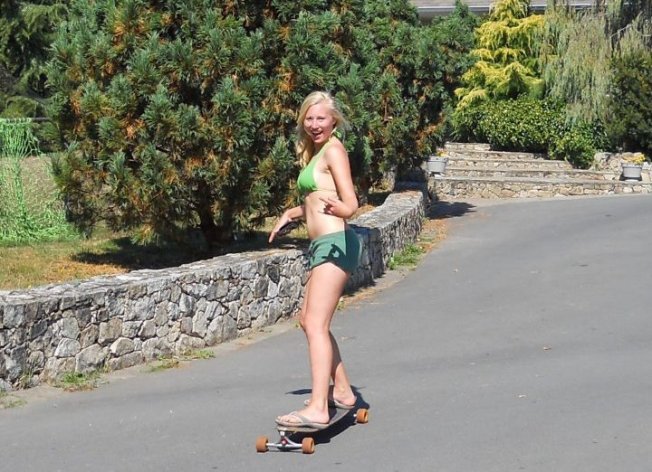
Even when you’re not working, you can still learn new skills in your free time from family members. The first time I went fishing was during a help-exchange in southern BC (I wasn’t very successful). On another exchangeI learned the basics of lacrosse and after a few attempts (and one fall) had (almost) mastered the art of longboarding. It’s unlikely I would have accessed such activities so easily when travelling around alone.

317846_10150818528330495_967448782_n

4. Inspire youth
Being the youngest of five children, I’ve never had much of an opportunity to be a ‘big sister’ to anyone, but taking part in help-exchanges has changed that, as I’ve been able to become a confidante to those a few years younger than me. Being trusted by an adult you’ve never met to take a position of responsibility over their children is a humbling gesture, and as a result makes you determined to live up to the duty and set an example. In my case this has mainly involved listening to problems, sometimes of an everyday form and sometimes more serious, and using my experience to give advice for the short or long term. With young teenage girls I think, being female myself, that it’s a particularly rewarding process. They’re going through a stage when older authority can be resented, and being a good role model without alienating them can be quite challenging. But if you get the balance right, you’re likely to see reserved body language become more confident and bored facial expressions develop into expressions of curiosity and familiarity, as they realise that the new girl in their house is actually not that bad, even though she travels by herself/is single/wearing scruffy clothes and no make-up/into running/a bit of a geek. I hope that as a result of this, most of the girls I’ve stayed with have decided that they too would like to embark on their own independent travel adventure one day. Help-exchanges demonstrate that you don’t have to be in a less-developed country (or pay lots of money) to have a strong impact on someone’s life.

5. Expand human knowledge
Taking part in help-exchanges has made me become a better reader of both individual people and families, reminding me in the process that despite any cultural differences, certain human emotional dilemmas occur universally. As a result I feel like I’ve gained greater maturity and sensitivity, which can be applied to everyday life. It’s something that can’t be taught, only obtained through observational experience. An example is from Canada, where I lived with a 15 year old girl whose life, at the insistence of her mother, revolved around horse-riding and ice hockey. Most of the time she was reserved around the household. Then at the end of the week the two of us went to the cinema and I saw an excitement in her that I hadn’t seen before, realising that it was simply because she wasn’t used to going out for social events. Away from her normal routine and slightly domineering mother, she felt freer and more open. Meanwhile on an exchange in Germany, the 18 year old daughter started tearing up as she said goodbye to her parents before they left for their holiday. She wouldn’t see them when they got back as she would be on holiday herself. “I just feel bad because by going away and doing my own things I see them less, and they’re only getting older,” she explained to me after they’d gone. I could completely empathise with her, having experienced similar feelings of guilt in relation to my own parents. It was an irrational feeling that I hadn’t considered might be felt by others. Doing a help exchange can make a ‘foreigner’ seem more familiar, while also giving you something to take back to your own family; be that a greater appreciation of or the inspiration to change its dynamic!

6. Practise a language
The best way to learn a language is through immersion – visit the relevant country and spend time with native-speakers, listening to their conversations and attempting to initiate ones yourself. Even if you’re not planning to learn the language (mastering Icelandic in two weeks would have been asking a bit too much), it’s nice to simply listen to the different sounds and watch people interact through it, sometimes being able to guess what they’re talking about from their actions. While staying with a small family in Germany, I would carry a notepad around with me, at times randomly asking the daughter, “How would I say this?” or “What does that word you keep saying mean?” She would also ask for clarification that her English was okay too, so that both of us were benefitting. I was then able to use what I’d learned after I moved on from the family. It makes a nice change from hostels and charity volunteering camps where, on the whole, English is the international language. And even better: the tuition is free.

7. Learn about other cultures
Living in a family’s home creates an intimate environment where you can witness the everyday native lifestyle – it’s the best way to learn about the values and norms of the country, either through conversations or general observation. Whilst on my Icelandic help-exchange I was told about Christmas traditions (including a detailed description, involving a picture book, of the 13 different Santas), as well as the less obvious and random traits of the country’s culture. For example: when trying to establish ages, an Icelander will always ask for year of birth over the actual number; a wife doesn’t take her husband’s surname – instead it is always the father’s name, ending with the prefix ‘dottir’ for girls and ‘son’ for boys; names of all residents are written underneath the house number next to the door; dried haddock is a popular snack, and so forth… Staying with locals gives one a greater awareness of and access to the signature brands and dishes of that country, such as ‘Tim Hortons’ in Canada and Skyr yoghurt in Iceland.

Doing a few help-exchanges in different areas is even better, as you get to witness the variety of the country for yourself, just like someone travelling to England would notice changes between London and Yorkshire. For example, I could sense varying attitudes towards immigration, marriage and careers in different areas of BC which, as a History student, I found really interesting. What’s more, if there are other foreign helpers staying at the house, you can learn more about their culture too. The first time I had a proper conversation with someone from China was during a help-exchange in Canada, while meeting a few Germans there partly inspired my decision to travel there the next summer.

8. Integrate into a family and community
In previous posts I’ve written about the overwhelming effect of being welcomed into a host’s life so warmly. Sometimes the ‘click’ won’t happen, either inevitably from significant differences in outlook, or as a result of events during the exchange. But when it does, especially in such a short period, it’s a very touching experience. This, combined with getting to know the local area well, can make you really feel ‘at home’. Doing errands for a host in Germany such as going to the post office and doing the shopping required me to familiarise myself with the area, making me feel like part of the community by the end of the exchange. By the end of my week with a family in Reykjavík, I was on greeting terms with an old man who walked his pug at the same time as I walked my host’s border collie. At family dinners or parties, I’ve been involved in the conversation almost, at times, like a member of the family. Such moments can lead to a bond with a family – a long-term bond that hasn’t been formed through the influence of alcohol and consolidated by the desire for a companion to provide temporary convenience and security, as is quite often the case with volunteer-travel friendships.

For me having no younger siblings, forming a bond with a child or young teenager is particularly special. At first introduction they are often quite shy and making conversation isn’t so easy. My Icelandic help-exchange also involved babysitting an eight year old. His English was exceptional, but there still seemed to be a barrier as we sat eating breakfast on my first morning. After getting a shrug in response to “What’s your favourite subject at school?” I asked if he wanted to walk the dog with me: “Nahhh”; or go swimming: “No thanks.” Hmmm. ‘It’s going to be a long week,’ I though despairingly. “Maybe you’d like to play a game?” I asked hopefully. The boy said nothing. Then suddenly his eyes lit up: “Do you like Star Wars?” Ermm… “Yeahhhhh!” I replied enthusiastically. I know nothing about Star Wars. The next two hours was spent playing a game with no idea what I was doing. But it was worth it, because by the end of it the boy was interacting with me more. Within the next few days I was making him laugh as we played toy soldiers or football, and chatting animatedly with him. Then came the day when he asked “Will you be here this time next week?” followed by a sad “N’owhh” when I said no, and upon hearing that I welled up.

One might say that the same emotion can be experienced after looking after an orphan as part of a charity project, but I would disagree. A charity scheme essentially requires a bond to be formed, by expecting volunteers to devote complete attention to a child who is not already emotionally attached to a regularly-present biological relative. In contrast, children from a host family are less likely to require or crave a new bond, simply because they already have a strong and satisfying connection with their family.  The process of forming a bond is therefore more contingent on both characters involved, which subsequently makes it feel more treasurable.

9. See incredible places & do amazing activities for free
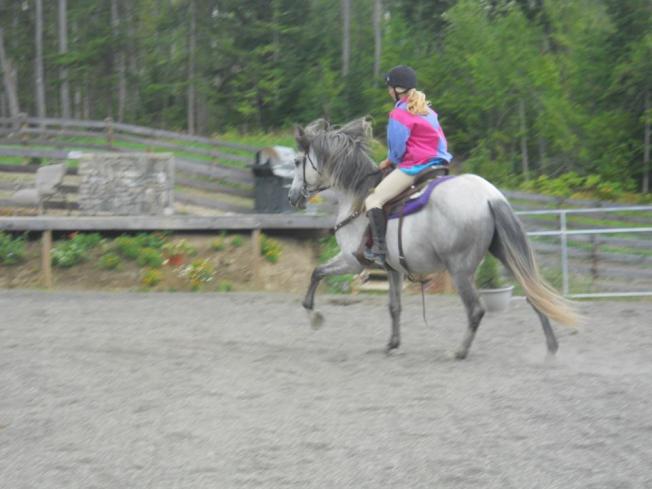
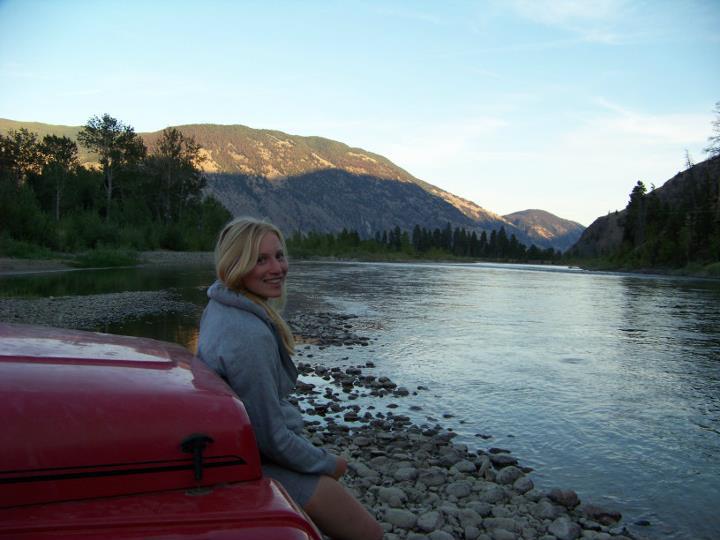
They say that guide books shouldn’t be relied on as source for travel ideas, and help-exchanges prove it. A key reason I’m such a big fan of them is because of their potential to help one discover a phenomenal area of the world, or be given a rare opportunity to do something wonderful. For example, one of my help-exchanges in BC involved working on an Andalusian horse farm, where I helped care for and exercise the horses. Being allowed to ride such beautiful animals as ‘work’ made me feel so lucky, as I thought about what some people would give to be in my position. Another family took me tubing down the Similkameen River, and on my final night with them we drank beers and ate ‘smors’ around a campfire in the Okanogan forest, giving me a true rural Canadian experience. This was an area that I would probably not have considered visiting had I been touring the area independently, because of both the lack of tourist accommodation and lack of attention given to it in my guide book. On Vancouver Island, my hosts lived five minutes from the beach, from where I could admire some of the most enchanting sunsets I’ve ever seen. I was given a tour of Victoria and taken out on the family’s boat for an evening cruise. Meanwhile in Germany I was taken on an afternoon sight-seeing tour of Frankfurt with all the benefits of local knowledge, and in Iceland I got to experience the brilliant Culture Night celebrations with native company. For just a few hours work a day, you can receive something back in return that no salary, no matter how big, could buy.

296149_10150810495360495_1363672671_n

10. Form special memories & valuable contacts
The sense of accomplishment after discovering or arriving at a stunning place completely on my own is what makes me love travelling alone…but I’d be lying if I said that some of my favourite and strongest memories from trips haven’t come from help-exchange experiences. Some of them are from the examples stated in #9, while some weren’t necessarily so treasured at the time but in hindsight have provided extraordinary tales of great humour that, without a help-exchange, I probably wouldn’t have experienced. Take the time I went to a house party in Canada, only to find myself constructing a sling out of a tea towel for a guy who broke his collarbone after falling off his quad-bike whilst riding under a very very large influence; or the time a host asked me to give her daughter a lift to a bonfire party in her car (as if having to quickly adjust to driving in an opposite way to what I was used to without damaging her car wasn’t enough, I then had to reverse half a mile along a dyke in the dark after we took a wrong turn); and last but not least was the time one family’s 12 year old daughter jokingly drove a lawnmower towards where I was sunbathing on a downhill slope before parking up, only for someone to start screaming at me to move (she’d forgotten to put the handbrake on…)

Then of course, there are the friends that can be made from a help-exchange, either host’s children or fellow helpers, who themselves account for many of the memories formed. I’m still in regular contact with many of those people I’ve been fortunate to stay with, one of whom I visited in Germany after meeting her in Canada, and one of whom I travelled around the USA with three years after first meeting. These people provide a travel contact either for at the time of the exchange or in future, and meeting them has inspired me to become a host one day myself, in the hope of meeting even more special people and creating even more special memories.

***

Being involved in a help-exchange is beneficial for a range of reasons: the potential to help a person develop for the better whilst allowing them to have an impact on someone else; the potential for new knowledge, exciting opportunities and significant experiences; the potential to form strong friendships; and simply for the potential to produce a fulfilling sense of knowing you’ve done someone a favour, whilst also feeling extremely grateful for what they’ve done for you. And the best thing about it is that these elements can be attained without having to spend thousands of pounds.

***

Been convinced? Check out some of the websites below and get your own help-exchange adventure started!

http://www.workaway.info/
http://www.helpx.net/
http://www.wwoof.net/

Unknown's avatar

A Bus, a Backpack, and a Blessing in Disguise

528077_10151625041290495_589838579_n

 “Don’t lose your passport” must be one of the most-heard pieces of advice given to the young person by their parents before they begin their travels. The gateway to one’s adventure, it seems like the most obvious and significant item that could go missing. So what about the backpack? It is, afterall, the locker to your life during your time away. The love-hate relationship you develop with it from acquiring achy shoulders after walking with it all day, combined with your sigh of relief at seeing it emerge on the conveyor belt, make it almost indifferent to a human travel companion.

This is something that’s particularly true when one is travelling alone. Your backpack becomes your loyal friend who you love to see when you wake up in the morning, but occasionally grow frustrated with for following you everywhere for the rest of the day. It only takes a week of its sole company to appreciate it so much that you begin taking for granted just how important it is. Whilst losing backpacks in transit is common, the location of the traveller in the airport means that on the whole, one can expect to find experienced guidance and a swift resolution of the problem. If someone is with other people, there is the emotional and practical support present to help dry their tears of stress and lend them clothes for a few days.

But when you’re on your own in a random part of the country, who will be there to support you? This was the exact question I found myself asking outside an empty bus station when I lost my backpack, halfway through my first sole travelling experience, aged 19.

***

I’ve mentioned in previous posts how I viewed travelling alone as a more do-able prospect after meeting someone who was doing a help-exchange with my family friends in Australia. The system was simple – you did around six hours work a day for the family and received free food and accommodation in return. It seemed like a great way to save money whilst learning about a country’s culture first hand. Seeing this guy become a valued member of the household was touching and I liked the idea of it for myself.  Inspired by his experience, I began planning some for myself in Canada.

However, being biased I assumed my new friend had simply been lucky – surely not all families could be so welcoming? To invite a stranger into your home with your children and possessions seemed risky. After the increased media-hype about child abuse in care homes, I couldn’t help but feel unconvinced about the ability of a family to welcome someone they met through the internet so easily into their life.

I had a week of sleeping in hostels before I would experience this for myself though. And indeed, that one week was enough to confirm to me just how important the backpack is to an independent traveller. Being my first time alone in a foreign country, I was borderline obsessive-compulsive about its security for the first couple of days while in Toronto. I doted on it like a baby, making sure I was super-careful doing up the zip so as not to strain it, and reluctant to get any dirt on it. Then I landed in Calgary to explore the Rockies and embraced the knocks and scuffles the backpack would inevitably receive from various rural activities. Hoisting it onto my back every morning before a hike, its company made me feel like I was on a real adventure. I was experiencing huge senses of personal achievement and my backpack was the one consistent partner who understood. What had begun as a protective arm over it as it sat by my side evolved into a gesture of fondness and appreciation for the feelings of support and security that its presence produced.

***

My first help-exchange in British Columbia was on a horse farm. The week went fast and by the end of it, as pleasant as my hosts were, I still felt separate from them. I’d been so busy working that I hadn’t had a chance to immerse myself in their way of life. And yet I sensed that this wasn’t something they looked for from the scheme, instead viewing it as the share of a practical favour, with no strings attached. How included I was seemed completely contingent on how useful I had been, and my sceptical beliefs were reinforced. ‘What was I expecting from one week’s stay anyway?’ I thought as I filled (and refilled) my backpack.

It was a sweltering hot day on August 16th as we arrived late at the bus station. I hurried through the depot and gave my backpack to the bus driver to store without even thinking about the need to tag it, since my journey was direct anyway. Our friendship had reached that stage where I was taking its constant company for granted, and I presumed I’d see it again in a few hours. The family thanked me for all my help and then walked back to the car without looking back. Feeling like I’d already been forgotten, I boarded the bus with my smaller bag.

The bus picked up a fault, so we had to change at Kelowna. I went to retrieve my backpack but the driver assured me it would be put onto the correct bus, so I left him to it. I was the only person getting off next and began feeling excited about my second home-stay as the driver went to fetch my luggage. “A green backpack?” he asked uncertainly as he rummaged through. “I don’t see one here.” Silently blaming his eyesight, I went to look myself. But it wasn’t there; my companion wasn’t there. There was no feeling of comfort at the sight of its bulky shape. Butterflies began to flood my stomach. He asked if I’d put a tag on it, and shook his head disapprovingly when I blushed and said no. “Where do you think it could be?” I asked with panic rising in my voice. The station was closed, so he suggested I ring the Kelowna bus depot.

I frantically slotted dollar coins into a phone box as the driver stood waiting awkwardly beside the bus. The lady in Kelowna’s office couldn’t see a backpack anywhere and suggested it was on the bus to Vancouver. I dialled the number she gave me immediately as sweat drops gathered on my forehead – a mixed effect of the heat and my sudden stress. The bus driver came over to check my progress. Nobody was picking up. He scratched his head and hesitated before saying “I’ve gotta go,” with a shrug of his shoulders. I watched the bus turn the corner and disappear out of sight, leaving only clouds of gravel-dust behind. Suddenly everything seemed quieter. That was the point where it hit me that I now really was on my own. The apprehensions I’d had a year earlier about travelling alone were unfolding and the tears began falling. I felt like the stupidest and unluckiest girl in the world at the same time.

30 minutes and a list of furiously-crossed-out unsuccessful numbers later I reached the correct number for the Vancouver office, only to find it had closed for the day. Frustrated, I crossed the road to buy a drink from the gas station and sat on a bench outside this empty depot, thinking to myself ‘Mum and dad can’t help you now.’ Trying to be rational, I told myself that most importantly I still had all my essentials, including my passport.  In the meantime I’d just have to find my hostel for the night and try the Vancouver office again in the morning. But I was meant to be meeting my second hosts tomorrow. What use was I going to be to them without any clothes? I couldn’t work outside in the peep-toe sandals I was wearing. I had no number to contact them on, so I had no choice but to turn up simply to say that I couldn’t work for them anymore, because I had to go to Vancouver to find my backpack.

The next two hours waiting for my next bus were the loneliest two hours of my life. When it did arrive the driver asked if I had any luggage for the hold, so I told him what had happened. But my brave face had returned in the presence of others and I said with a laid-back manner that I’d ring the Vancouver office tomorrow – “it’ll be probably be there.” Climbing the steps onto the bus however, my face burned as behind me he exclaimed ‘Good luck!’ with a sarcastic snigger. That comment stuck in my head and I struggled to sleep in the hostel that night, filled with unease knowing that my travel companion wasn’t by my side. Wearing the same clothes from the day before, I rang the office early only to hear that nothing there fitted my description. My heart sank and I boarded my next bus reluctantly, anxiously anticipating my next host’s reaction to meeting me, luggage-less.

A blonde lady in an old VW was parked outside the tiny bus station. I felt like a child as I introduced myself with a squeaky voice and explained my problem.  With a drawl expressing both surprise and calm, she recalled never hearing this happen before and led me to the office to speak to the staff. A man and woman inside greeted her with a casual “Oh hey, Lisa”. It turned out they were her daughter’s neighbours. They gave me the numbers of potential stations my backpack could have been deposited at. I rang one of them and hesitated on the pronunciation of my new location. Lisa corrected me with a wink, adding, “You can give them my number to contact, honey.”

Lisa lived in a small town five minutes away. Bare trees dotted the dry brown hills that overlooked the sparse valley like bristles on a hair brush. “I’ve lived here my whole life”, she said proudly. Whenever a car did pass on the bare road, it was likely that Lisa would recognise them and flash a wave. We stopped by her daughter’s place to say hello. I went in for a handshake but she gave me a hug and said “Don’t worry, you can borrow anything,” when hearing about my backpack. They didn’t seem bothered at all. Lisa’s lovely house was a few minutes down the road. The sweet aroma of banana muffins filled the air in the huge kitchen. Country songs played on the radio, soon drowned out by the sound of her pug greeting me with yelps of excitement. I was shown upstairs to my room and offered a shower. “Just chill out today and make yourself at home,” Lisa said with a warm smile.

I collapsed onto my new bed next to my fresh towels and stared into space, overwhelmed. Only an hour ago I’d been fretting over my next move, biting my nails as I wondered where I’d be sleeping tonight. Now I was sat in a room with a toothbrush and clothes lent to me by the younger daughter, as if nothing had happened and I was a regular guest. The sudden change of situation stunned me. I’d never felt so grateful in my entire life. And I wanted to show it. So I put on the clothes and started weeding the garden, determined to show my appreciation and make myself useful no matter what.

In the evening the whole family came round and we sat outside drinking beers. They spoke about the latest town gossip, with me wondering how there was so much to say about such a small place. It was like being at home, only thousands of miles away. The next morning Celia and her fiancé offered me a lift to a second-hand store in Penticton. She sang along tunelessly to ‘Under the Bridge’, with Ben resting a hand on her leg. They planned to marry in Lisa’s garden. In the evening we took the pick-up down to the Similkameen River and spent a few hours fishing and shooting at tin cans, with Celia laughing at her photos.

I don’t know whether it was because I was wearing new clothes, but something about being in this place, with these people, made me feel like a new person. They lived in such a close-knit community and yet I knew that as long as I had a heart and a sense of humour, I would be welcomed into it. At first, losing my backpack had made me feel like I was missing part of myself, but now its loss brought a strange sense of new identity. With a greater dependence on other people had also come a greater willingness to integrate and share my experiences with them. Out jogging later on in the week I waved absent-mindedly at a passing car being driven by a guy I recognised from a house party I’d gone to a few days earlier. I’d been here less than a week and already felt like part of the neighbourhood.

I imagined turning up my previous hosts’ house with no clothes and knew they would not have been as sympathetic. My incentive to help this family out wasn’t from knowing it was a compulsory condition of the agreement, but from a desire to help in return for their generosity. Likewise I could tell that Lisa didn’t simply view me as a temporary employer. She was curious about my life and family, asking questions about us as if wanting to compare. In the car she sang along to Joni Mitchell on the radio, like my mum would.  And I really did see her that way – like a temporary mum. Help-exchanges aren’t necessarily meant to produce that feeling. They might cook for you, but the mothers of the house aren’t required to treat you like a child of their own. But Lisa did just that for me, when I needed that sense of comfort and care. On my last day I went to do my washing, but she said “Oh just leave it, honey, I’ll do it.” The only other person who had done my washing was my real mum. As we hugged goodbye at the station she said, “And remember, you’re welcome any time.” Sometimes I think people say that because they feel they have to. With Lisa, I knew that she genuinely meant it.

I only spent a week with the family in that small town, but it was enough to restore my faith in the compassion of people from around the world towards others they have only just met. Some people will re-define the ‘rules’ of a certain agreement for the sake of helping another human being. I spoke of a backpack almost being like a backbone. When I lost mine, Lisa replaced it and restored my confidence in continuing my trip with an adventurous mindset. I really valued my backpack, but without losing it, I’m not sure I would have got so much out of this travel experience. I never did see my backpack again, yet the trip went on to become my most treasured to date.

***

Help-exchange websites: www.helpx.net / www.workaway.info

Unknown's avatar

Three Days in the Canadian Rocky Mountains

I spent three days exploring Alberta’s Rocky Mountains back in August 2011.  Three days is of course inadequate for covering the whole of this vast area, but it’s enough time to get caught in its majestic spell. Banff, Jasper and Lake Louise are ideal stops for acquiring a taste of the Canadian Rockies.

Day 1

A UNESCO World Heritage Site, Banff National Park is the third oldest of its kind in the world, having been established in 1885. The town itself is also the most populous in the region, and I was glad that my hostel was located away from Banff Avenue with its bustling tourists. Banff Y Mountain Lodge is situated right next to the Bow River, which is lovely to walk along during sunrise or sunset.

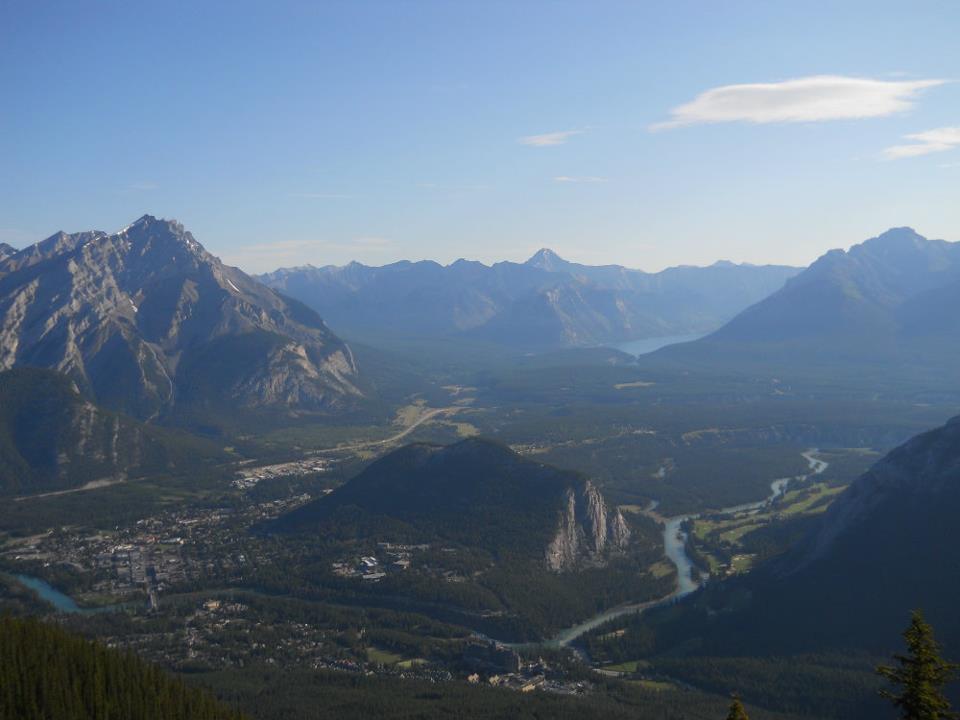
A bus from the town will take you up the base of Sulphur Mountain, and if you don’t have time or desire to hike your way up, it cost just under $35 (at the time of writing) for an adult ticket to take the 10-minute ride on the Gondola. This might seem pricey but the views are definitely worth it. Imagine being surrounded on all sides by nothing but jagged mountains studded with fir trees, as you look down like a royal on your kingdom below. I could have happily stayed up there all day. The gondolas run from 8 a.m. to 9 p.m. in summer so technically, you could.

Views from Sulphur Mountain, Banff

Banff’s Central Park was heaving with midday activity. Lying down basking in the sun, head resting on my backpack, I was reminded of childhood camping trips as mothers dealt out food to their excited kids on picnic tables. It was such a pretty area, but I couldn’t help but wish there were fewer people around. There was something very commercial and glamorous about Banff Town, and if anything I felt slightly left out in my untidy outdoor clothes. I could see hardly anyone else with a backpack, and anyone who did have one was likely to be kitted out in fancy clothes that screamed ‘all gear no idea’. But maybe that was just because the more experienced travellers were out hiking on a mountain somewhere.

I’d heard that Jasper, also a World Heritage Site, was quieter than Banff and contained more wildlife, so had high hopes as I boarded my Brewster bus in the early afternoon. At one point in our journey the bus slowed to a halt. I looked towards the front, wondering if we’d broken down and starting to wish I’d stocked up on more food at the supermarket in case. But no, the bus driver had simply spotted a black bear on the side of the road. I scrambled out of my seat to look through the window on the other side and just caught a view of its large rear as it sneaked behind a bush. A few people on the bus laughed at those tourists who’d got out their cameras excitedly. This was obviously a sight they were used to.

Continuous mountains towering like statues above sparkling-blue lakes dominated the scenery as we carried on along the Icefields Parkway. The air conditioning on the bus stopped working and I grew more impatient, itching to be on my feet again. I instantly noticed a difference upon getting off the bus in Jasper Town. It felt more homely and natural here. I’d booked two nights at the HI-Jasper, which was located 7km southwest of the town. The staff at the tourist information centre will happily book a taxi for you, as buses run less frequently in the evening. A guy in his twenties with long hair picked me up. He must have been drinking coffee all day because he was full of energy, constantly making jokey observations about the tourists as he nodded his head in time to ‘Give it Away’ by the Red Hot Chili Peppers whilst the taxi climbed the steep hill up to the hostel.

I walked up some steps into a rustic building, where Fleetwood Mac was playing in the reception. My dorm contained 28 bunk beds and I was reminded of those hospital wards you see on films about World War Two. A tiny Vietnamese girl was in the bed above me. I introduced myself and asked if she wanted to go for a wander outside with me – a decision I soon regretted as I found myself being attacked by midges. Her name was Wen and she was painfully shy and with limited English. If I’d been slightly anxious about travelling alone in a country that spoke my first language, I couldn’t imagine how apprehensive this girl was.

Day 2

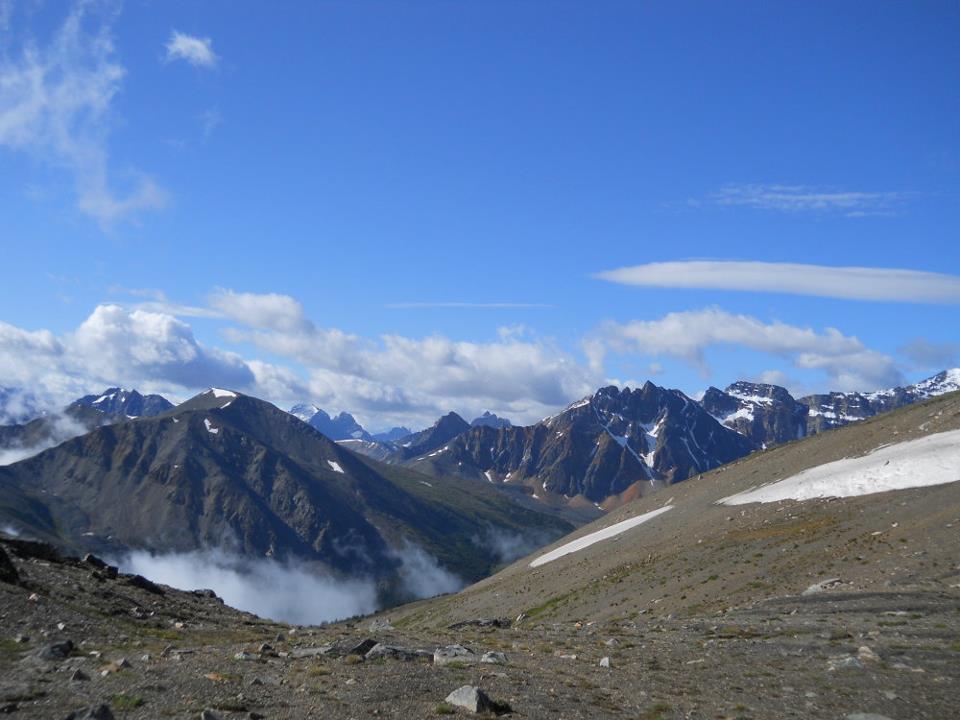
I rose early and packed a small bag, excited for my busy day ahead. Jasper Tramway was about 20 minute’s walk up the road from the hostel. Unlike the Banff Gondola, larger carriages carried groups of us up to Whistlers Mountain, which stands at 2464m high. Puffy clouds surrounded us and the cold air hit me immediately as I stepped out of the tram. As I stood waiting for gaps in the clouds to appear and reveal the view below, I was joined by a group of Chinese tourists who insisted that I be in a photo with them.  After my two minutes of feeling like a celebrity I proceeded with the 1.5km hike up to the summit of the mountain. As I climbed higher over the loose rocky terrain, the air gained a greater sting in its bite and I began to regret wearing a playsuit that showed my bare legs.

Teeth-chattering views in the Canadian Rockies

The views were even more incredible that those on Sulphur Mountain. I was stood level with the mountains, their sharp snow-capped peaks poking up for miles in front of me, with wispy clouds floating lazily between them. I stood gazing in mesmerisation, until a man approached and asked dubiously “Aren’t you cold?” Feeling like I’d been woken from a dream, I turned to him and insisted I was fine. “I’m from Yorkshire,” I joked. He didn’t look convinced. I didn’t want to leave but ten minutes later the chattering of my teeth told me it was probably a good idea.

There was a souvenir shop at the bottom of the tramway and I appreciated the fact that, for once, I could find my name on the gifts! A shuttle bus ran down to Jasper town, from where I would begin my afternoon tour with Sundog Tours. There were only seven of us and I was the youngest and only sole traveller, but because it was a small group I didn’t feel swallowed up. If anything, I felt like everyone was looking out for me, even though I didn’t crave it, and it was quite touching. Our first stop was Maligne Canyon with its steep gorges and gushing falls. Then we were driven onto Maligne Lake, slowing every now and then to make way for a group of care-free mountain sheep taking over the road.

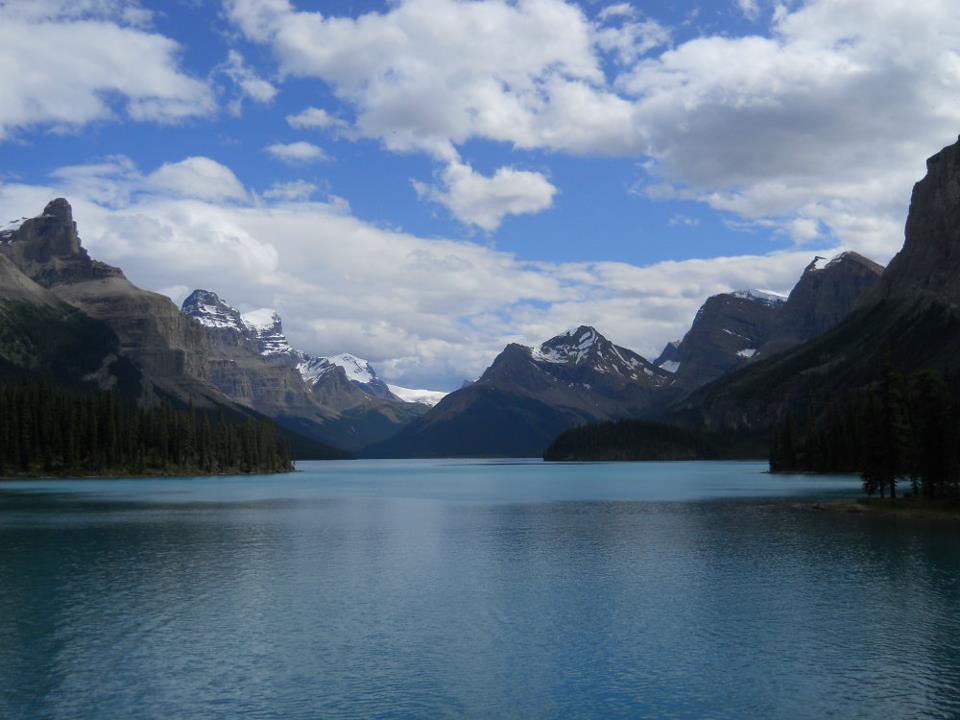
Our group joined a few others as two young guys with ear plugs took us out on a boat trip to Spirit Island, where the magic really began.  The name ‘Maligne’ (or ‘malignant’ in English) at first seemed unsuitable for an area of such beauty, but I soon started to understand its relevance. The views were spellbinding – like something from a fantasy film. Huge glacier mountains looked down on the shimmering water, the colour of which was a turquoise-blue unlike anything I’d ever seen before, surrounded by forests on either side. It was an infectious sight, and one could almost believe that there was poison in the lake to make it such an incredibly rich and unique colour. The lake was placid and so inviting, but who knew what secrets were hidden underneath.

Majestic views of Maligne Lake from Spirit Island will put a spell on you

When the boat got back to shore we went for a hot drink in the cafe. A Belgian couple sat with me and asked where I was from. Upon learning that I was English the woman sat up with interest and said “Oh! So, do you know how Amy Winehouse died?” I couldn’t help but feel amused. Of all the questions she could have asked me, this was the first one! The man remarked how unusual it was to see people my age on their own here, and that made me feel quite special. As the bus took us back through the Maligne Valley and passed Medicine Lake with its sinister grey water, I realised that I was living in dreamland, and pinched myself when I thought back to the stunning places I’d been that day. My thoughts were interrupted by the bus stopping again, this time because the driver had spotted an elk in the bushes. I could just make out its huge horns.

In the hostel that evening I met a girl from South Korea, an American woman and an Australian girl who was taking the same tour as me the next day. Four people from different areas of the world chatting together – that was a new and exciting experience for me during my first solo travel adventure.

Day 3

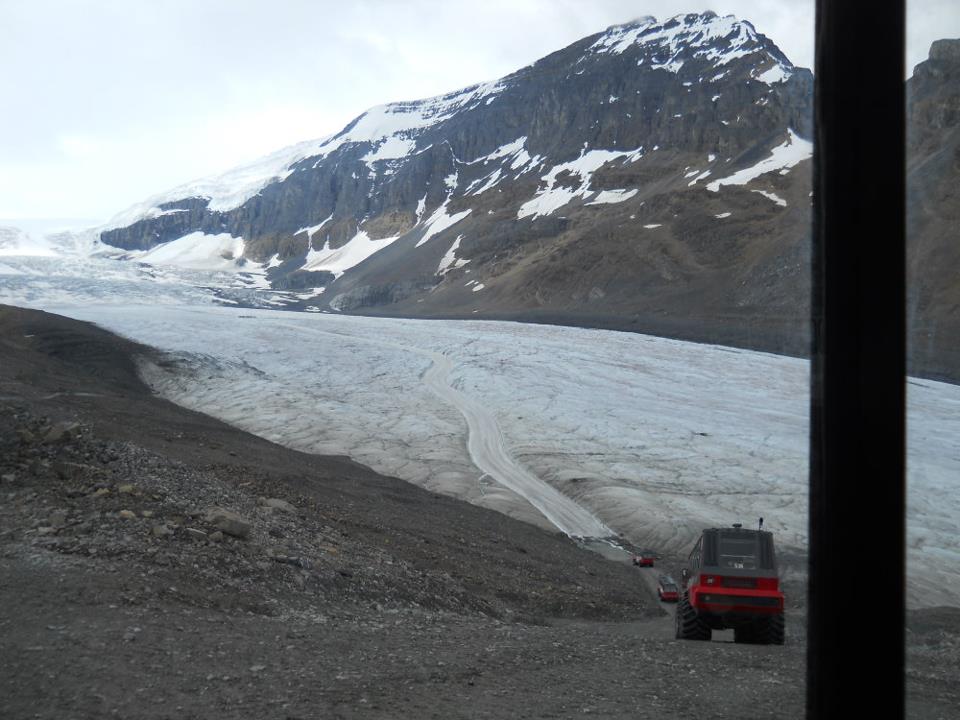
On this morning I got kitted out well and truly professionally: big rugby shirt, jeans tucked into warm socks and trainers. My friends back home would later tease me for how funny I looked. The first stop on today’s tour was Athabasca Falls, with more gorges of sheer velocity. Next we stopped at Columbia Icefield, halfway between Jasper Town and Lake Louise and evidently the largest icefield in the Rockies. A special coach with huge tyres driven by a tall hunky man took us down slowly over the icefield and onto Athabasca Glacier, where we were allowed to get off and walk around. The tour guide used a metal pole to show us how deep the ice went. Luckily there were no crevices nearby for us to fall into.

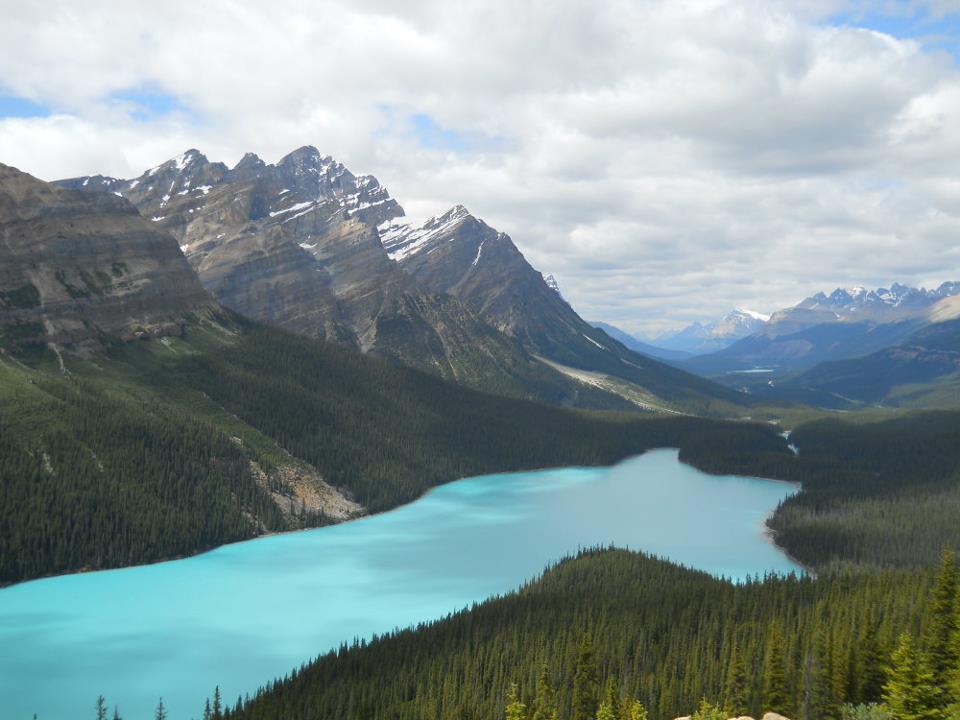
The tour continued on until we stopped again at another viewing point. I wasn’t sure what we were looking for and followed the others along a path curiously, only to gasp at the view that appeared below. Peyto Lake was even bluer than Maligne Lake and didn’t look real. There were clouds in the sky but they failed to dim the brightness of the water that shone like a diamond, with forests surrounding the lake like a guard protecting a rare jewel. Looking at my photos was like looking at an oil painting. If you go to the Rockies, this is a must-see.

The sneaky surprise of Peyto Lake will make your jaw drop open

Peyto Lake

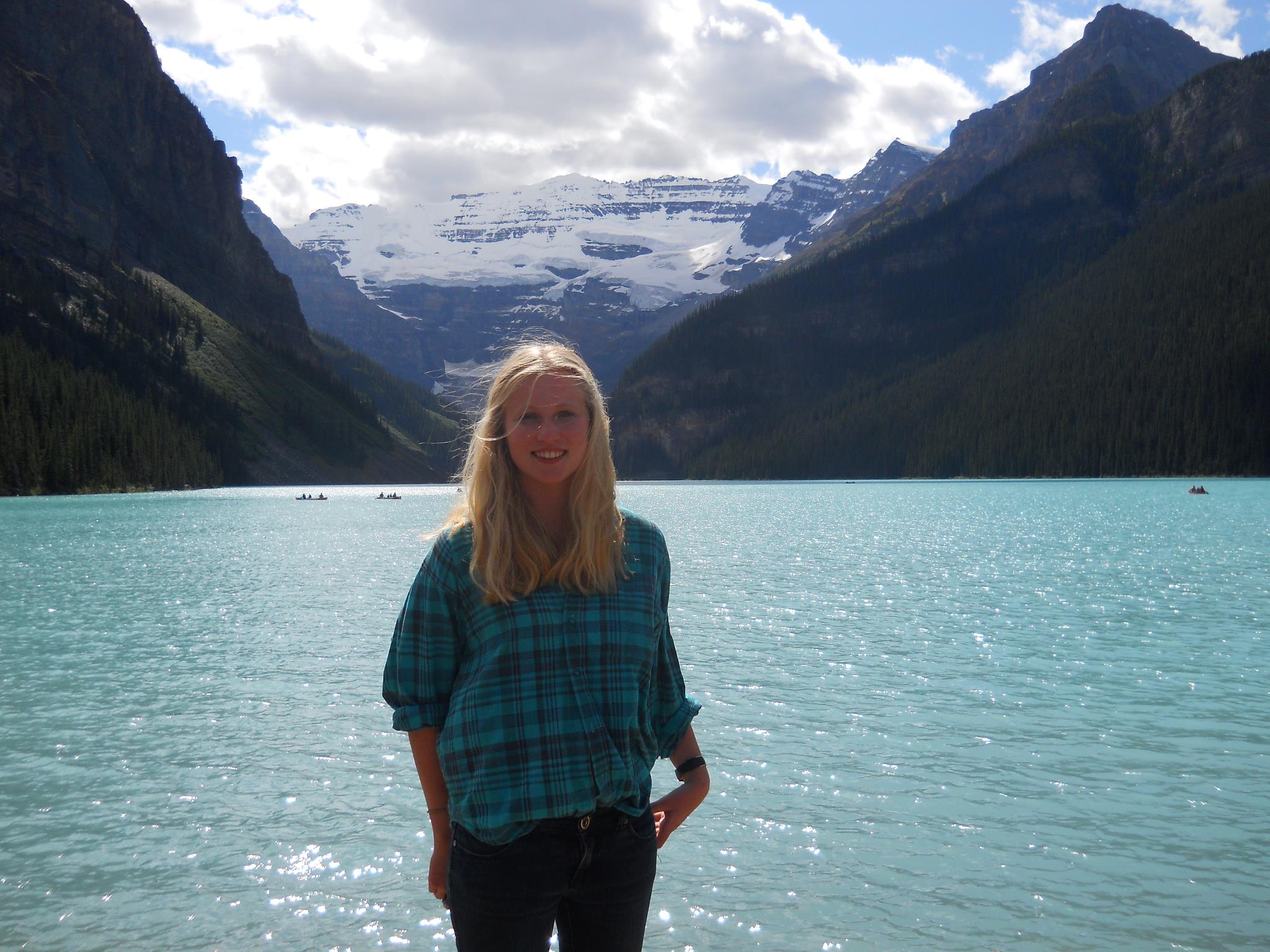
Finally the tour brought us to the famous Lake Louise. It was more enclosed by mountains than Maligne Lake, and dotted with kayaks. I wanted to jump in and join them. As expected the place was brimming with tourists, many of whom wandered over from the fancy Fairmont Chateau nearby. I resented how busy it was, but at the end of the day, you could understand why.

My hostel was situated just north of the quaint village. I went for a wonder round and sat by a river, glad to see less people and hear nothing but bird song and the gentle lapping of the water on the rocks. There was something charming about this little place, and it felt fitting that my last night in the Rockies would be here.

Even though I’d managed to pack a lot into my three days here, it felt way too short. There was so much more to see, and just that brief taste I’d got had made me hungry for more. The next morning I boarded a bus that would take me on into British Columbia. As we wound our way past the mountains with Neil Young entering my head, I felt rejuvenated. My adventurous mindset had been unleashed. I can’t wait to come back and see even more of this amazing part of the world.